












Arrival of ducks and geese highlights festive season
New arrivals show up every day. My mittens and binoculars are my favorite accessories. Last week, Wagamons Pond hosted a large raft of ring-necked ducks, while a lone snow goose stood among a gaggle of Canada geese at Silver Lake. The return of familiar birds is like greeting friends over the holidays. Let’s meet. Where? A quiet corner or out frolicking in the surf? At the seafood buffet or the salad bar? With a few mellow companions or in a mosh pit? Time and place flexible?
Our aquatic landscape offers a variety of habitats where migrating waterfowl can touch down each winter. Missing the autumn leaves, my eyes search for color and focus on the male or “drake” of each species. The drakes have colorful plumage, which will become more brilliant and showy as pair bonds form in February. The females or “hens” are a subtle group of tans, suedes and patterned browns. A great reference is the classic U.S. Fish and Wildlife Service publication, “Ducks at a Distance: A Waterfowl Identification Guide,” by Robert W. Hines. To jump-start your exploration or visit favorite feathered friends, Prime Hook National Wildlife Refuge offers great viewing opportunities!
Tucked between the cattails of Turkel Pond or in the tidal creek along the observation trail, dabbling ducks feed in shallow water on aquatic plants and snails. These ducks often reach the vegetation by tipping head down-bottom up, or sieving through the mud with their bill. Male mallards (Anas platyrhynchos) have a distinctive green head with a yellow bill. The similar-sized American black duck (Anas rubripes) has a light-brown head with a yellow bill and a dark-brown body. Joining this company with an elegant “tuxedo with tails” feather pattern is the northern pintail (Anas acuta). The dapper pintail is slightly larger than the mallard and floats higher in the water. It has a brown head with a gray bill, brown neck, crisp white breast, distinct heather-gray body and a very long, thin, pointed tail.
At the photography blind, look beyond the golden phragmites and spartina grasses in Broadkill marsh. Do you see that bill? Sitting low in the water with its head in the mud, a northern shoveler (Anas clypeata) has a bill that is longer than its head! The drake, slightly smaller than a mallard, has a green head with a dark, extremely large, spatulate bill. It also has a bold white and orange-brown body pattern. Nearby, the smallest dabbling duck, the green-winged teal (Anas carolinensis), is one of hundreds. Each male sports a jaunty emerald-green “Zorro mask” from the eye to the neck over cinnamon-red head feathers.
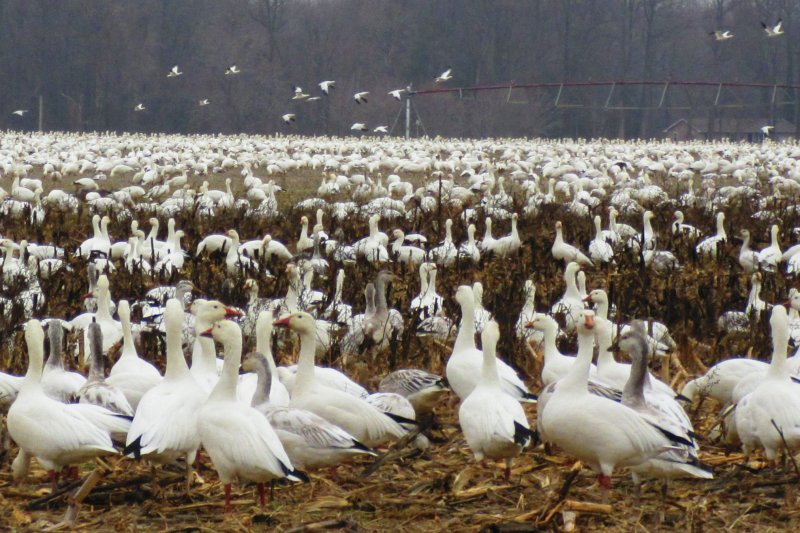
Alerted by distant honking, look for a skein of birds strung out across the sky like a thread, an extended “V” of several hundred thousand snow geese (Chen caerulescens). Migrating flocks call out constantly during flight, and the team is able to quickly change direction by following a cue from leaders. Following the Atlantic flyway, these arctic nesters fly quickly at high altitudes and include frequent stops, called staging areas. A “blizzard” of snow geese creates a constellation of patterns against the sky before they descend on a cornfield to feed. Don’t miss the daily morning and afternoon flights over Sussex County this winter! Traveling high in the sky, these small white geese have black wing tips.
A tight group or “wedge” of snow geese may raft on Delaware Bay while other sea ducks ride the waves. At Broadkill Beach, look for the mini soccer balls bobbing along the current in small groups. The bufflehead (Bucephala albeola) drake, almost half the size of a mallard, has a round, purple-black head with a wide white triangle wedge behind the eye. Between wave crests, a quick glimpse of an uncommon common goldeneye (Bucephala clangula) reveals a large white oval between the eyes (yes, they are golden) and a small bill. Diving alone in the waters between the surf and the shore is a svelte, “scruffy bed-head.” The red-breasted merganser (Mergus serrator) sports a green head with uncombed feathers. It also has a thin, bright-red serrated bill used for fishing.
A hum of anticipation is in the crisp air. Will the iconic-looking, blue-billed “Daffy Duck,” also known as a ruddy duck, be cruising Silver Lake with his mates? Perhaps a flotilla of light-colored long-tailed ducks is surfing near the inlet rock jetties. Variety is the spice of life. Explore, enjoy and embrace the season.
-

Wild Cape is a monthly column by Alice Mohrman dedicated to the rich and diverse ecosystem of Delaware’s Cape Region. It is our hope to bring readers closer to the natural world by exploring fascinating creatures, plants and habitats that thrive in one of the most ecologically significant areas of the Mid-Atlantic.