












Rehoboth changes two summer concert dates in 2026
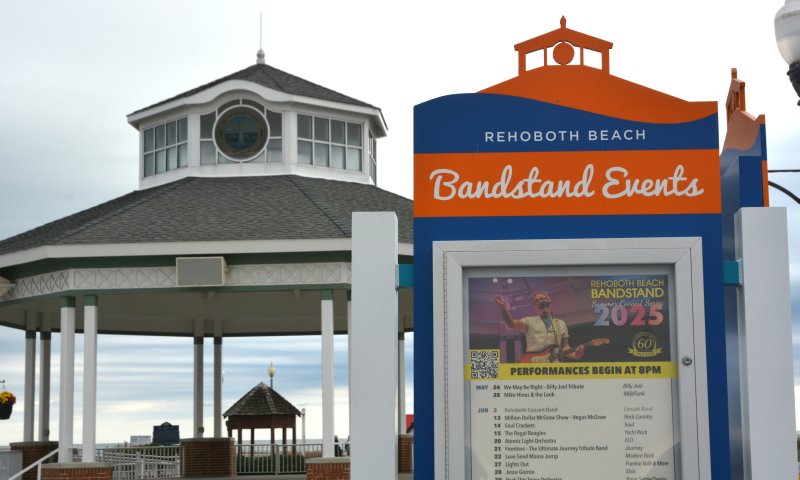
Rehoboth Beach officials continue to explore ways to change the summer concert series so it could be more beneficial to the businesses that surround the Bandstand.
During a commissioner meeting Jan. 16, City Manager Taylour Tedder said the city is changing the concert schedule for two weekends this coming season – the fourth weekend in June and the third weekend in July. First, there will be a concert Thursday, June 25, not Friday, June 26. Second, there will be no concert Sunday, July 19.
“These changes allow us to experiment with a midweek concert and return two of the busiest nights to local businesses,” said Tedder, during his city manager’s report. “These changes will be heavily publicized, working closely with chamber and Main Street to help businesses track using tools available to the city.”
Mayor Stan Mills asked Tedder how the changes will be evaluated.
Tedder said the city will be able to analyze data from Placer.ai, an analytics company that collects geolocation data using cellphone apps, to see the foot traffic of the specific area and of the specific businesses. The city can compare that with seven years’ worth of data to compare year over year, he said.
“Hopefully this will give us enough data to see if this is prudent to make further changes,” said Tedder.
Commissioner Patrick Gossett encouraged Tedder to conduct the experiment for at least two summers. It will be difficult to base a decision on the metrics of a single year, he said, adding the experiment should probably be at least three years, but he didn’t think it could be extended that long.
Tedder acknowledged two or more years would provide better data.
The city has held free concerts at the Bandstand on Friday, Saturday and Sunday nights for decades. The past few months, there’s been heavy discussion about the schedule and how it affects businesses around the Rehoboth Avenue horseshoe. The discourse was spurred by a recommendation from city staff to make permanent the temporary closures of the road around the Bandstand on concert nights because it would allow for new signs to be installed and make enforcement of the closures easier. The city implemented the temporary closures a few years ago because concert crowds were spilling into the streets.
In response to the recommendation, business owners in the immediate area showed up to meetings and voiced their concerns about how the concert series was being handled by the city and that it actually hurt business the night of the concerts.
Adding to the business owners’ frustration was an announcement from the city that it was planning to install nearly 70 bollards and swing gates in the area around the Bandstand and the Boardwalk. The city said the project, estimated to cost about $1.3 million, was in the name of safety. Business owners expressed concerns that the bollards – a short, vertical post used to block off areas and control traffic – would make the Bandstand area feel unwelcoming. Commissioners approved the project anyway.
However, in response to the concerns of business owners about codifying the temporary closures, the city put the discussion on hold and began to evaluate possible operational improvements. Some progress has been made.
Staff have suggested a handful of ways to improve crowd control, including better enforcement of pedestrians on sidewalks, improved communication about temporary travel lanes during the concerts, continuing to solicit feedback from stakeholders, assisting with additional promotions of downtown businesses and having the streets department monitor the placement of benches.
Staff are also evaluating the process to determine who gets to use the Bandstand as part of a special-events permit application, because business owners have expressed frustration that some events are too small to warrant shutting down the whole Bandstand area. To that end, commissioners recently approved a number of changes to the special-event terms, including the creation of a tier system that has different rates depending on the expected number of people and need for help from the city. Staff said these changes will help as they evaluate applications moving forward.

Chris Flood has been working for the Cape Gazette since early 2014. He currently covers Rehoboth Beach and Henlopen Acres, but has also covered Dewey Beach and the state government. He covers environmental stories, business stories and random stories on subjects he finds interesting, and he also writes a column called Choppin’ Wood that runs every other week. He’s a graduate of the University of Maine and the Landing School of Boat Building & Design.