













Sea Grant consultant: Sea rise caused by climate change will present challenges
As the lowest-lying state in the nation, well known for its beaches, water plays a big role in the lives of Delawareans.
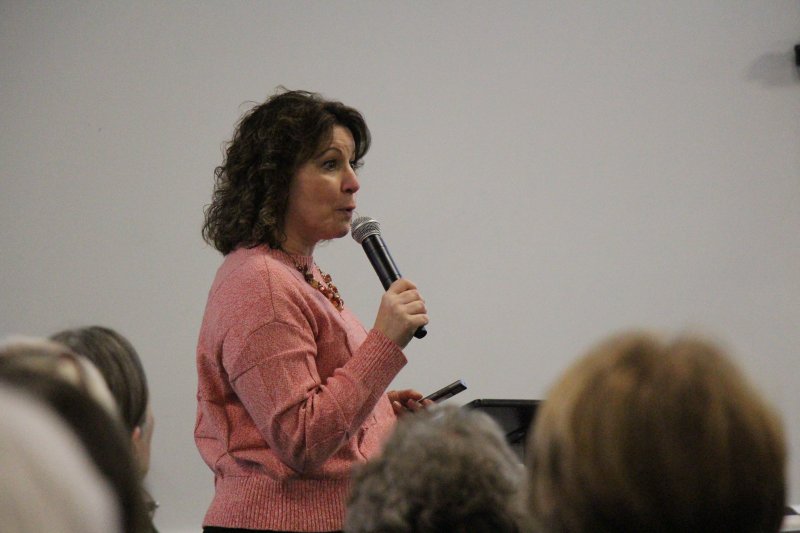
But sea levels are slowly rising, and preparing for the consequences is becoming increasingly important, said Danielle Swallow, a coastal hazards specialist with Delaware Sea Grant, at a Jan. 14 meeting of the Sussex Preservation Coalition.
“We have to think about living with more water,” Swallow said. “The paradigm is going to be changing. Our flood plain is going to be changing.”
Delaware has the lowest mean elevation of any state at 60 feet.
Swallow, who is based at the Lewes campus of the University of Delaware, said some people confuse weather and climate. Weather is short-term conditions – for minutes, hours, days or weeks – while climate is long-term weather conditions over decades or longer.
Climate change has natural and man-made causes, Swallow said. She noted the pattern of gradually warming temperatures since the dawn of the Industrial Revolution in the late 19th century, which increased production of greenhouse gases that trap heat in the earth’s atmosphere.
One of the state’s sea-level gauges, located at Lewes, has risen 15 inches since 1919, and the rate of increase began to accelerate about 2000, Swallow said. Sea-level rise is measured by the average height of tides.
By 2100, the state is projecting sea levels will rise 2.53 to 5.2 feet, Swallow said. Another foot or more of sea-level rise is expected by 2050.
The average annual temperature has increased 3 degrees since 1895, she said. Another 3- to 4-degree increase is expected by the middle of the century, and 5 to 9 degrees by 2100.
Delaware and local municipalities have been taking steps to deal with the anticipated sea-level rise and other environmental problems.
The state’s five-year climate action plan was released Jan. 7, the first update since climate goals were passed in 2023 by the General Assembly and the governor. It includes a chapter dedicated to land-use planning.
“Climate change is already reshaping life here in the First State, from extreme rainfall overwhelming our stormwater systems, to heat islands driving up temperatures in our cities, and coastal roads flooding regularly,” Gov. Matt Meyer said in a statement announcing the updated action plan.
Climate change resilience is also included in the draft 2025 State Strategies for Policies and Spending, which was backed Jan. 12 by the Cabinet Committee on State Planning Issues.
Meyer is expected to sign an executive order to enact the plan, which will help determine how the state spends money on programs and services, including construction and operation of roads and schools.
Gregory Patterson, secretary of the Delaware Department of Natural Resources and Environmental Control, said during the cabinet committee meeting that all state agencies would help implement the strategies plan.
“There is a new land-use section, because that is a big part, conserving agricultural land, wetlands and forest and open space are all part of achieving our climate goals,” Patterson said.
The state has also enacted a requirement that local and county comprehensive plans consider sustainability issues. Sussex County will be among the first counties subject to the requirement. Its next comprehensive plan is due by the end of 2028, and work to draft it is expected to begin this summer.
Climate change is becoming an increasingly important consideration in municipal planning, Swallow said.
“It avoids damages to property and to life,” she said.
Climate resiliency will be incorporated into developing communities, public works projects and environmental protection, Swallow said.
The Lewes Board of Public Works recently reached an agreement with Sussex County for the county to process Lewes’s wastewater. It was necessitated by the projection that the city treatment plant will be at risk of being inundated by rising sea levels by 2050.
The future could see warmer winters, and hotter days and nights during the summer due to climate change, Swallow said. Predictions call for increased rainfall and greater likelihood of heavy downpours.
There will also be more summer nights over 75 degrees and daytime highs over 90 degrees.
On the positive side, climate change could result in longer growing seasons for farmers in Delaware and less need for winter heating fuel, Swallow said.
Taking steps to prepare for effects of climate change is worth the investment, she said.
For example, denser housing development can preserve flood plains, forests, wetlands and marshes elsewhere that are natural buffers against sea-level rise.
The U.S. Chamber of Commerce estimates that every $1 invested in preparedness and resilience saves $13 in avoided damages and economic savings, Swallow said.
“I really want to emphasize that now is the time to innovate, and there is room and space to do that,” she said. “We will never have more choices than we have right now. Our choices will never be cheaper than they are right now. With change comes opportunity.”

Kevin Conlon came to the Cape Gazette with nearly 40 years of newspaper experience since graduating from St. Bonaventure University in New York with a bachelor's degree in mass communication. He reports on Sussex County government and other assignments as needed.
His career spans working as a reporter and editor at daily newspapers in upstate New York, including The Daily Gazette in Schenectady. He comes to the Cape Gazette from the Cortland Standard, where he was an editor for more than 25 years, and in recent years also contributed as a columnist and opinion page writer. He and his staff won regional and state writing awards.
Conlon was relocating to Lewes when he came across an advertisement for a reporter job at the Cape Gazette, and the decision to pursue it paid off. His new position gives him an opportunity to stay in a career that he loves, covering local news for an independently owned newspaper.
Conlon is the father of seven children and grandfather to two young boys. In his spare time, he trains for and competes in triathlons and other races. Now settling into the Cape Region, he is searching out hilly trails and roads with wide shoulders. He is a fan of St. Bonaventure sports, especially rugby and basketball, as well as following the Mets, Steelers and Celtics.