












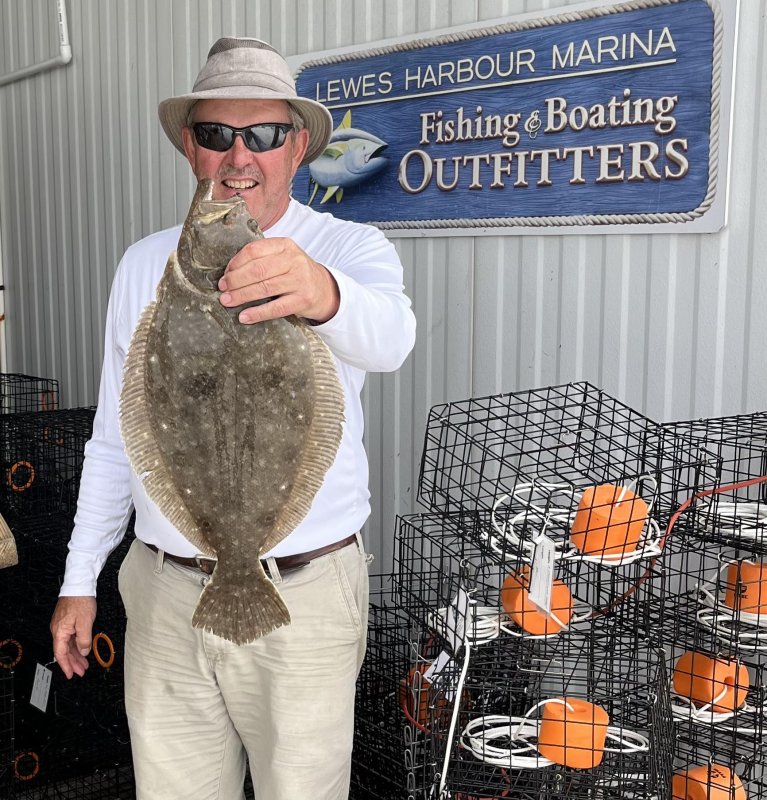
The first summer flounder of the year were caught on April 1, one from the fishing pier at Woodland Beach on a bloodworm, and a few from the Lewes-Rehoboth Canal on what I suspect were live minnows. The air temperature that day was in the mid-80s, and that would have heated the shallow water near the fishing pier and in the canal to 50 degrees or more, which would have put the flounder in a feeding mood.
The powers that be at NOAA have decided to keep the summer flounder regulations in Delaware at status quo, so we will have a 16-inch minimum size and a four-fish bag limit until June 1. The same regulations apply to Maryland.
Unfortunately, the air temperature is going up and down like a yo-yo, and that results in winds of 25 to 30 knots, first from the south and then from the north. Once the temperature realizes it is spring and settles down, the wind will do the same, and we should be able to enjoy some decent flounder action.
The water is still on the cold side, so flounder fishing is going to be best in shallow areas such as the Lewes-Rehoboth Canal and Indian River Bay. Sunny days that can heat the water are best, with two hours before high tide and the two to three hours into the ebb usually being the best times to fish.
When it comes to flounder fishing the Lewes-Rehoboth Canal, I start along the east bank as soon as I launch my boat at the Lewes ramp. I will work up and down the bank along the east side during the incoming water until I get close to the canal that goes behind the houses at Broadkill Beach. There is some sort of structure there that eats flounder rigs.
Once I bypass that area, I will continue up to Oyster Rocks Road and work that area very well. I have not only caught flounder there, but some pretty impressive bluefish as well.
If the current is still running in, I will fool around up the entrance to the creek there until the current begins to run out. Then I will station myself at the mouth of said creek, hoping some hungry flounder will do the same.
There is a sandbar south of the creek, and I like to make a few drifts over it on my way down the Broadkill River. After that, there is another small creek near a duck blind, and then there is some rough bottom until I get back to the boat ramp.
From the ramp, since the current is now running out, I will have to run back to Lewes and begin my drift past the Savannah Road Bridge. From there, I will fish any structure I see. That includes pilings, moored boats, bridges and docks. One of the biggest flounder I have caught came from the pilings at the base of the Savannah Road Bridge.
By the time I have worked my way back to the ramp, including a trip out along the rocks at the inlet, if I don’t have my four flounder, I do have enough for a decent dinner.
My tackle for this type of fishing is pretty basic. I use a rod that was custom-made for me by a friend in Virginia Beach. It carries a very old ABU Garcia reel with 20-pound braid and 30-pound fluorocarbon shock leader. Today, I would go with a Tsunami SALTX 4000 on a Tsunami Airwave Elite 6’4” MH. My favorite presentation is a ½-ounce, round, green bucktail with a Gulp! crawfish. I use a Tactical Angler clip to connect the bucktail to the shock leader. A live minnow on a rig that will get it and keep it on the bottom would be my second choice. A rig that has a teaser is a good idea when fishing for flounder. Quite often, the bait will attract the flounder and it will grab the teaser.
It has been a while since I have fished Indian River Bay, but the area of shallow water between the VFW and the Main Channel that runs from the Coast Guard Station on back to the Junction Buoy and then toward Oak Orchard is a good location for flounder in the spring. The shallow water warms up on sunny days, and if you can get out there before the entire fleet arrives, you can catch some impressive flounder. Once the tide drops too low for fishing the flats, try the channels, especially any outflows from the marsh.
Same tackle, same baits, same tides.
My largest flounder, an 8-pounder, was caught near what was once an old duck blind that was between Bay Shore and South Shore.
-

Eric Burnley is a Delaware native who has fished and hunted the state from an early age. Since 1978 he has written countless articles about hunting and fishing in Delaware and elsewhere along the Atlantic Coast. He has been the regional editor for several publications and was the founding editor of the Mid-Atlantic Fisherman magazine. Eric is the author of three books: Surf Fishing the Atlantic Coast, The Ultimate Guide to Striped Bass Fishing and Fishing Saltwater Baits. He and his wife Barbara live near Milton, Delaware. Eric can be reached at Eburnle@aol.com.