













State efforts planned to coordinate homeless services
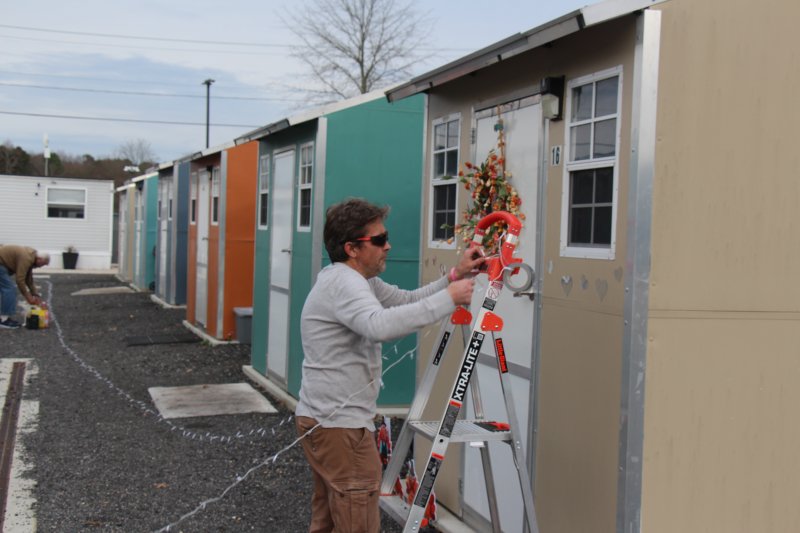
As the number of local homeless people quickly grows, a patchwork group of nonprofits and their volunteers struggles to help them survive another day and do what they can to help rebuild their lives.
By one count, there are about 200 nonprofit groups statewide whose goals include helping the homeless, said Judson Malone, executive director of Springboard Delaware.
Malone’s group operates Pallet Village, a cluster of 40 small living units on Douglas Street in Georgetown for homeless people who had previously lived in encampments outside town.
Despite the outpouring of assistance, there is no coordination of the work of nonprofits or state agencies tasked with providing services to the same population.
State lawmakers representing Georgetown say they expect to unveil a plan around the end of the year to coordinate the state’s currently fragmented services to the homeless. It could eventually be replicated in other communities.
Rep. Valerie Jones Giltner, R-Georgetown, and Sen. Brian Pettyjohn, R-Georgetown, held a closed-door meeting Nov. 3 at the Georgetown Public Library to begin planning.
In attendance were Georgetown’s mayor, town manager and police chief, and leaders of state agencies whose work involves homelessness, substance abuse and mental health issues, Jones Giltner said.
“We wanted to let them know of the escalating problem that the Georgetown area is facing,” Jones Giltner said.
“There’s no good central hub to be able to coordinate all of these services,” Pettyjohn said Nov. 20. “Some didn’t realize what was going on on the ground in Georgetown.”
“That is a correct high-level assessment of the state of services,” Malone said of the explanations provided by Pettyjohn and Jones Giltner.
Those at the Nov. 3 meeting discussed solutions that have worked elsewhere in the state and across the nation, Jones Giltner said.
State agencies will work to provide multiple paths out of homelessness that meet the needs of individuals, she said.
Jones Giltner would not yet release details of the plan, but said it would be announced by the end of the year.
While the initial plan involves coordination of state agency services, the Town of Georgetown and eventually nonprofit organizations would be brought into the process, Pettyjohn said.
“We wanted to get the state agencies in a room first,” Pettyjohn said. “By the end of the year, the first of next year, we should have that plan.”
The plan to coordinate state services will focus on the legislative districts of Jones Giltner, which includes the Georgetown area, and Pettyjohn, which overlaps but extends more broadly toward Lewes, Millsboro and other areas.
If it is successful, the coordinated state effort to help the homeless could be a model for other communities, but it may have to be revised to take into account specific local needs and circumstances, Pettyjohn said.
“There is not usually a one-size-fits-all solution,” he said.
A current by-name list compiled by Springboard Delaware of homeless people shows 237 in Georgetown,36 in Lewes, 27 in Seaford, 13 in Milton, 11 in Rehoboth, seven in Milford, four each in Dover and Laurel, three in Greenwood and one each in some other communities.
Malone emphasized that his group’s work focuses on Georgetown, and the figures for communities beyond the town are incomplete and less reliable. Also, the 45 or 46 people who live in Pallet Village are not included in the Georgetown homeless figures.
The disjointed safety net for the homeless in Sussex County, primarily run by government agencies, religious groups and other nonprofits, includes scattered shelters, hotel rooms funded by federal vouchers, and distributions of food, clothing and other essentials.
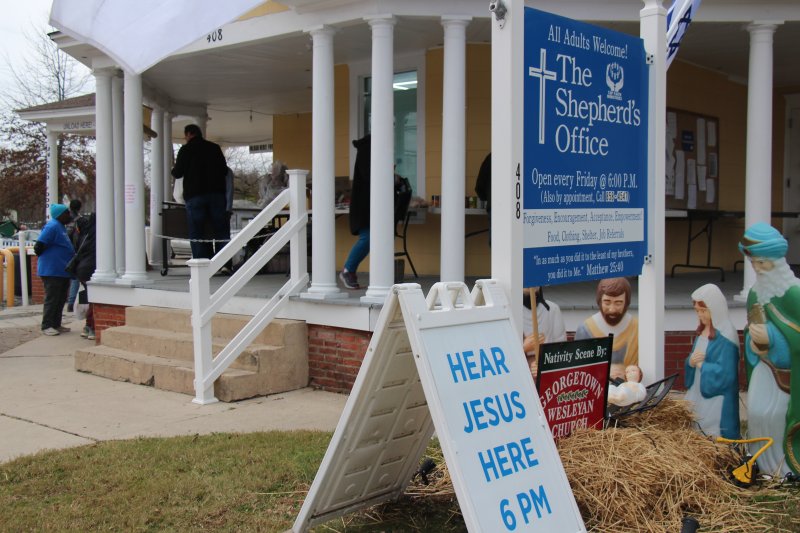
Some have come under fire from the public, especially Pallet Village and the Shepherd’s Office.
Jim Martin, director of the Shepherd’s Office, said he is aware of criticisms, but noted his group does important work, and public scrutiny has only raised awareness of his operation and donations to his efforts.
“God wants us out in the slimy mess, the chaos, the hopelessness,” Martin said.
Springboard Delaware and Georgetown Mayor Bill West, a vocal supporter of the group, say Pallet Village has been a success story. It has resulted in permanent housing elsewhere for 57 people in the past three years.
Pallet Village residents are not allowed to drink alcohol or use illegal drugs on the site. They also must seek employment or volunteer service, receive case management for substance abuse and other issues, and work toward permanent housing.
Malone gave a report on the progress of his group at the Nov. 10 Georgetown Town Council meeting.
He cited findings of the Georgetown Pallet Village Outcomes Report from October:
- 40% of participants moved into permanent or supportive housing, compared with the national average of 25% to 35%
- 62% of participants of working age and able to work obtained employment
- 38% secured benefit income
- 48% of those with substance-use disorder received treatment, compared to 24% of homeless nationally
- 97% of those with mental health needs received care
- 156 essential identification documents were issued, helping residents reenter the work force and qualify for housing.
“These outcomes demonstrate that the navigation center delivers measurable progress,” Malone wrote in a letter published Nov. 7 in the Cape Gazette that provided the same statistics.
“Since opening in January 2023, Springboard Delaware’s Georgetown Navigation Center (also known as the Pallet Village) has helped more than 160 residents experiencing homelessness,” he added. “The center provides safe, short-term housing and access to job training, mental health care and recovery support – offering a hand up, not a handout.”
Georgetown has many independent nonprofit groups providing services to the homeless, which creates redundancy and inefficiency, and there are gaps in service, Pettyjohn and Jones Giltner each said.
They help meet daily needs of the homeless, but Springboard Delaware is the only local group that leads to permanent housing, Malone said.
There are shelters providing temporary housing, and some homeless stay at hotels in Georgetown and Seaford using federal vouchers.
During winter months, Code Purple at the Cape operates a men’s shelter at St. Jude the Apostle Church in Lewes and a women’s shelter at Lutheran Church of Our Savior in Rehoboth Beach. Each can accommodate 14 people overnight.
For the second year, Code Purple ran Tharros Village, a structured tent encampment, during the warm weather for 28 homeless people on state-owned land off Route 1.
A $1 billion plan to expand access to healthcare released Nov. 12 by Gov. Matt Meyer includes funds to open Hope Centers in Sussex and Kent counties, replicating a model developed in New Castle County.
Initiated when Meyer was New Castle County executive, it would be an integrated hub for healthcare, housing and workforce services.
“It basically provides a short-term stay where we try to provide those who are most vulnerable in our communities with everything they need to stabilize their lives and help support them to get to a new step,” Meyer said in a Nov. 12 announcement.
Pettyjohn said a Hope Center is not part of the plan to coordinate state services for the homeless that he and Jones Giltner are planning.
Meyer has also announced creation of the Delaware Interagency Collaborative to End Homelessness, with a goal to cut homelessness in half and end youth homelessness within five years.
Malone said he heard the state legislature is also considering an initiative to address homelessness.
With the plan being created by Pettyjohn and Jones Giltner, that would make three parallel and independent state initiatives to coordinate services to reduce homelessness.
Malone said he hopes they are successful, but worries they might complicate an already disorganized system.
“It could add more separate, uncoordinated activities,” he said. “Local representatives are finally, finally taking an active interest, and they’re doing it in the most collaborative way possible. The danger is that they could be adding another layer of dysfunction.”
Editor’s note: This is the second part of a two-part story about homelessness in Sussex County.

Kevin Conlon came to the Cape Gazette with nearly 40 years of newspaper experience since graduating from St. Bonaventure University in New York with a bachelor's degree in mass communication. He reports on Sussex County government and other assignments as needed.
His career spans working as a reporter and editor at daily newspapers in upstate New York, including The Daily Gazette in Schenectady. He comes to the Cape Gazette from the Cortland Standard, where he was an editor for more than 25 years, and in recent years also contributed as a columnist and opinion page writer. He and his staff won regional and state writing awards.
Conlon was relocating to Lewes when he came across an advertisement for a reporter job at the Cape Gazette, and the decision to pursue it paid off. His new position gives him an opportunity to stay in a career that he loves, covering local news for an independently owned newspaper.
Conlon is the father of seven children and grandfather to two young boys. In his spare time, he trains for and competes in triathlons and other races. Now settling into the Cape Region, he is searching out hilly trails and roads with wide shoulders. He is a fan of St. Bonaventure sports, especially rugby and basketball, as well as following the Mets, Steelers and Celtics.