












Study brings rail-trail closer to starting line
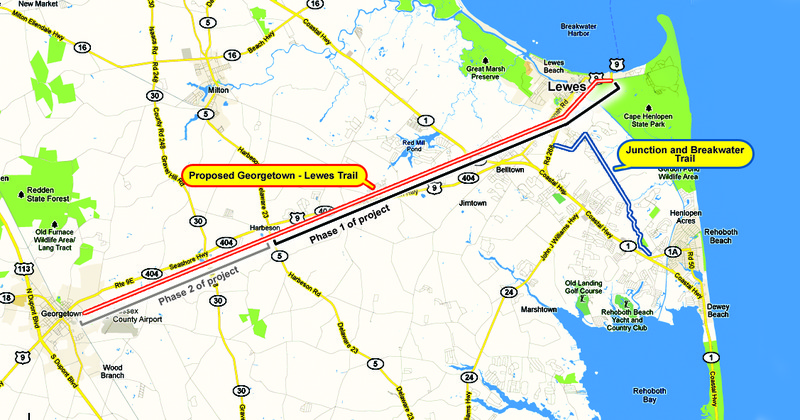
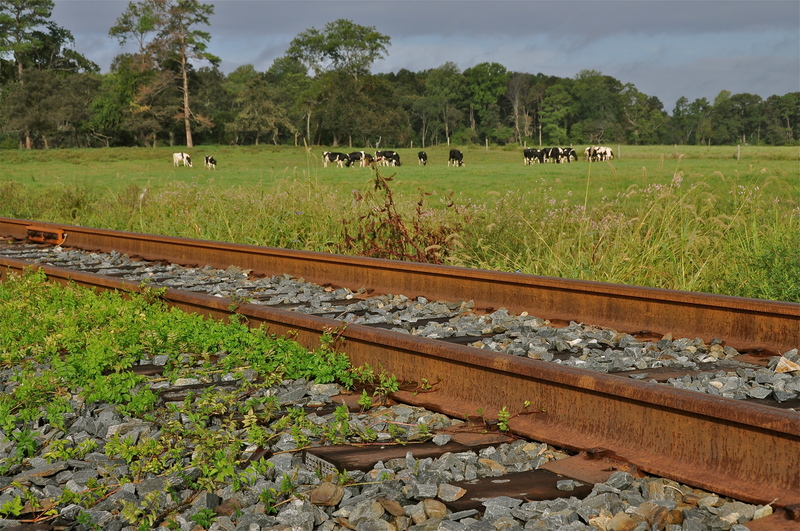
Should a proposed recreation path running from Georgetown to Cape Henlopen State Park be a rail-to-trail or rail-with-trail pathway?
That’s one of the questions Delaware Department of Transportation officials posed at an Aug. 22 public workshop at the Lewes Public Library.
Of the two options, a trail that runs alongside the railroad line appears to have more support than a trail that eliminates the railroad line.
“We’ve heard a lot of folks say please put the trail beside the tracks,” said Ralph Reeb, a DelDOT planner working on the project.
Michael Rothenheber, of Sparks, Md.-based Johnson, Mirmiran & Thompson, is DelDOT’s consultant for the project.
Rothenheber explained how the trail would be developed along Delaware Coastline Railroad’s route, which operates between Georgetown and Lewes, on tracks owned by the state.
He said for now, the state is only considering a first-phase of the trail, running from Coolspring to the state park. The complete trail would run 17.8 miles.
Keeping rail vs. rail removal
Rail-to-trail would require removing existing tracks and ties and constructing a multiuse path on the old rail bed.
But Mountaire Farms, which operates a chicken processing plant in Harbeson, and Schagrin Gas, which has a facility at Sussex County Industrial Air Park in Georgetown, say removing the tracks would have an adverse economic impact on their businesses.
The Mountaire facility is served by as many as nine rail cars a week, and Schagrin Gas receives as many as four rail cars a week.
SPI Pharma, located near the entrance to Cape Henlopen State Park at the east end of the railroad line, receives about three rail cars of nontoxic sodium hydroxide every two weeks.
Trains travel at a maximum speed of 10 mph.
If portions of the rail line were terminated and tracks removed, SPI Pharma would require a transshipment area where the material would be offloaded into tanker trucks. Company officials said it would take eight to 12 trucks about every two weeks to replace rail cars. A transshipment area would cost about $330,000, and might be built at Gravel Hill or Cool Springs Road. Building the trail alongside the rail line has significantly more right-of-way impact than removing the rails. About 175 properties from Coolspring Road to the state park would be affected if the tracks remain in place. Sheds; mature trees and tree canopy; and private landscaping, some placed on public right-of-way, would have to be removed.
The railroad swing bridge crossing the Lewes-Rehoboth Canal carries rail track only.
An evaluation of the structure finds the bridge cannot accommodate and cannot be modified to accommodate a bicycle or pedestrian path. But the Freeman Highway Bridge, which also crosses the canal, could be used for a sidewalk or bikeway. Trailheads – parking areas and trail-entry points – could be located at Coolspring Road, Nassau near Route 1, Queen Anne’s Railroad Station in Lewes and Cape Henlopen State Park.
Future rail use
The study finds no major increase in commercial railroad volume or use is anticipated along the proposed path. Based on Federal Transit Administration statistics, the rail line has little potential for public transportation. Census data indicates that through 2030, Sussex County land use and density would fall far below the threshold needed to support light rail or commuter service.
Design guidelines
The trail would be 10-foot wide asphalt pavement, with 2-foot wide safety grading on both sides. Emergency and rail maintenance vehicles would be the only motorized vehicles permitted on the path. Equestrian use would be prohibited. The trail would provide connectivity to nearby trails, bicycle routes and sidewalks and would feature mile markers, way-finding signs and benches.
The Georgetown-Lewes Trail would have connectivity with Junction and Breakwater Trail, Southern Delaware Heritage Trail, sidewalks and shared roadways, and Lewes’ bicycle-friendly travel network. The trail would also provide access to Cape May-Lewes Ferry, Lewes’ Scenic & Historic Byway, residential developments and neighborhoods and commercial developments.
Cost of proposed trail
Reeb said the cost of the trail with no rail line would be about $10.1 million; the cost of the trail maintaining the rail line would be about $12.9 million. He said the cost difference isn’t a factor in deciding which plan to use. “DelDOT wants to preserve rails. Getting them back is difficult, but not impossible. We don’t know what the future is going to be,” Reeb said.
“I don’t see the rationale to remove the tracks at all. I would strongly endorse keeping them there,” said Lewes Mayor Jim Ford. He said removing the rails would kill the city’s economic potential.
Lewes City Councilman Victor Letonoff agreed. “We have to think 20, 30, 40 years out,” he said.
Next steps
To move the project forward, DelDOT will seek input from City of Lewes; coordination with SPI Pharma; to determine funding options and implementation strategies; to complete final design and right-of-way requirements; and to obtain right-of-way funding. DelDOT would provide continuous construction updates to the public throughout the process through completion.
Reeb said DelDOT is consulting with several states throughout the country that already have several hundred miles of trails alongside rail lines.
“We have plans we can steal because there are plenty of them, and they’re all in the public domain,” Reeb said.