













Trump’s funding threat against Delaware vague
Just over a week before President Donald Trump’s deadline for sanctuary states and cities to agree to assist in enforcing federal immigration laws or lose federal aid, Delaware and local officials had no details of the cuts.
In widely circulated comments made Jan. 13 in Detroit, Trump announced his intention to cut off funds, but he did not elaborate.
“Starting Feb. 1, we’re not making any payments to sanctuary cities or states having sanctuary cities because they do everything possible to protect criminals at the expense of American citizens, and it breeds fraud and crime,” Trump said.
While Trump has not identified which states and cities would be targeted, the U.S. Department of Justice posted a list of sanctuary cities and states created at the direction of an executive order by Trump. It lists the District of Columbia and a dozen states, Delaware among them. It also includes 21 counties and cities, none in Delaware.
As of midday Jan. 21, Sussex County officials had not received any information about loss of federal aid.
“This is something that we will monitor, but as details are scarce at the moment, it’s just simply too early to tell,” said Chip Guy, Sussex County’s communications director.
The Delaware Attorney General’s Office and U.S. Sen. Chris Coons also said they had not heard any specifics, but predicted a court fight against any effort to cut funding to the state.
“We have taken this administration to court nearly 50 times in the past year,” said Attorney General Kathy Jennings in an Jan. 21 email. “We are ready to do it again if they follow through on this lawless threat.”
“If President Trump wrongfully and illegally tries to withhold federal funds for Delaware in an attempt to force unpopular and far-right policies on our state, he will lose in court once again” Coons said in Jan. 22 statement. “If President Trump is actually interested in keeping Delaware safe, he could return funds to local police departments that the Justice Department has been withholding for a year.”
Other states and cities have also pushed back against the threatened federal funding cuts.
"You touch any more money from the State of New York, we'll see you in court," said New York Gov. Kathy Hochul earlier this month.
U.S. Attorney General Pamela Bondi has defended the president’s efforts to bring sanctuary states and cities into line.
“Sanctuary policies impede law enforcement and put American citizens at risk by design,” Bondi said in an Aug. 5 statement that accompanied the list of sanctuary states and cities.
“The Department of Justice will continue bringing litigation against sanctuary jurisdictions and work closely with the Department of Homeland Security to eradicate these harmful policies around the country,” Bondi added.
Trump signed an executive order April 28 titled: Protecting American Communities from Criminal Aliens. It stated that “some state and local officials nevertheless continue to use their authority to violate, obstruct and defy the enforcement of federal immigration laws” and “[i]t is imperative that the federal government restore the enforcement of United States law.”
Gov. Matt Meyer signed legislation last year limiting local law enforcement cooperation with federal immigration efforts. The bills prohibit state resources from being used to assist U.S. Immigration and Customs Enforcement without warrants and restrict local enforcement of civil immigration violations.
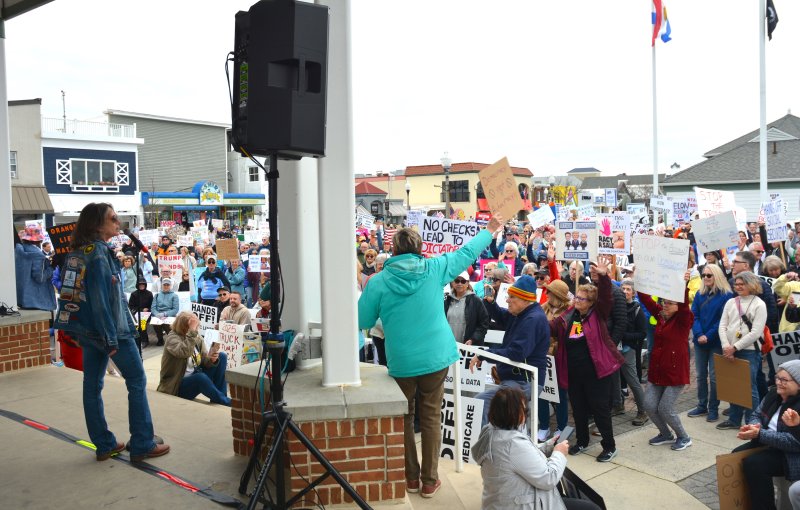
Increased enforcement actions across the country have helped fuel protests in many communities, including weekly ones on Saturdays along Route 1 near Rehoboth Beach.
The Delaware Attorney General’s Office and the Delaware Hispanic Commission in December issued a document titled Know Your Rights on Immigration, giving advice to immigrants dealing with ICE.
It notes that while Delaware has not declared itself a sanctuary state, it has not entered into any agreements with the federal government that would be necessary to assist in federal enforcement of immigration laws.
“All residents of Delaware, regardless of immigration status, are entitled to the protections of state and federal law, including under the Delaware Constitution and the United States Constitution, and the rights outlined in this document,” according to the six-page statement.
It informs immigrants of their rights and gives advice on dealing with immigration officials. It explains the rights of the immigrant and the authority of federal officers, and urges the immigrant to cooperate, be honest and seek help if needed. Several resources are listed.

Kevin Conlon came to the Cape Gazette with nearly 40 years of newspaper experience since graduating from St. Bonaventure University in New York with a bachelor's degree in mass communication. He reports on Sussex County government and other assignments as needed.
His career spans working as a reporter and editor at daily newspapers in upstate New York, including The Daily Gazette in Schenectady. He comes to the Cape Gazette from the Cortland Standard, where he was an editor for more than 25 years, and in recent years also contributed as a columnist and opinion page writer. He and his staff won regional and state writing awards.
Conlon was relocating to Lewes when he came across an advertisement for a reporter job at the Cape Gazette, and the decision to pursue it paid off. His new position gives him an opportunity to stay in a career that he loves, covering local news for an independently owned newspaper.
Conlon is the father of seven children and grandfather to two young boys. In his spare time, he trains for and competes in triathlons and other races. Now settling into the Cape Region, he is searching out hilly trails and roads with wide shoulders. He is a fan of St. Bonaventure sports, especially rugby and basketball, as well as following the Mets, Steelers and Celtics.