













Governor issues new guidance for fall sports
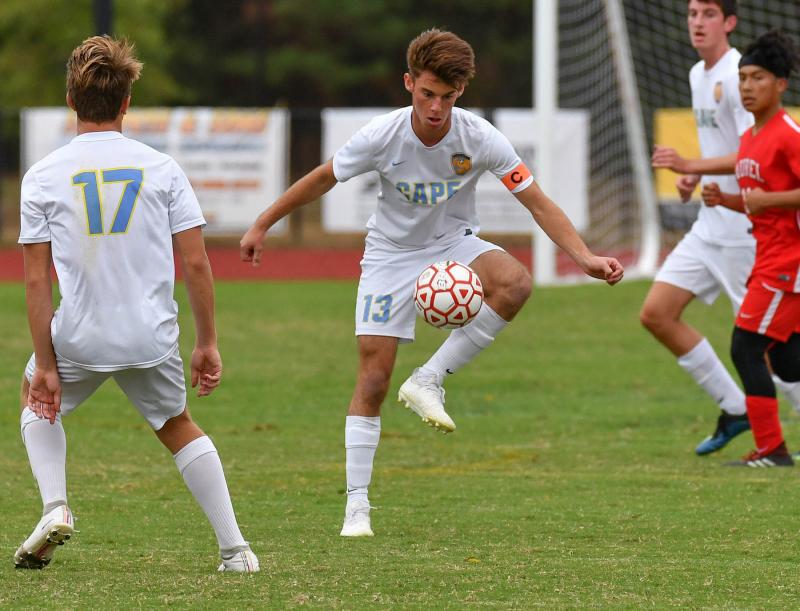
Nearly two weeks after the State Board of Education approved a plan to move fall sports to February, Gov. John Carney announced new guidance that could allow fall sports to be played this fall.
“To get more students and more players on the field – and we have lots on the field already – then we have to get everybody to take the guidance seriously and follow through,” Carney said on Sept. 1.
In the 26th modification to his state-of-emergency order, Carney included guidance on high-risk sports, such as football and wrestling, which had been absent from previous guidance offered on medium-risk sports that include field hockey and soccer.
After viewing some sports events over the summer, Carney said he was concerned over crowded dugouts and the lack of face coverings worn by players and spectators on the sidelines.
New guidelines emphasize the need for face coverings and social distancing for athletes, coaches, referees and spectators. Facilities are required to clean regularly throughout the day if hosting large events, and to disinfect once a day.
Facilities and organizations that do not follow DPH guidelines can face fines or closure. Groups must have plans approved by DPH, and those that do not comply could have their plans revoked and face further enforcement.
On Aug. 6, the State Board of Education approved a schedule for all fall sports, except football, that would sandwich a fall sports season between winter and spring seasons. Jamie Mack, chief of health systems protection for the Division of Public Health, said the Delaware Interscholastic Athletic Association, which had recommended the plan, will have to consider the new guidelines in context of the approved schedule.
Following Carney’s Sept. 1 announcement, DIAA said it will reconsider fall sports at its Thursday, Sept. 10 meeting. The DIAA board will continue to accept petitions for reconsideration or revision of the plan to delay fall sports, and it will consider such petitions at the meeting. If the DIAA votes for fall sports to begin in the fall, the State Board of Education would still need to approve the plan.
The DIAA’s Sports Medicine Advisory Committee will meet Tuesday, Sept. 8, to consider the order and provide any additional recommendations to the DIAA board of directors regarding middle and high school interscholastic athletics.
“DIAA will conduct a survey of superintendents and heads of schools to obtain DIAA member schools' feedback regarding today's order,” the DIAA said in a statement. “DIAA remains committed to protecting the physical well-being of all student athletes and ensuring fair competition among member schools.”
Carney said he saw a petition that was signed by nearly 5,000 people before the decision was made to delay the fall season.
“The letter from the parents reinforces my view that this is an important activity that we can do safely,” he said.
Parents speaking at the State Board of Education meeting in which the revised fall schedule was approved noted that hundreds of athletes and spectators had participated in and attended tournaments up and down the state all summer long, and none of them were COVID-19 super spreader events. Some parents voiced concern over a pay-to-play culture taking over youth sports.
Sports guidance
Under the governor’s order, no modifications are needed for low-risk activities if social distancing and other general guidance can be followed. Low-risk sports include singles tennis, golf, running, swimming, sailing, biking, surfing, horseback riding, hunting and fishing.
For medium-risk activities, staggered starts must be used for sports like running that typically involve group starts. Activities must be conducted outside unless approved by DPH. Shared equipment must be disinfected between users. Shorter practice times or smaller groups shall be used to reduce contact time among participants.
The following rule and play modifications are required if face coverings are not worn at all times: Deliberate, direct physical contact, including body checking, tackling, blocking, pack running/riding must be eliminated. Rule changes must be in place to prevent close proximity or contact by replacing face-offs, restarts, etc., with alternatives that allow for social distancing.
Medium-risk sports include baseball, softball, field hockey, girls’ lacrosse, soccer, flag football, team running, track and field, team swimming, crew, volleyball, dance class, fencing and gymnastics.
For high-risk activities, athletes must comply with the face covering requirements, unless a rule or face coverings modification is approved by DPH. High-risk activities may combine requests for rule modifications and face covering modifications with a cohort model. If a cohort model is used, each cohort must be limited to no more than 15 athletes, and the cohort should be maintained as a stable group with no mixing with other cohorts. Equipment should not be shared between cohorts. If sharing is unavoidable, the equipment must be cleaned and disinfected between cohorts. Shorter practice times or smaller groups should be used to reduce contact time among participants.
High-risk sports include ice hockey, basketball, tackle football, boys’ lacrosse, wrestling, boxing, rugby, competitive cheer, martial arts, ultimate frisbee and pair figure skating.
For sports where the risk category has not been identified, sports organizers must confirm the risk category with DPH prior to initiation of practices or competitions.
Anyone playing a high-risk sport, including football and wrestling, must wear a face mask at all times, or an organization or league must present a plan to DPH to modify the sport to limit contact, according to the guidance.
All youth and adult amateur sports facilities and organizations must review and follow the DPH guidance. Every athletic facility and sports organization is responsible for enforcing these requirements.