












State parks director talks slow traffic, fast bikes in Lewes
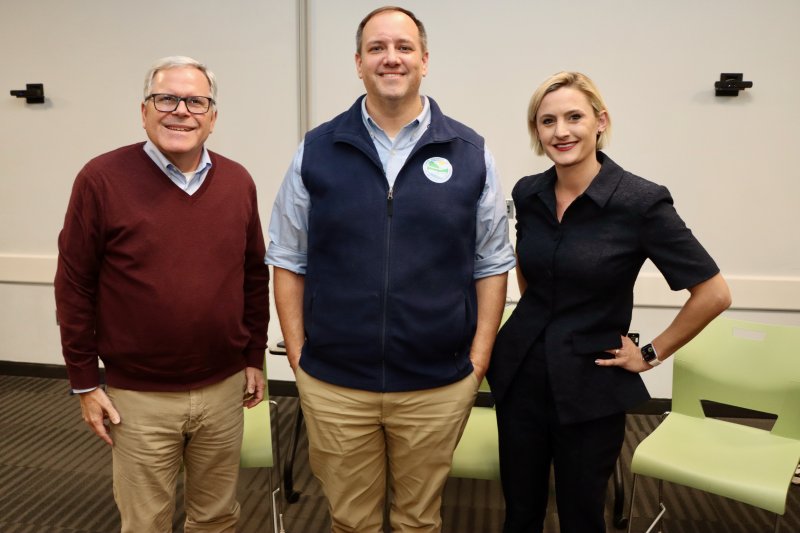
When the big snowstorm hit Jan. 25, Matt Ritter, director of Delaware Parks and Recreation, jumped into action.
Besides making sure that hundreds of state park buildings were winterized, he said there were 64 people camping in cottages and RVs in parks across Delaware.
Ritter said their safety was the priority.
“It’s OK to camp through some of this, but we have to make sure there’s no expectation that you’ll be leaving Sunday,” he said. “We want to make sure you’re safe in our campgrounds and informed so you can make a decision whether you need to leave.”
Ritter has a lot on his radar, no matter the season.
He answered questions on topics related mostly to Cape Henlopen State Park at the second Shine a Light event at the Lewes Public Library Jan. 29.
Shine a Light is a series of public forums organized by the Lewes250 committee. They are designed to increase transparency and understanding of how city, county and state governments operate.
Ritter took questions from Bill Shull of the Cape Gazette, Madeleine Overturf of WRDE-TV and members of the audience.
Ritter said Cape Henlopen State Park has some big challenges ahead because of its age and complexity.
“It’s an old park, with old infrastructure,” he said. “Replacing the fishing pier and the McBride Bathhouse have to be priorities. The underground infrastructure – water, wastewater – are worrisome. They all come with a significant price tag. We have to be more proactive, find solutions, before they become major issues.”
Gov. Matt Meyer’s proposed Fiscal Year 2027 budget includes $2.5 million for pier repairs, replacement planning and design; $10 million for a new park office and entrance; and $1.5 million for the water distribution system.
Ritter said they are currently doing a planning exercise, looking at replacing the McBride and Fenwick Island State Park bathhouses at the same time. He said they do not have a figure for the true cost of that project.
He said the McBride building will stay on its current footprint and not move to a nearby dune. He said the bathhouse needs to be bigger, more accessible, have more family units and a bigger rest area for lifeguards.
The volunteer group Preserve Our Park supports a new bathhouse, but has previously opposed moving it to another dune.
“The governor’s budget is tight,” Ritter said. “We buy toilet paper for 8 million people, so we feel it across the board. The good news is we have funding for planning and design [for the bathhouse] and we’ll have real numbers, so next year we can go to the Bond Bill and really push hard to get those funds or look for alternate funding.”
No less important is how people get in, out and move around Cape Henlopen State Park.
Barbara Warnell, who lives in Port Lewes, said she can’t get home on summer weekends because of the long backup of vehicles trying to get into the park.
“Why can’t you put up a sign on Freeman Highway, or a couple of places, to alert people that park is closed?” she asked.
Ritter said they are working with DelDOT on solutions, including earlier notification, but people still come to get in line.
He said he does not know what park capacity is, but that it is more about how long it takes people to get in than the number of vehicles.
“The credit card [booths] don’t always work and they’re slower,” he said. “We’re working on expediting that and still accepting credit cards.”
Ritter said a redesign of the park entrance could include moving the fee booth farther back in the park.
He said they use the parking lot at the main beach as a measure when traffic gets to a critical point and they have to start a one-in, one-out approach.
“If there is minimal beach, we won’t let that lot get to capacity,” he said. “But if it’s a hot day, there are a lot more people in the water. It’s more of a feel than anything else. Staff makes a call when they cut it off at the gate.”
Ritter also discussed the volume and speed of bike traffic on state park trails, especially e-bikes that can go more than 25 mph. Ritter said he does support responsible e-bike operation.
“We don’t have the ability to regulate speed on the trails,” he said. “We’re not putting up a Route 1 speed camera. It is more about outreach and education, letting people know of the safety concerns [and] that they’re putting others at risk.”
Ritter said they have not seen an increase in bike-related accidents and injuries, although many do not get reported.
He said the Junction & Breakwater and Gordons Pond trails have seen a dramatic increase in traffic.
“[Those trails] are not the places to travel fast; there are too many people on the trails,” he said. “They’re not built for that. We could have gone twice as wide and it would still be popular.”
Ritter said they could consider one-way traffic and bike- or pedestrian-only trails in some places. He said the state is not looking at timed entry or reservations as a way of managing trail use, as is being done in some parts of the country.
For information on future Shine a Light events, go to Lewes250.com.

Bill Shull has been covering Lewes for the Cape Gazette since 2023. He comes to the world of print journalism after 40 years in TV news. Bill has worked in his hometown of Philadelphia, as well as Atlanta and Washington, D.C. He came to Lewes in 2014 to help launch WRDE-TV. Bill served as WRDE’s news director for more than eight years, working in Lewes and Milton. He is a 1986 graduate of Penn State University. Bill is an avid aviation and wildlife photographer, and a big Penn State football, Eagles, Phillies and PGA Tour golf fan. Bill, his wife Jill and their rescue cat, Lucky, live in Rehoboth Beach.