












18th century ceramics unearthed near Minos Conaway Road
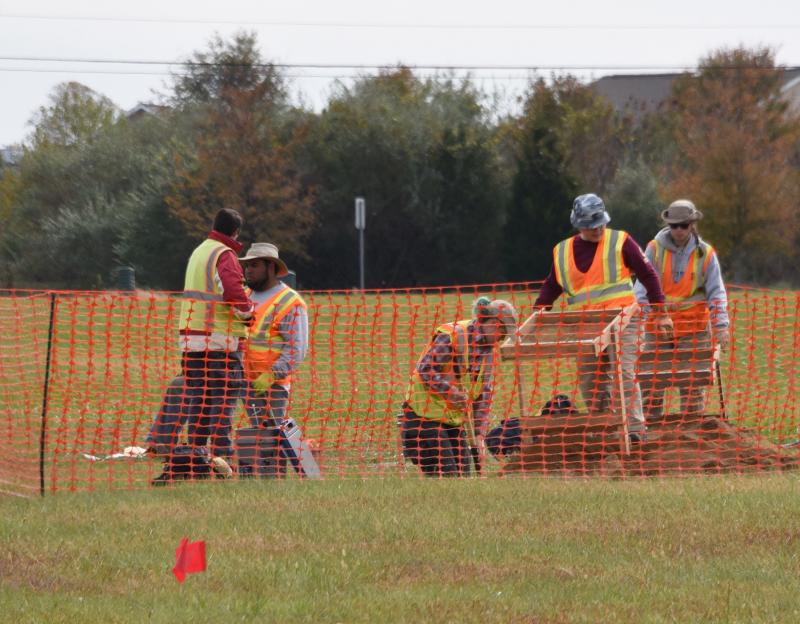
Work is underway to determine if centuries-old ceramics found near Minos Conaway Road are historically significant.
The artifacts were discovered during the first phase of an archaeological study of the area, an early stage of the Minos Conaway/Nassau Bridge grade-separation project.
Kyle Edwards, an archaeologist with the Department of Transportation, said a consultant hired to do the work found a small scatter of mass-produced European ceramics dating back to the late 1700s or early 1800s.
In recent weeks, the consultant’s crew was back on the site, an open field between Route 1 and the Mill Pond Acres subdivision, to complete the second phase of work. The goal this time, Edwards said, was to recover more artifacts to learn more about the site and determine if it is significant enough for preservation.
The consultant’s crew excavated a dozen 3-by-3-foot pits and used a metal detector in an attempt to find a concentration of nails or metals that would indicate the remanants of a building.
“This allows them to get a better idea of what is there, recover more artifacts and identify features,” he said.
Evidence is also found in the dirt, he said, as discolorations could show human use in the past.
The consultant has finished the field work and will now process artifacts before writing up a report that explains their work and provides some interpretation of what they discovered. Edwards said it’s too early to determine if the site is significant.
The final report will go to DelDOT and the State Historic Preservation Office for comment. If the project will use federal money, it is also sent to the federal agencies for evaluation. It is ultimately the federal government’s decision on how to move forward with the project.
If it’s not deemed significant, Edwards said, the recovered artifacts will go to the State Historic Preservation Office and the project will move forward as planned.
If the site is significant, he said, the first priority is to adjust the plan to avoid the area. If that’s not possible, he said, another option is to excavate the historically significant artifacts.
No matter how it plays out, he said, he doesn’t anticipate any delays in the Minos Conaway Road project.
“I’d say 90 percent of the time it doesn’t hold up a project,” he said. “This work is built into the project timeline. Our goal is to always be on pace with the project.”

Nick Roth is the news editor. He has been with the Cape Gazette since 2012, previously covering town beats in Milton and Lewes. In addition to serving on the editorial board and handling page layout, Nick is responsible for the weekly Delaware History in Photographs feature and enjoys writing stories about the Cape Region’s history. Prior to the Cape Gazette, Nick worked for the Delmarva Media Group, including the Delaware Wave, Delaware Coast Press and Salisbury Daily Times. He also contributed to The News Journal. Originally from Boyertown, Pa., Nick attended Shippensburg University in central Pennsylvania, graduating in 2007 with a bachelor’s degree in journalism. He’s won several MDDC awards during his career for both writing and photography. In his free time, he enjoys golfing, going to the beach with his family and cheering for Philadelphia sports teams.