












Charged up: Officials weigh in on high energy bills
January’s deep freeze has faded, but astronomical energy bills for Delmarva Power customers last winter continue to have a chilling effect.
Winter bills that normally average $200 climbed to $500 for many, and even higher for some.
Kathy McGinty said she noticed an increase early last winter when the bill on her circa 1900 home in Bethel shot up over $1,000.
“It was like a mortgage payment,” she said.
She lives alone and uses firewood to heat her home.
“The only room I’m heating is the upstairs bedroom at 60 degrees,” she said.
Her January bill still came in at more than $500.
“This doesn’t just affect low-income residents; it affects us all,” McGinty said.
With warmer temperatures in February and March, she looks forward to lower bills, but awaits each bill with trepidation.
Gov. Matt Meyer said he’s heard similar stories from residents across the state, and he is taking aim at Delmarva Power, accusing the state’s largest utility company of having a monopoly.
“With the recent record-breaking cold and historic snow and ice storms, bills particularly of Delmarva Power customers are skyrocketing,” he said Feb. 17. “What’s happening is not sustainable for working families.”
Nothing has changed about usage; what’s changing is the bills, he said. Other utility companies in the state, such as Delaware Electric Cooperative and Delaware Municipal Electric Corporation, have lower bills.
A review of one Delaware Electric Cooperative bill for January shows distribution charges half of what Delmarva Power customers pay with only 32 cents taken out for a renewable energy fund, compared to $10-$35 in surcharges added to comparable Delmarva Power customers.
Delmarva Power and Light Region President Marcus Beal said electric co-ops are unregulated and operate differently from the way Delmarva Power, a regulated utility, operates. “As a regulated company, we don’t set our own rates,” he said.
Still, Meyer holds Delmarva Power and its parent company Exelon accountable for placing stockholder profits over customers, and he said the Public Service Commission that approves rate increases for Delmarva Power “must scrutinize every penny of delivery and transmission charges to make sure customers are not getting ripped off.”
“Our job is to regulate to make sure you’re getting a fair deal … too many families are not getting a fair deal from Delmarva … we need to do a much better job holding Delmarva Power to account,” Meyer said.
But when asked about the surcharges added to Delmarva Power bills, the largest being Renewable Compliance Charges for wind, solar, and fuel cell energy as part of Delaware’s participation in the Regional Greenhouse Gas Initiative, Meyer had a pointed response.
“The attack on RGGI and green energy, while maybe politically appealing, is mathematically so incorrect, it makes no sense. Sure, we can eliminate all this stuff, so now your bill is going to go from $625 to $617. Did we really solve your problem?” he said.
A review of three separate Delmarva Power bills for January, however, shows total surcharges ranging from about $10 for a $71 bill to over $35 for a $529 bill.
Other state-mandated surcharges included in every Delmarva Power bill are for Green Energy, and a charge for “low income.” A Qualified Fuel Cell charge goes to pay for Bloom boxes, a form of energy that converts hydrogen into power by using natural gas.
When asked about the Bloom box surcharges that have been placed on Delmarva Power customer bills since 2012 and under state law will continue through 2033, Meyer acknowledged there are legal agreements but characterized them as reprehensible.
On the three Delmarva power bills reviewed for January, charges for the Bloom boxes ranged from about $4 to $14. Solar and wind charges ran $5.50 to $20 for the same bills as part of the Renewable Compliance Charge required by Delaware’s participation in the Regional Greenhouse Gas Initiative.
In 2009, Delaware officially joined 10 other East Coast states as part of the Regional Greenhouse Gas Initiative through legislation passed by the General Assembly and signed into law by former Gov. Jack Markell. RGGI is a cooperative effort by the states to limit the amount of carbon dioxide or equivalent produced by power companies annually, essentially creating a carbon price to incentivize power companies to switch to cleaner energy sources.
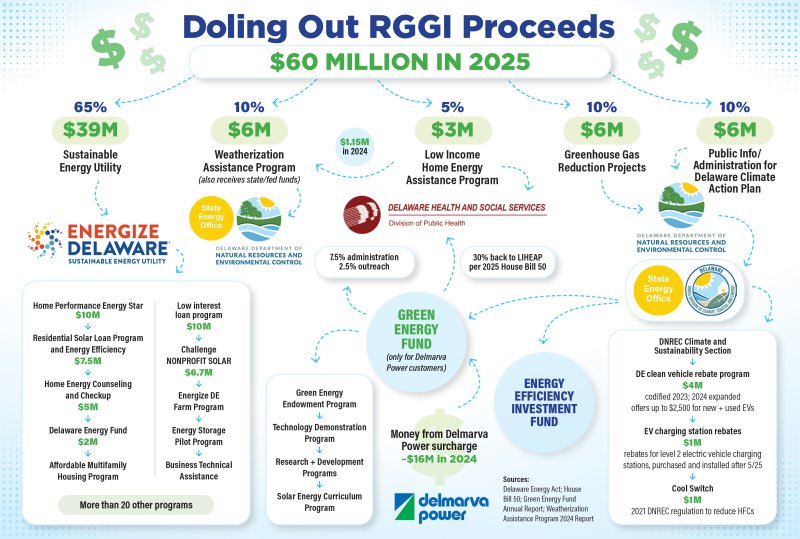
Since joining, Delaware has received $368 million in RGGI funds, which are then dispersed to several entities funding more than 40 programs.
Connecting the dots to all the programs, which departments administer them, and where the funding comes from, however, turns into a labyrinth.
‘A monopoly’
Meyer said he understands Delmarva’s parent company Exelon has a legal obligation to make money for investors, but he has a legal obligation to protect Delawareans. As a publicly traded stock, any investor, including Delawareans, can buy Exelon shares, recently listed at about $47 a share on the NASDAQ stock exchange.
Meyer said Delmarva Power has publicly stated a 9.5% annual return on equity for shareholders, referencing past testimony given to the Public Service Commission.
“They’re a monopoly, and we need to make sure if the returns for out-of-state investors are too high, then we regulate and reduce it,” he said, adding he’s not “big into regulating companies” but power utilities have a monopoly.
“You can’t just flip a switch and switch [a provider],” he said.
Power lines, poles, substations and other installations needed to bring power to a home are proprietary and owned by a power provider company, Meyer said, and state regulators do not want a situation where multiple power lines are run along every street and into every home to give consumers a choice of power providers.
“I’ve asked, but I don’t know if there’s anywhere in the country where you truly have a choice. Just like you can change your power [supplier], I don’t know if there is any way or anywhere in the country where you can say I want to switch my transmission, my last mile provider,” Meyer said.
As the largest utility in the state providing energy for more than 560,000 customers, Delmarva’s president said the company is committed to ensuring power grid reliability.
“Over the years, we have absolutely invested in the reliability of the grid,” Beal said, cutting outages by nearly half over the past decade.
Beal said he was unsure where Meyer got the 9.5% return for investors, but the utility industry aims for 10% return overall. Of the total earned by Delmarva Power, Beal said 76% goes toward improvements to energy delivery and the grid – a percentage that increases to 95% when the cost of employees is factored in.
The biggest reason for high electric bills, Beal said, comes from the supply side power costs, which Delmarva Power cannot control.
“We simply don’t have enough generation. If we had more generation being built over the past 15 years, the cost of electricity would be lower. Unfortunately, that did not happen.
“And currently the independent power producers, or merchant generators, folks who build power plants, they simply have not built power plants,” he said.
Energy production strained
PJM Interconnection, the company that runs the eastern power grid supplying power to Delaware and states throughout the region, has warned since 2023 that government policy forcing fossil fuel-burning power plants, such as coal and natural gas, to shutter would have serious consequences. Coal and gas power plants have historically provided baseload energy – a constant, reliable form of energy that can be quickly fired up when power is needed.
In its 2023 report, PJM, which serves 65 million customers across 13 states including Delaware, warned that solar, wind, and other sustainable energy production does not make up for the number of existing fossil fuel generators scheduled to retire before 2030.
“Thermal generators are retiring at a rapid pace due to government and private sector policies as well as economics,” the report states. “Retirements are at risk of outpacing the construction of new resources due to a combination of industry forces, including siting and supply chain, whose long-term impacts are not fully known.”
Plant closures since the report was released included all coal-fired generation in New Jersey, several plants in Maryland, and the Indian River Power Station in Delaware. On the horizon are two more coal units slated to retire in 2028 as a result of EPA Effluent Limitation Guidelines, and starting in 2030, the Illinois Climate & Equitable Jobs Act mandates the scheduled phase-out of coal and natural gas generation. The remaining phase-out dates are 2035, 2040 and 2045, the report states.
Meyer said he is open to legislation that would allow Delmarva to produce energy – a request denied to the utility in the past.
“As long as the consumer is protected, and it will bring down costs and increase the availability of energy, we’re certainly open to it,” he said.
Meyer heavily supports wind power as an energy source, particularly an offshore wind project planned near Ocean City, Md., with power lines coming into Delaware near the Indian River Inlet and running toward the Indian River power plant. Those plans, however, have been stalled with the Trump administration’s move away from wind projects, but legal action remains in the courts for the project to continue.
During the snow and ice storm Jan. 23-25, solar energy output was cut in half, according to data available from PJM. Wind power was also lower during the storm, dropping from a high of 8,907 MW per hour at 9 a.m., Jan. 23, to 1,035 MW by 3 p.m., Jan. 24. Wind power production picked up to 8,907 MW by 8 p.m., Jan. 25.
At the same time, the price for energy spiked to as much as $708 per megawatt hour, with prices largely fluctuating between the $200-$600 range, according to PJM data.
Energy solutions floated
Meyer has supported the idea of small-scale nuclear, although the technology for those units is probably close to a decade away from connecting into the power grid. In the short term, however, he said in a recent interview that progress is being made on the energy front.
“You’ll be hearing more. We have some stuff we’re working on that will come out shortly,” Meyer said.
Delmarva’s Beal said his company communicates with the Meyer administration on a weekly basis, and he expects that to continue.
As a regulated utility, Beal said Delmarva must partner with the governor, state and Public Service Commission in order to build utility-generated energy, in the absence of independent power companies building more plants.
“The piece we can control is us getting involved in utility-generated energy, or regulated generation, and we are absolutely ready to do that so we can help,” he said.
Beal said they are working with legislative leaders on legislation that would allow Delmarva to pursue batteries and solar.
“We are looking at the utility getting involved in batteries as a regulated utility. There are benefits to that because we can partner with the state,” he said. “To have the state involved in the process with us building batteries, we think that’s a positive.”
Something larger, such as a natural gas plant, would need the state to partner with Delmarva.
Although Beal said he would like to see a change in the way energy projects are funded, as a regulated utility, Delmarva has to spend money upfront. “We select the projects. We’re trying to get the most impact on reliability for the dollars spent,” he said.
Costs Delmarva Power must pay upfront include improvements to power lines, substations, and other infrastructure. A proposed rate hike of $6 on average would help defray those costs if approved by the Public Service Commission in about a year, Beal said.
“We know that the work we are doing, the things we’re spending money on, is directly translating to better reliability for our customers,” he said.


Melissa Steele is a staff writer covering the state Legislature, government and police. Her newspaper career spans more than 30 years and includes working for the Delaware State News, Burlington County Times, The News Journal, Dover Post and Milford Beacon before coming to the Cape Gazette in 2012. Her work has received numerous awards, most notably a Pulitzer Prize-adjudicated investigative piece, and a runner-up for the MDDC James S. Keat Freedom of Information Award.