












Governor shares views during Lewes meeting
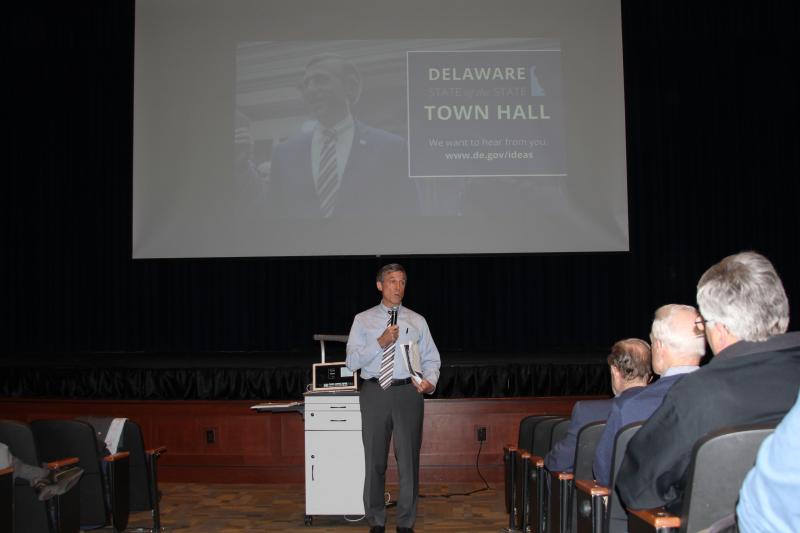
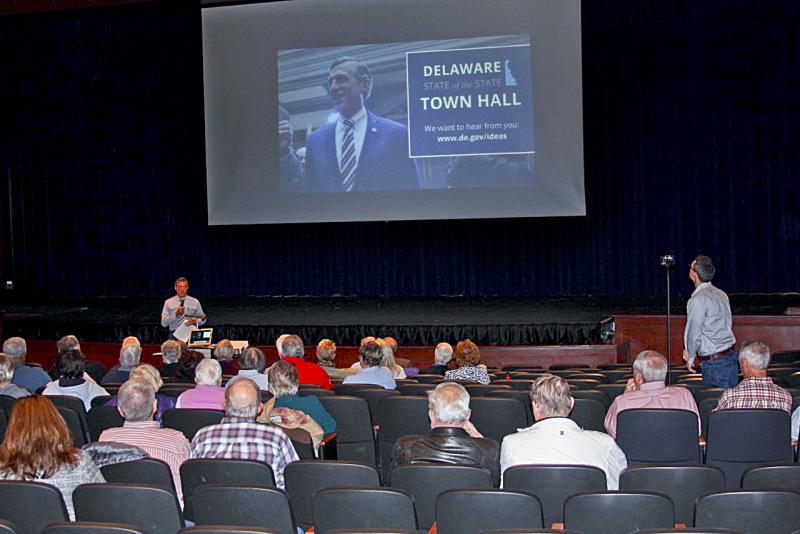
Gov. John Carney fielded questions on healthcare costs, property assessments and legalizing marijuana during a town hall meeting held April 3 at Cape High.
After an overview of the state economy – 3.7 percent unemployment is the lowest in a decade, more people are working and state revenues are up – Carney took questions from some of the more than 100 attending the Cape Gazette-sponsored event.
Starting off the question-and-answer session was a question about why Carney supported the National Popular Vote movement – legislation he signed into law after the General Assembly passed it in March.
The legislation now binds Delaware to a pact of states which will give their electoral votes to a presidential candidate who wins the national popular vote, instead of the individual state's popular vote winner. Delaware will continue to cast its three Electoral College votes to the presidential candidate who wins Delaware's popular vote until the pact of states passing National Popular Vote legislation reaches 270 electoral votes – the number needed to ensure a presidential candidate wins the election. So far, the pact of states has less than 200 combined votes.
Carney said he supports the National Popular Vote because it's a system that counts every person’s vote.
“My own view is that the person who gets the most votes should win the election,” he said. “It's an issue we can disagree on, but the reality is that some states don't count as much. If every vote counts, then every state should count.”
Carney said he also supports early voting and same day registration for voting because voting should be easy. “We don't get the participation we should have now,” he said. “It really comes down to whether you want to make it easier or harder for people to vote.”
On the issue of property reassessments – last done in 1974 for Sussex County – Carney said a bill to reassess property was in the state Legislature when he was Secretary of Finance under then-Gov. Tom Carper, but the Senate leader refused to address the bill, and the legislation died. At the time, he said, a property reassessment would have resulted in 1/3 of properties getting a tax increase and the other 2/3 would stay the same or drop.
A lawsuit now in Chancery Court is seeking property reassessment across the state, and, Carney said, he expects the judge may order Delaware's three counties to reassess their properties. He said it is a serious equity issue – property taxes are used to pay for schools and county services – and it would cost millions of dollars to reassess property across the state.
“I'm prepared to provide some assistance to do that,” Carney said
On healthcare costs, Carney recalled a conversation he had with a colleague in Congress who said, “At the rate that we're going now, the United States will be a healthcare organization with an army – a small army because the healthcare costs continue to eat up more and more of the budget.”
Carney said his administration is focused on keeping rising healthcare costs in line with the annual gross domestic product increase – now about 3 percent. He said his administration is reviewing hospital costs in other states, and has found residents pay more for most hospital procedures in Delaware than what residents pay in other states for the same procedures.
“We looked at the top 15 hospital procedures for state employees, and just about every single one of them we were paying more to our hospitals in Delaware than they were paying across the line in Pennsylvania and Maryland,” he said.
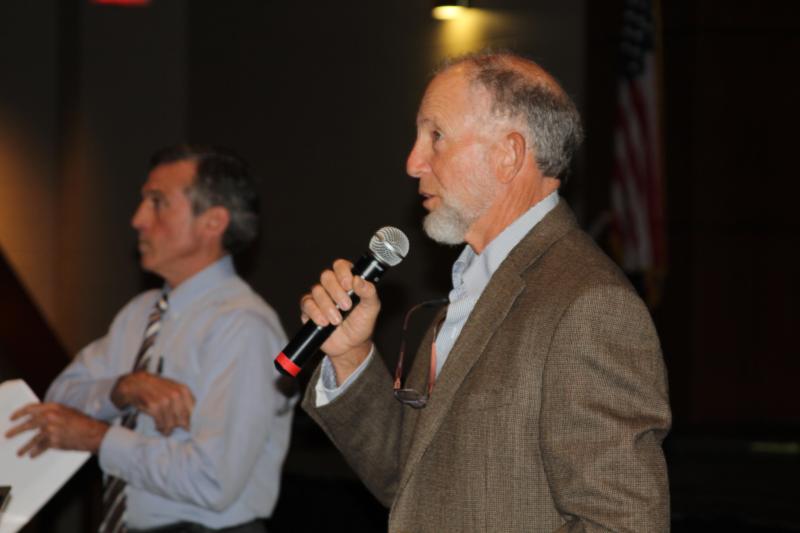
In order to increase competition and lower healthcare costs, Lewes resident John Toedtman said Delaware must eliminate the Certificate of Need it requires before a medical facility can open in the state.
With more than 40 years of experience in senior management in the healthcare sector, Toedtman said studies show that any region that has three hospitals has competitive prices. In a region with two hospitals, he said, prices are 15 percent higher, and when you have one hospital, prices are 25 percent higher.
Christiana Care has a virtual monopoly in New Castle County, Bayhealth has the largest presence in Kent County, and there is little competition in Sussex County, he said.
“The Certificate of Need is way outdated and not needed anymore. What it does is keep out competition,” he said. “If you just eliminate the Certificate of Need and increase competition, most prices will come right down.”
Carney said he agreed with the information Toedtman shared but private investment is difficult to come by in the medical industry.
“It's hard to get somebody to invest in something like that,” he said.
In one of the last questions of the night, Carney was asked about his stand on legalizing marijuana and he said it goes against his campaign for healthy lifestyles.
“I don't want to do something that would encourage people to smoke pot. It doesn't create communities that are good to live in,” he said.
Carney said he has visited states that have legalized marijuana and he called it a “dirty industry.”
“I don't want to do it to be cutting edge, and don't want to do it for revenue,” he said. “I don't think it's a good idea.”

Melissa Steele is a staff writer covering the state Legislature, government and police. Her newspaper career spans more than 30 years and includes working for the Delaware State News, Burlington County Times, The News Journal, Dover Post and Milford Beacon before coming to the Cape Gazette in 2012. Her work has received numerous awards, most notably a Pulitzer Prize-adjudicated investigative piece, and a runner-up for the MDDC James S. Keat Freedom of Information Award.