












Local scout completes conservation project at James Farm Ecological Preserve
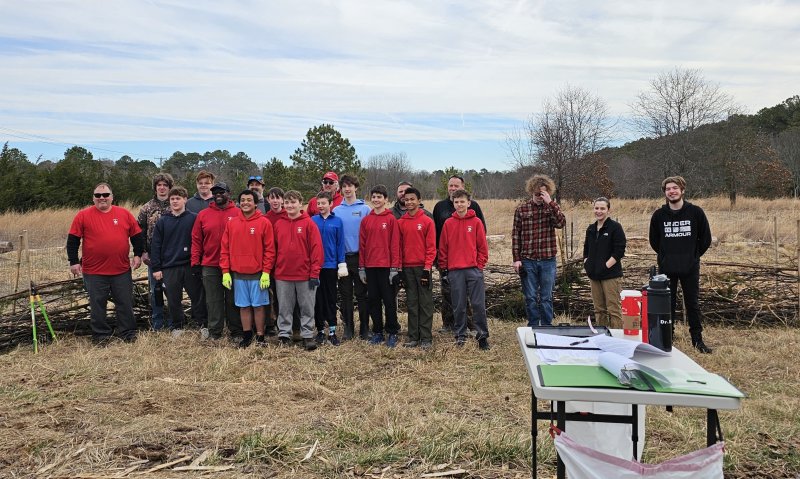
Life Scout Matthew Hanna of Troop 1, chartered to St. Peter’s Church in Lewes, recently completed a conservation project at the James Farm Ecological Preserve as part of his Eagle Scout requirements.
The project focused on reforestation, habitat restoration and conservation education within the Inland Bays watershed. Through months of planning and coordination, Hanna led volunteers in transforming a previously open parcel of land into a developing forest demonstration area designed to benefit both wildlife and the thousands of visitors who explore the preserve each year.
The project involved preparing and planting more than 250 young native trees across a roughly 250-by-50-foot section of the preserve. These included a diverse mix of species such as white oak, persimmon, holly, sassafras, sweet bay, scarlet oak, mockernut hickory and flowering dogwood, selected for their ecological value and suitability to the local environment.
Hanna also organized the construction of more than a dozen protective micro-forest enclosures designed to protect the trees from wildlife damage during their most vulnerable growth stages.
Additional work included installing soil amendments such as biochar and wood chips to improve soil health and accelerate ecosystem development. Volunteers also constructed about 100 feet of natural “dead hedge” using cut bamboo and fallen branches to provide shelter for wildlife and further encourage habitat development.
The project converted about one-quarter acre into a new forested area that will serve as an ecological corridor connecting existing forest sections of the preserve with marsh and field habitats.
The conservation effort addresses environmental needs identified in a historical ecological study of the preserve that documented a decline in forest resources between 1954 and 2012. By restoring tree cover in this area, the project is expected to improve water quality and habitat resilience.
The planting also serves as a demonstration windbreak designed to showcase best practices in forestry and land management. The 50-foot buffer width used in the design reflects local development buffer standards and provides a practical example of how conservation practices can be incorporated into land-use planning. As the trees mature, the windbreak is expected to reduce wind speeds and provide environmental benefits extending hundreds to thousands of feet beyond the planting area.
More than 30,000 visitors who come to the James Farm Ecological Preserve each year will be able to observe the site as it matures, providing an educational example of reforestation and environmental stewardship in action.
The project required significant preparation before any trees were planted. Hanna devoted about eight months to planning, including 54 hours of project development, coordination and logistics. This included securing approvals and coordinating project support from James Farm Ecological Preserve, Delaware Center for the Inland Bays, Sussex Community Corrections Center, and the Scouting America Coastal District Eagle Board.
During implementation, Hanna demonstrated leadership by organizing work schedules, assigning crews, coordinating materials and tools, and ensuring work progressed safely and efficiently. His role focused not only on performing the work, but also on directing others.
“Matthew played a key role in the project,” said Bob Collins, manager of programs and facilities at the preserve. “He secured trees and mulch, prepared materials and helped lay out the planting areas. He also organized the labor, including workdays with Department of Correction inmates and a planting day with scouts and their parents. Throughout the project, he provided hands-on help and steady supervision with a positive attitude.”
The project brought together a broad coalition of volunteers. Altogether, 542 volunteer service hours were contributed, including 243 hours from Scouts and Sea Scouts. Volunteers included members of Troop 1, Ship 198, DeMolay Henlopen Chapter and participants from the Sussex County Corrections Center work-release program.
This strong turnout reflects both the scale of the project and the community support behind Hanna’s effort.
The total project cost reached $32,890, funded through the Tree for Every Delawarean Initiative. Hanna played an important role in supporting the grant application process through the Delaware Center for the Inland Bays, helping secure the funding necessary to complete the project.
Additional support was provided by the Sussex County Corrections Center work-release program and East Coast Garden Center in providing 10 large shrubs as part of the habitat growth augmentation.
Eagle Scout service projects are intended to create lasting benefits for communities while demonstrating a scout’s ability to plan, lead and execute a complex service initiative. Hanna’s project stands out not only for its scale, but for the long-term environmental value it will provide as the forest matures in the years ahead.
His work represents the values of service, leadership and environmental responsibility that define the Eagle Scout rank and leaves a meaningful and lasting contribution to the Delaware coastal community.