












Meyer talks schools, reassessments and budget
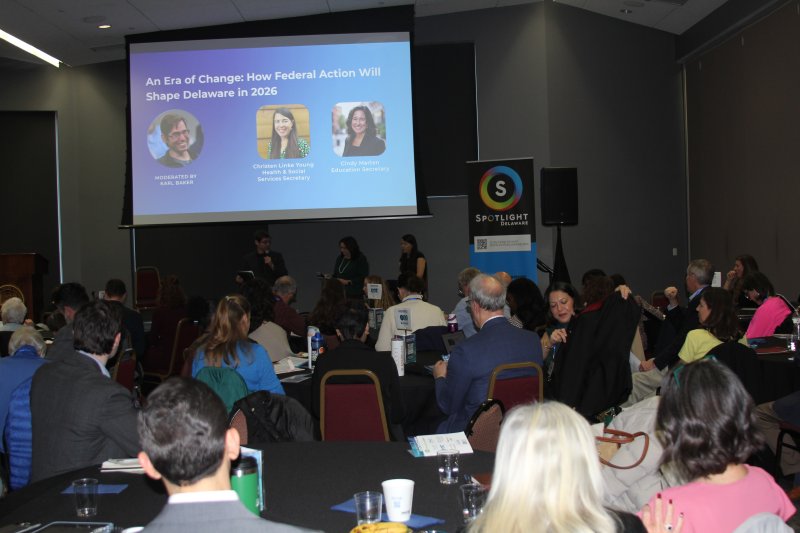
Gov. Matt Meyer, top legislators and cabinet secretaries shared some insight on issues facing the state in 2026 during a forum presented by Spotlight Delaware Jan. 7 in Dover.
As a former teacher, Meyer said funding schools and making sure money goes to students who need it remains a top priority for his administration.
Delaware’s school funding formula is woefully obsolete, he said, and he would welcome legislation that attaches funding to a student.
“If a student has higher needs or higher costs, we want the state to be able to provide those higher costs,” Meyer said. “The [funding formula] needs to be simplified, it needs to be clear and needs to be equitable.”
Meyer said there is probably too much money spent per capita in some schools and classrooms, but there are other classrooms that are underfunded and need more resources.
Equalization funding, which had been paused for more than a decade over the property reassessment fight, could be brought back now that all three counties have completed their assessments.
“We now are in a place where we can start using that equalization formula again,” Meyer said. “We don’t need a new law to do this [because] the equalization formula is there. As long as the assessments are more or less right, we’re at a place where we can put that in place.”
School district consolidation, which Meyer supports for New Castle County, is another way to move more money into classrooms. However, he said, any effort for district consolidation in Kent or Sussex counties would have to start at the community level.
“I’m not going to stand up and say that Laurel and all these school districts need to consolidate. I think communities need to make decisions about where they go,” he said.
On property reassessments, Meyer addressed criticism that has been levied against him during his time as New Castle County executive overseeing the process. Some say he intentionally released tax bills after the gubernatorial election, but Meyer said that is not so.
“I oversaw the process to make sure it was honest, to make sure Tyler [Technologies] was meeting its goals,” he said about the company hired to do the reassessments. “I never personally, and no one on my team, ever changed the schedule.”
As for the upcoming year, Meyer said he is optimistic.
He said he is working for a budget where revenue and expense growth are more on par with each other.
“We don’t need to cut left and right all these critical services for Delawareans to balance the budget, but I think you’re going to see a responsible budget that moves the state forward,” Meyer said.
Meyer will release his budget Thursday, Jan. 29.
State departments navigate federal changes
Cabinet secretaries for education and health and social services say navigating new federal rules for funding has been tricky, but for the most part, Delaware continues to receive money for necessary programs.
Department of Education Secretary Cindy Marten said by the end of 2025, the department was able to secure nearly all of its federal funding.
“Some of it was in question, but it all worked out,” she said, adding no cuts were made by the state so far.
DOE’s main focus remains providing guidance to local school districts, and keeping Delaware’s congressional delegation apprised of how federal dollars are flowing into Delaware.
“If you overreact to what’s coming from the federal government, you’re probably on the wrong side of history, but if you don’t react, you could also be on the wrong side of history,” Marten said.
At the Department of Health and Social Services, Secretary Christen Linke Young said the uncertainty of federal policy has been the greatest challenge facing her department.
The federal government has lowered its share in some of its entitlement programs, she said, putting more stress on the states to make up the difference. In particular, she said, there will be challenges in the affordable healthcare arena.
“Our work is very much focused on what we do in the way we operate these programs so that as many beneficiaries as possible continue to have the life-transforming benefits of health insurance,” she said.
Legislators touch on tax brackets
As the General Assembly prepares to return to session Tuesday, Jan. 13, bringing a progressive tax rate to the state could again be a topic of discussion.
“A $60,000 annual salary should not be at the top of the bracket. That doesn’t make sense,” said Speaker of the House Rep. Melissa Minor-Brown, D-New Castle. “You should not compare someone making $60,000 a year to someone who’s making $2 million a year.”
Still, Republicans said increasing the top bracket can affect small businesses that have slim margins, and have been struggling with years of inflation.
“The amount that they’re paying for supplies as a restaurant is way up, and now we’re talking about increasing this top bracket, which is going to affect restaurants and other small businesses like them even more,” said Rep. Jeff Spiegelman, R-Smyrna. “And then we’re turning to them and saying, ‘Please, please, please hire people.’”

Melissa Steele is a staff writer covering the state Legislature, government and police. Her newspaper career spans more than 30 years and includes working for the Delaware State News, Burlington County Times, The News Journal, Dover Post and Milford Beacon before coming to the Cape Gazette in 2012. Her work has received numerous awards, most notably a Pulitzer Prize-adjudicated investigative piece, and a runner-up for the MDDC James S. Keat Freedom of Information Award.