












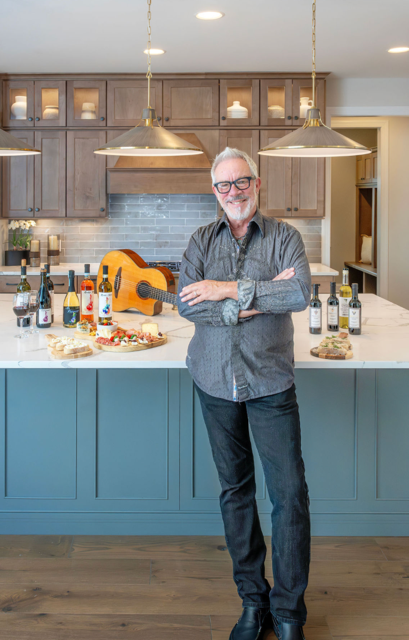
Paul Cullen grew up in Buffalo, N.Y., and moved to Fort Myers, Fla., when his family moved there to take over a dry-cleaning business. Paul followed his family, thinking he would learn the business and maybe take it over. But after two years, Paul decided that neither living in Florida nor being in the dry-cleaning business was for him. So, he started taking guitar lessons to pursue his dream of becoming a performing musician.
As Paul became a better guitarist, a mentor gave him some advice that would forever change his perspective as a musician. He told Paul there weren’t many bass guitarists out there, and being able to play bass guitar could give him a real advantage in an extremely competitive business. So in 1980, Paul started playing bass guitar and traveled extensively playing all styles of music. While the travel was exciting for a while, Paul soon longed to feel more settled. Eventually he moved back to Fort Myers and joined a local band, where as luck would have it, the lead singer of an internationally known band, Bad Company, heard Paul play. The singer approached Paul and said he liked his music. More importantly, he told Paul the bass guitarist in their band had decided he didn’t want to travel anymore, creating an amazing opportunity for Paul. He jumped at the chance to audition for Bad Company in 1990 and was offered a contract on the spot to play with the band.
Paul toured with the band over the next three years, but unfortunately, musical differences and politics led to significant changes within the group, and after three years, Paul was forced to leave the group. He moved back to Buffalo and continued playing in local bands. In 2001, Mike Daisey convinced Paul to come to Delaware and play with his band. Paul saw it as the opportunity for a fresh start in his life. He played with the band for a short while, and on his last night in Delaware, a beautiful woman walked into the bar where they were playing – his future wife Bonnie. He left for Buffalo the next day, but as love would have it, Paul came back to Delaware 10 days later and moved in with Bonnie.
He managed to find various odd jobs, including handyman work around the house for Rob and Sherry Tunnell. When Sherry casually mentioned that she didn’t enjoy shopping or cooking, Paul offered to cook a few meals for them. That became another turning point in Paul’s life, as he rekindled his love for cooking. It started when he was at his Italian grandmother’s side in the kitchen as a kid. Cooking was soon to be another life skill from which he could earn money. Today, he does about 150 in-home dinners each year.
Paul had always been interested in wine, and with his private chef dinner business, he saw an opportunity to share the wines he developed in partnership with other winemakers around the world. He currently offers seven different wines, soon to become 10, under his own label. Paul’s wines are now sold in 35 retail stores and five restaurants in Maryland and Delaware, and available online in 43 states.
To help manage his many and varied interests, Paul has an assistant, Nina Carle, who helps him with his in-home dining business. Jim Rivette helps manage his wine business as well as Paul Kares, his nonprofit business that runs his musical venue on Cedar Grove Road outside Lewes. Revenue that comes into Paul Kares is used to fund scholarships for young adults who want to make careers in the music and culinary arts. In the past four years, Paul has been able to contribute more than $70,000 in scholarships.
“I make a living here, and I want to be able to share my good fortune with the community that has always supported me,” he said.
With so many different businesses and interests pulling him in multiple directions, Paul manages to keep it all in check because, as he says, “I absolutely love what I do.”
Paul’s biggest challenge, with the many demands on his schedule, is trying to find time to support his businesses while making sure he and Bonnie get to enjoy their time together.
If Paul could go back in time and give advice to his 18-year-old self, it would be to focus on building relationships in the business world. Paul acknowledges he learned the hard way the importance of business connections.
“I was so used to doing everything myself, I didn’t always see the benefit of being able to nurture relationships that could have been mutually beneficial,” he said.
And while that may have slowed his progress to some degree, he’s more than made up for it with his menu of many ventures and successes.
-

This column provides an opportunity for readers to connect with the personal side of business leaders in area communities. Many of our local business owners and CEOs are thought leaders in their community, and they can provide valuable insights and ideas on issues of common interest to all of us. Successful businesses are essential for a healthy and growing society, especially as people continue to move to this area looking for employment opportunities. This column will highlight leaders who are not only successful, but also making a difference in our communities.
Jeffrey Fried was an executive in the healthcare industry for over 40 years, including serving as the president/CEO of Beebe Healthcare for 24 years. After leaving Beebe Healthcare, Jeff started his own consulting and executive coaching business and has coached other executive in a wide variety of industries. In addition, Jeff has partnered with a company called Vistage, the oldest executive development and coaching company in the country. He serves as a Vistage chair on the Delmarva Peninsula, where he supports a local group of business owners and CEOs. Jeff and his wife Sherry reside outside Lewes and have three children, six grandchildren and two rescue dogs.