













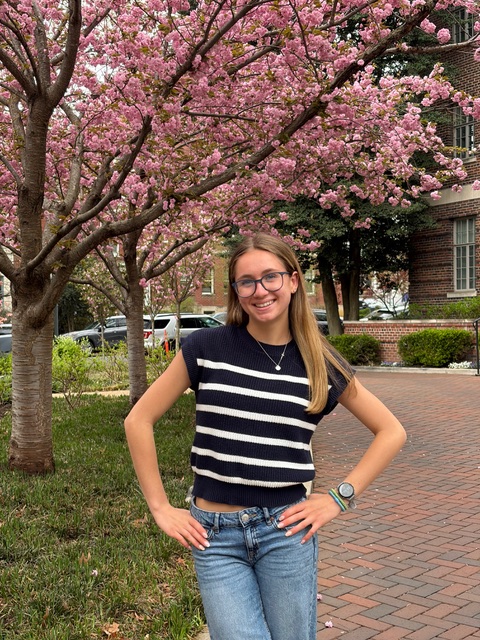
Editor’s note: Sussex Academy senior Katya Geyer was recently named the winner of the RENEW Essay Contest sponsored by ReWild Delmarva.
“Nothing exists in isolation.”
I did not read that in a textbook first. I felt it before I knew how to name it. Still, it was not until I picked up “Silent Spring” by Rachel Carson that the feeling sharpened into something I could follow. Carson writes as if she is pulling a single thread and asking you to watch what unravels. A pesticide settles. Insects disappear. Birds follow. And then there is a morning that sounds different, though you might not notice it right away.
It is not the disappearance that unsettles you most. It is how easily it happens.
Carson never raises her voice on the page, and somehow that makes the argument louder. She does not beg the reader to care. She assumes you will, once you understand. That confidence in the reader is what pulled me in. It felt less like being told a story and more like being trusted with one.
I started to think about that kind of unraveling closer to home. In Delaware, the landscape does not announce its changes all at once. It shifts. Marsh grass thins where it used to hold firm. Water moves a little farther inland each season, not enough to alarm you, but enough to redraw edges you thought were fixed. The shoreline is not a line at all, just a negotiation that never quite settles.
Stand in a salt marsh long enough and you begin to notice that it is not still, even when it looks it. The ground gives slightly under your feet. Water threads through narrow channels, carrying nutrients, salt, and sediment in patterns that are anything but random. These marshes are often described as buffers, but that word feels almost dismissive. They are carbon sinks, storm barriers, nurseries for marine life, and entire ecosystems layered into one space. They do not simply sit between land and water. They translate between them.
There is a word for this in environmental science. Feedback. A system responding to itself, adjusting, sometimes stabilizing, sometimes spiraling. You can watch it happen if you are willing to stand still long enough. Salt changes the soil. The soil changes the plants. The plants determine what can live there next. And then the cycle continues, never repeating in quite the same way.
Nothing makes a decision alone. And yet, we often act as if we do.
That contradiction is what holds my attention. The idea that we are part of a system defined by interdependence, while still believing our actions stop with us. Carson understood that they do not. She did not argue that nature is fragile in the sense of being weak. She showed that it is intricate, and that intricacy is what makes it vulnerable. Complexity creates beauty, but it also creates consequence.
Once I started seeing the world this way, it became difficult to go back to simpler explanations.
Environmental issues were no longer just topics you study for a test. They were systems you could trace. Sea level rise was not only about water. It was about displacement, salinity shifts, habitat loss, and the communities that experience those changes first. Climate change was not only a future problem. It was already present, already shaping outcomes, already uneven in who it reached.
And that unevenness matters.
Some neighborhoods flood more than others. Some communities have the resources to adapt, to rebuild, to move if necessary. Others do not. Environmental science has terms for this, phrases like environmental justice and unequal exposure, but those words feel almost too clean compared to what they describe. In reality, it looks like repetition. The same streets underwater after every storm. The same homes absorbing damage again and again.
When you connect that back to the idea of a web, it becomes clear that the strands are not evenly weighted.
My connection to the environment grew in that space between understanding and responsibility. It was never just appreciation. It was the realization that once you see the connections, you cannot pretend they are not there. Through my work with environmental initiatives like Green Team and the YES Summit, I have tried to engage with that reality in ways that are tangible, even when the larger problems feel overwhelming.
It is easy to say that sustainability matters. It is much harder to define what that looks like in practice. What does it mean to reduce waste in a system built on convenience? What does it mean to advocate for environmental change in a community where not everyone experiences that change in the same way? What does it mean to act locally when the problem is global?
These questions do not resolve neatly. They branch. Every solution introduces new variables, new considerations, new trade-offs. That does not make the effort pointless. If anything, it makes it more necessary. Systems thinking does not promise simplicity. It demands awareness.
Sometimes progress looks small. A shift in how resources are used. A conversation that reframes how someone understands an issue. A project that does not solve the problem but makes it visible in a new way. Those moments matter because they build the kind of awareness Carson relied on. Not awareness as a passive state, but as something that leads to change.
I think often about what it means for future generations to experience the environment not as something distant or damaged, but as something alive with possibility. Not just preserved, but understood. That requires more than protection. It requires connection.
People care more deeply about what they feel connected to.
That connection does not come from statistics alone, even though the numbers are important. It comes from experience. From standing in a place long enough to notice how it changes. From asking questions that do not have immediate answers. From realizing that the systems we depend on are not guaranteed to remain stable.
Wonder plays a role in that, but not the kind that exists at a distance. Not the kind that looks without questioning. Real wonder is more demanding. It asks you to look closer, then closer again, until what once seemed simple reveals itself as layered and interdependent.
And once you see the world that way, it becomes difficult to accept carelessness. Not because someone told you to care, but because you understand what is at stake when something begins to unravel.
Carson did not write “Silent Spring” to end a conversation. She wrote it to start one that would continue long after her. The book itself feels like part of the web it describes, passed from reader to reader, each person adding their own understanding to it.
I think that is where my role fits into all of this.
Not as someone who stands outside the system trying to fix it, but as someone within it, paying attention, asking questions, and working to make those connections clearer for others. Whether that is through environmental initiatives now or through future work that addresses sustainability and environmental change, the goal remains the same. To make the invisible visible. To trace the threads before they break.
A single thread rarely looks important on its own. Until you realize what it is holding together.
-
Cape Gazette commentaries are written by readers whose occupations, education, community positions or demonstrated focus in particular areas offer an opportunity to expand our readership's understanding or awareness of issues of interest.