













Rehoboth homeowners question county wastewater takeover
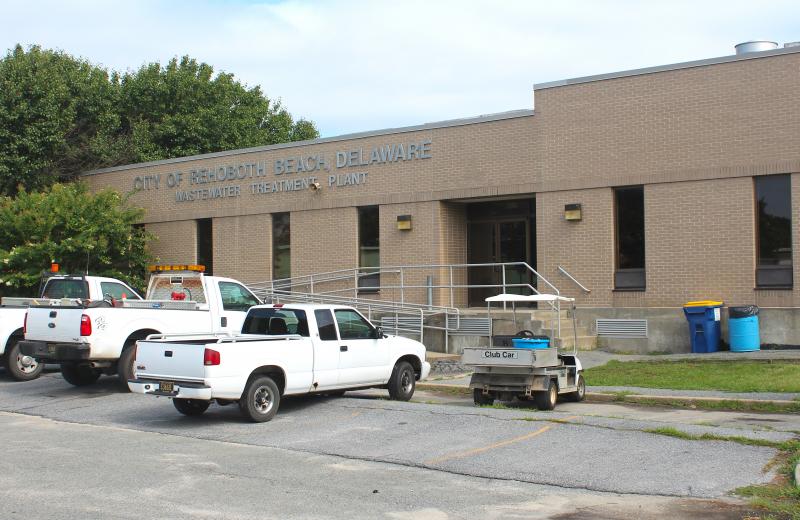
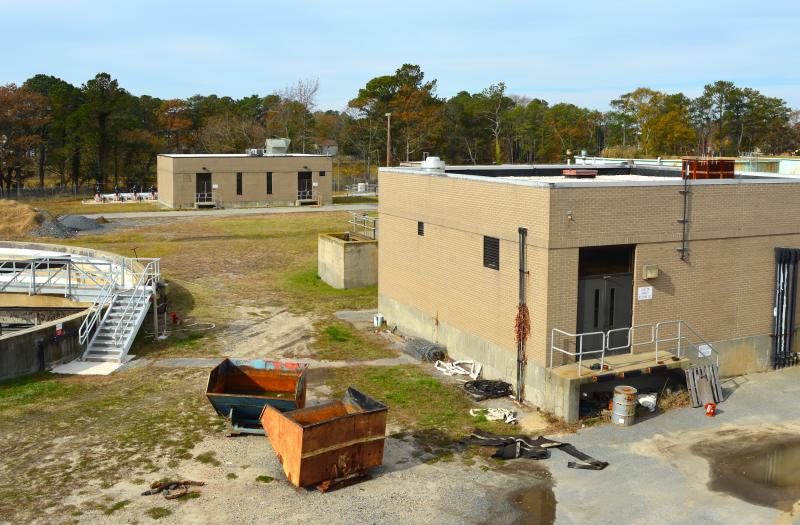
Story Location:
2 Bay Road
Rehoboth Beach, DE 19971
United States
Rehoboth commissioners are hosting a town hall meeting Saturday, Jan. 5, to discuss Sussex County’s proposal to take over city wastewater services. Rehoboth Beach Homeowners Association recently questioned inequities if the takeover occurs as proposed.
City property owners are facing rate increases to pay for the $42 million ocean outfall and about half as much more – $24 million – for system upgrades. The city approved about a quarter of the upgrades in August; under the city’s ownership of the system, the county pays for about half that cost under an agreement with Rehoboth officials.
City officials commissioned a rate study that predicted necessary rate increases for an average user. In early November, during an executive session questioned by the Cape Gazette, city officials concluded a presentation of the rate study with a discussion with county officials about taking over the wastewater system. A couple of weeks later, county officials presented a plan to take over the system, a plan county officials say will be less expensive for an average Rehoboth Beach user.
Now the Rehoboth Beach Homeowners Association says the study was flawed, noting the city bases its bills on usage, while the county does not. City residents who conserve water, homeowners say, will be subsidizing people who may use as much as 10 times more water. A second issue raised by the association is the county calculation for hotel usage, which is based on the number of rooms at each hotel.
The homeowner association board emailed a letter to association members in early December.
Beginning with the flat-rate structure, the letter questions data used by city consultants. The association contends the study may present an inaccurate and incomplete picture of future bills. The letter points out bills to residents can range from 10,000 gallons a year to well over 100,000 a year for large rental houses.
“We are concerned that, in a diverse resort community such as ours, the county’s flat-rate structure presents inequities. A household that uses 20,000 gallons a year would pay the same actual annual cost as the rental house that uses 100,000 gallons,” the letter reads. “On a per-gallon basis, the user of 20,000 gallons would be paying five times the rate of the 100,000-gallon user!”
The association estimates the breakeven point to be around $425, which means if a property owner’s current bill is above that, they could expect to benefit from the change.
Moving into commercial users, the association’s letter points out the city bills hotels based on equivalent dwelling units, or EDUs. The association says Rehoboth bills at .75 EDUs per room, while the county bills at less than half of that, at .33 per room. The association estimates there are 1,150 rooms in the city, which means the city bills hotels, taken together, at 862.5 EDUs, raising roughly $590,000, while the county would bill hotels for only 379.5 EDUs, or a total of $261,000, the association estimates.
In an email Dec. 27, Mayor Paul Kuhns said the city is in very early discussions and nothing is in stone. He said he is waiting for heavy input from the public and follow-up by the commissioners.
Kuhns said, based on information provided so far, he believes this potential transition may be very positive for the entire ratepayer and user base over the next 10 to 20 years.
Kuhns said under the current usage system, the heavy users of water in Rehoboth subsidize the low users for the system already in place. The higher water user pays more due to usage, but they also pay more to maintain the system that the low users are using.
He said the outfall, approved by the voters, is a new piece of the Rehoboth system. Whether the city keeps control or the county takes over, the entire user base is expected to pay for that project, he said.
Commissioner Richard Byrne said, at this point, there is just too much that is unknown, so he’s looking forward to the public discussion at the meeting with follow-up discussions after that. He said he hopes the county will be flexible enough to engage in some amount of negotiation as is appropriate for the city as this moves forward.
Commissioner Pat Coluzzi said the town is collecting information before the meeting, and it would be premature to answer questions until council has gotten additional answers to its questions.
Commissioner Stan Mills said the proposal from the county is still in its infancy, and he sees no reason to rush. He said he has yet to receive a proposal with enough specifics to make an informed decision on whether it is a good deal for Rehoboth Beach.
“I expect the town hall meeting will present and answer some questions, but will leave many more questions to be answered after more research,” said Mills. “If enacted, this is a monumental change in operations with potentially significant impacts both monetary and service-wise for our current wastewater clients – and one that cannot be reversed – so I see no rush to conclusions.”
Mills said constituent questions will be key in assisting the commissioners in conducting a thorough analysis before a vote is taken.
The meeting is scheduled to begin at 10 a.m. and will take place in the commissioners room of city hall, 229 Rehoboth Ave.
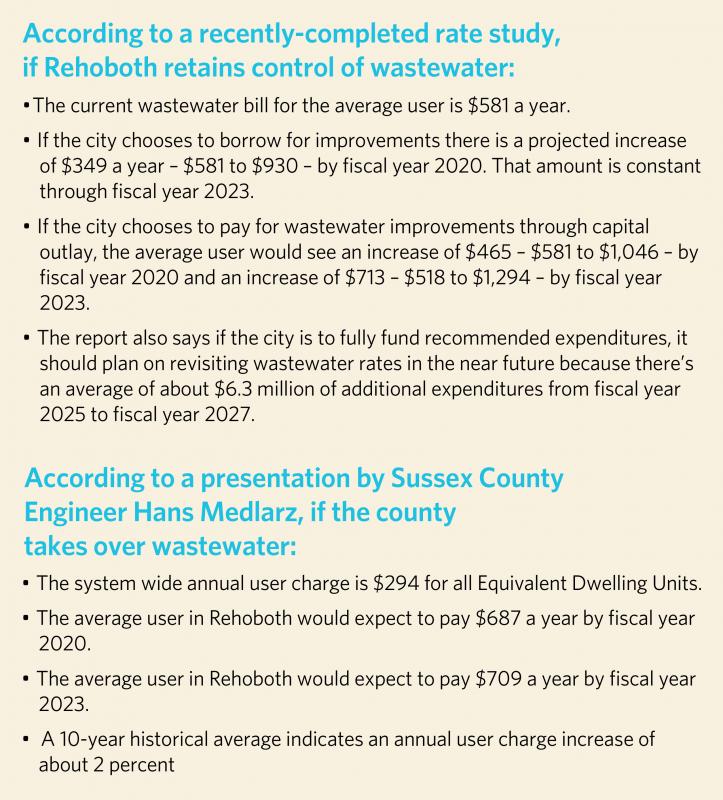
Wastewater Rates: A comparison
According to a rate study, if Rehoboth retains control:
• The current wastewater bill for the average user is $581 a year
• If the city chooses to borrow for improvements there is a projected increase of $349 a year - $581 to $930 - by fiscal year 2020. That amount is constant through fiscal year 2023
• If the city chooses to pay for wastewater improvements through capital outlay, the average user would see an increase of $465 - $581 to $1,046 - by fiscal year 2020 and an increase of $713 - $518 to $1,294 by fiscal year 2023
• The report also says if the city is to fully fund recommended expenditures, it should plan on revisiting wastewater rates in the near future because there’s an average of about $6.3 million of additional expenditures from fiscal year 2025 to fiscal year 2027
According to a presentation by Sussex County Engineer Hans Medlarz, if the county takes over wastewater:
• The systemwide annual user charge is $294 for all Equivalent Dwelling Units
• The average user in Rehoboth would expect to pay $687 a year by fiscal year 2020
• The average user in Rehoboth would expect to pay $709 a year by fiscal 2023
• A 10-year historical average indicates an annual user charge increase of about 2 percent

Chris Flood has been working for the Cape Gazette since early 2014. He currently covers Rehoboth Beach and Henlopen Acres, but has also covered Dewey Beach and the state government. He covers environmental stories, business stories and random stories on subjects he finds interesting, and he also writes a column called Choppin’ Wood that runs every other week. He’s a graduate of the University of Maine and the Landing School of Boat Building & Design.