












Roast goose offers a savory switch from traditional turkey
When did we stop having roast goose for Christmas dinner? Although this may be the main course on some holiday menus, more Americans have always served turkey. The focus on turkey is attributed to how much easier it was to grow turkeys into large-sized birds with enough meat on its bones to feed a family. If you peruse cookbooks and newspaper articles of the 1800s, turkey was the protein of choice for Christmas dinner.
With the publication of Charles Dickens’ story “A Christmas Carol,” readers began to associate goose with the impoverished Cratchit family and the bird’s role as a “poor man’s dinner.” The prize turkey hanging in the shop window was seen as more desirable, through the generosity of the enlightened and suddenly magnanimous Ebenezer Scrooge. In addition, the wild turkey was considered a largely American animal, and therefore a patriotic choice for the holiday meal.
Wild turkeys still roamed the countryside during the late 1800s (and even up through today). A common tradition emerged to organize a turkey hunt on Christmas Eve to secure the main course for the next day’s meal. Roasted goose was more prevalent in England and other European countries, especially for specific religious feast days, and goose was infrequently found on the menu in the United States.
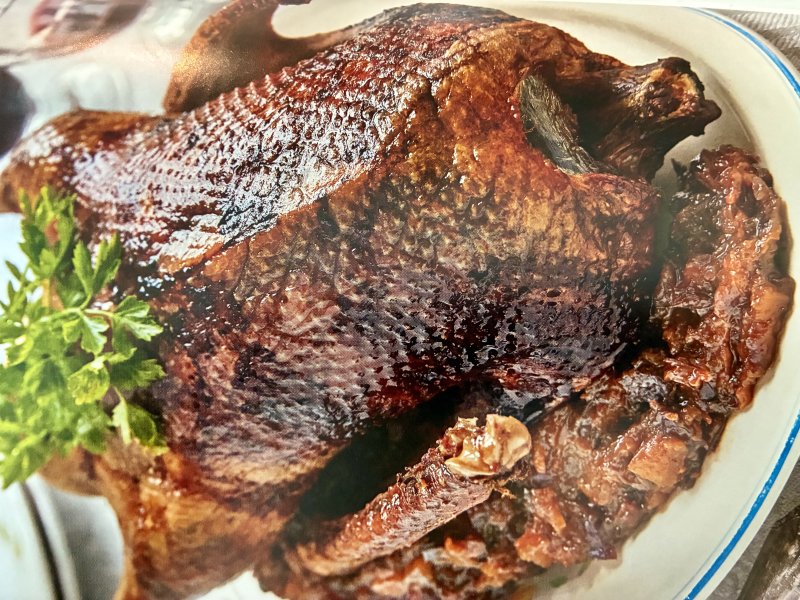
Another potential reason for less interest in preparing goose is that they are notoriously fatty birds and require careful attention to make sure they are cooked properly. It’s essential to prick or pierce the skin of the goose before roasting, using the tines of a fork or the sharp tip of a paring knife. Begin by roasting the goose at 425 F to render much of the fat; then cook at 350 F for another two hours to ensure tender meat and crispy skin.
The flavor of roast goose is rich, savory and gamey, with distinctive earthy notes. It has sometimes been described as a cross between beef and duck, with a dense, tender texture. Along with creating the desirable crispy skin, the high fat content bastes the dark meat, making it juicy and flavorful. Unlike other poultry, geese are big-boned, with less meat compared to other poultry.
Because of the fat content, it is not a good idea to fill the bird’s cavity with stuffing, as it will become quite greasy in texture. Instead, combine onion, apple and herbs to add interesting flavor notes. To reach the goal of a crispy-skinned goose, baste it at regular intervals with the fat in the pan, spooning out and saving some of the fat each time.
Just as you would while roasting a chicken or turkey, make a rich poultry stock by simmering the neck, heart, liver, giblets and wing tips in water enriched with herbs. This becomes the base to create tasty gravy or delicious soup. Let the goose rest before carving for at least 20 minutes after it reaches 150 F on your meat thermometer. It will come up to 160 F during the resting time and be perfect for carving.
Don’t try to carve the goose at the table, but use the kitchen to hide this messy business. Arrive with the perfectly carved meat on a platter, garnished with prune and apple compote. Serve with tasty gravy and some simple side dishes such as rice or mashed potatoes and a green vegetable.
Roast Goose with Prune Sauce*
The night before the meal, soak prunes in the cider. The day of, preheat oven to 425 F. Set goose in a roasting pan and prick the skin all over with a skewer or the tip of a paring knife. Season the goose liberally with salt and pepper. Roast for 30 minutes; then lower heat to 350 F and continue cooking another 2 1/2 hours. Every half-hour, draw the oven shelf forward and spoon out some of the fat in the pan, reserving it, and baste the goose with remaining fat in the pan. While the goose roasts, combine prunes and 5 oz of the soaking liquid in a saucepan. Simmer until soft, about 30 minutes. Cool and roughly chop, discarding any pits; set aside. Place 1 T goose fat in the same saucepan; sauté the chopped onion until softened. Add apples and cook until softened. Stir in honey and return prunes to pan; heat through. Season to taste with salt; set aside. When the thigh juices of the goose run clear when tested, remove bird from oven, tent with foil and allow to rest for 20 minutes. To serve, slice the goose and serve with prune sauce. Yield: 6 servings. *Adapted from Bruno’s Cookbook.
-

Send questions, comments and recipe ideas to Denise at deniseclemons1008@gmail.com.