












UD Lewes hosts severe weather awareness workshop
As recent weather has shown, the Cape Region is in a turbulent time of the year, ping-ponging between snow and summer-like temperatures. Those wild swings provide the fuel for severe weather.
The University of Delaware hosted an event at its Hugh R. Sharp campus in Lewes March 10 called Then and Now: Navigating Delaware’s Evolving Severe Weather Landscape.
The workshop was designed to get people and communities prepared for the severe weather season. It was held during national Severe Weather Awareness Week.
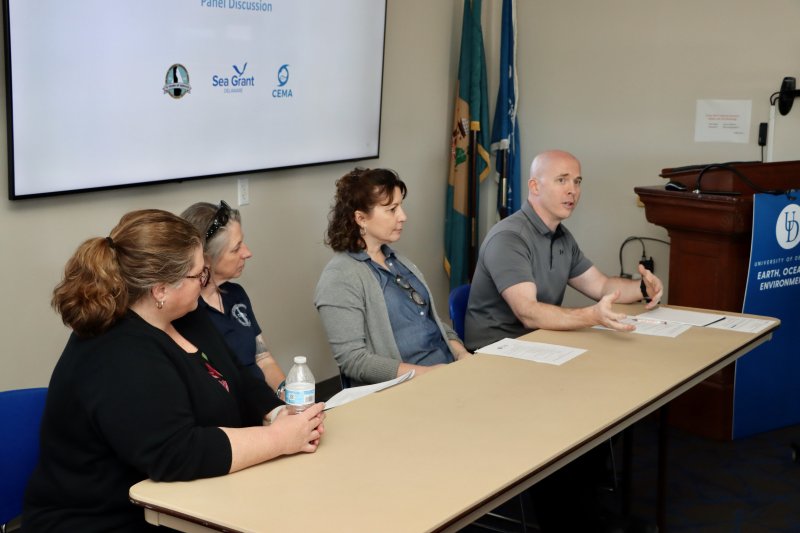
“People will say, ‘I survived the storm of ‘62 or Hurricane Sandy or the snowstorm of 2016.’ We hear that all the time, and that builds complacency in our population. The truth is no two storms are alike,” said Danielle Swallow, a coastal hazards expert with Delaware Sea Grant.
She said the goal is to have people make a disaster plan to be self-sufficient to better survive and recover more quickly from a storm.
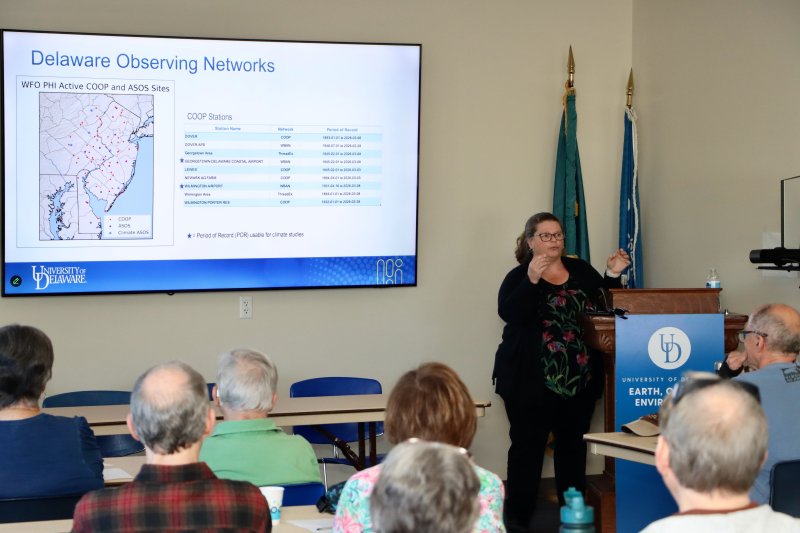
Tina Callahan, associate director of the Center for Environmental Monitoring and analysis, presented data that shows Delaware is getting warmer and wetter. Her organization is responsible for weather observations around the state. Callahan said the numbers often tell a different story from perceptions.
“Everybody talks about 2010, that’s the big year for [snowfall]. And then, everybody says, ‘It’s getting worse every year.’ But, if you look at the averages, there are years we get nothing and it brings the average way down,” Callahan said.
She also said, while there may be more snow events, it doesn’t translate into the most snow over a period of time.
Officials stressed the importance of individuals making a plan and, like storms, no two properties are the same.
“I’m on a big hill. I doubt the floods are going to reach me, so maybe it’s the tornado that is more of an immediate threat,” said Phil Cane, Delaware hazard mitigation officer. “Always know your exits, no matter what the emergency. Look around your house and get yourself prepared.”
Cane said it is critical for people to have go kits that include clothes, food, water, medicine, important documents and some form of identification that proves where you live so you can get back home. He said people should make a separate go kit for their pets.
Nikki Testa, senior administrator with the Delaware Emergency Management Agency, said there is a long list of items to consider when disaster strikes – electricity, roads, relocation and displacement are among them. But, she said, communication is the key.
“Do we have access to food, water and medical? What if we get separated from family and friends? How are we going to reunify?” Testa said.
She urged people to sign up for Delaware’s emergency notification system that includes wireless emergency alerts.
Linda Piffer lives in Frankford. She said she came to the workshop to hear about the impact of sea-level rise. But even though she lives inland, Piffer said she is taking resiliency seriously.
“We have an all-electric house, so we’re really at the mercy of the power grid. No power, and we don’t get water. So, I was able to find a hand pump that I can attach to my well head and I can get water manually. I’m pretty sure that would help my neighbors get water from my well, if we had to,” she said. “I don’t always expect things to go my way.”

Bill Shull has been covering Lewes for the Cape Gazette since 2023. He comes to the world of print journalism after 40 years in TV news. Bill has worked in his hometown of Philadelphia, as well as Atlanta and Washington, D.C. He came to Lewes in 2014 to help launch WRDE-TV. Bill served as WRDE’s news director for more than eight years, working in Lewes and Milton. He is a 1986 graduate of Penn State University. Bill is an avid aviation and wildlife photographer, and a big Penn State football, Eagles, Phillies and PGA Tour golf fan. Bill, his wife Jill and their rescue cat, Lucky, live in Rehoboth Beach.