













Coastal building task force discussing available options
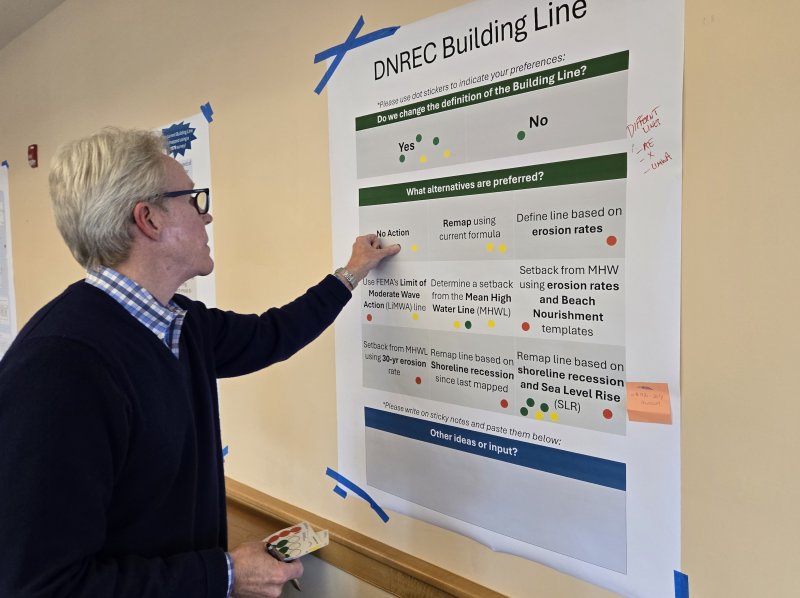
An advisory committee created to make recommendations on possible changes to the state’s coastal building line met for the second time April 22, and committee members began to discuss possible impacts to property owners and existing structures if the line is moved.
The committee is a collection of local municipal officials, construction industry representatives, environmental experts and representatives from different state agencies.
The first meeting, held virtually in February, was a listening session and introduction to the topic. It was facilitated by Delaware Department of Natural Resource and Environmental Control’s Shoreline and Waterway Management Section Administrator Josh Lippert and Jennifer Pongratz, an environmental scientist with DNREC's Coastal Construction Regulatory Program.
The state’s Beach Preservation Act has been in place since 1972, and while some of the act has been updated since, the line that regulates coastal building hasn’t been changed since a topographic survey was conducted in 1979.
The act defines the beach as the area from the Delaware-Maryland state line in Fenwick Island to the Old Marina Canal immediately north of Pickering Beach. The area extends from the mean high water line of the Atlantic Ocean and Delaware Bay landward 1,000 feet and seaward 2,500 feet. In general, the activities regulated are new construction, exterior renovations, excavation, hauling of sand, removal of sand, mechanical restoration of dunes, temporary structures, the installation of pipes or cables, septic systems and harmful dune doings.
Since the regulations went into place, there has been a total of 2,340 buildings constructed seaward and landward of the building line. A little less than 70% of the buildings – 1,601 – have been along the ocean beaches.
Pongratz began the second meeting April 22, by reviewing what other states along the Eastern Seaboard do. There are some approaches similar to Delaware, but there is not one specific approach and there’s often local control, she said.
Most of the discussion centered around a few main issues – how to best approach rebuilding existing structures if the line is moved farther landward and how to protect land values for property owners.
Brooks Cahall, administrator for DNREC’s Planning, Preservation and Development Section, said there aren’t many undeveloped lots along the coast, which means moving the building line would have substantial impact on existing properties and structures.
Carlton Savage, a local engineer, suggested the state look at grandfathering certain property rights for existing structures. Savage also suggested there could be two different dune building lines, one for the ocean and one for the bay.
Paul Townsend, a local Realtor, said he would like to see the beaches fortified with knees and groins along the coast. There should be an effort to fortify the beaches, he said.
Danielle Swallow, a coastal hazards specialist with Delaware Sea Grant, said most homebuyers seem to have an underappreciation of the risk associated with buying a coastal property. There are some inherent risks and there are going to be trade-offs, she said.
At the conclusion of the meeting, Lippert said the next step will be for DNREC to host two public information sessions – one virtual and one in person.
The virtual session is scheduled to take place at 6 p.m., Thursday, May 7. The in-person session is scheduled to take place at 10 a.m., Saturday, May 9, in Room 104 of the University of Delaware’s Cannon Lab in Lewes.
Lippert also provided a timeline for implementation of potential changes. He said he expects the task force to meet every other month for the rest of the year. From there, he said, it will likely take another year to work through the legislative and regulatory process before any new changes are formally adopted.
Pongratz said this won’t be the last chance the public will have to comment on the subject. If, in the future, there’s a proposed change to the line, there will be a public hearing, she said.

Chris Flood has been working for the Cape Gazette since early 2014. He currently covers Rehoboth Beach and Henlopen Acres, but has also covered Dewey Beach and the state government. He covers environmental stories, business stories and random stories on subjects he finds interesting, and he also writes a column called Choppin’ Wood that runs every other week. He’s a graduate of the University of Maine and the Landing School of Boat Building & Design.