













A whole lotta gypsum for greens, and other fun water issues
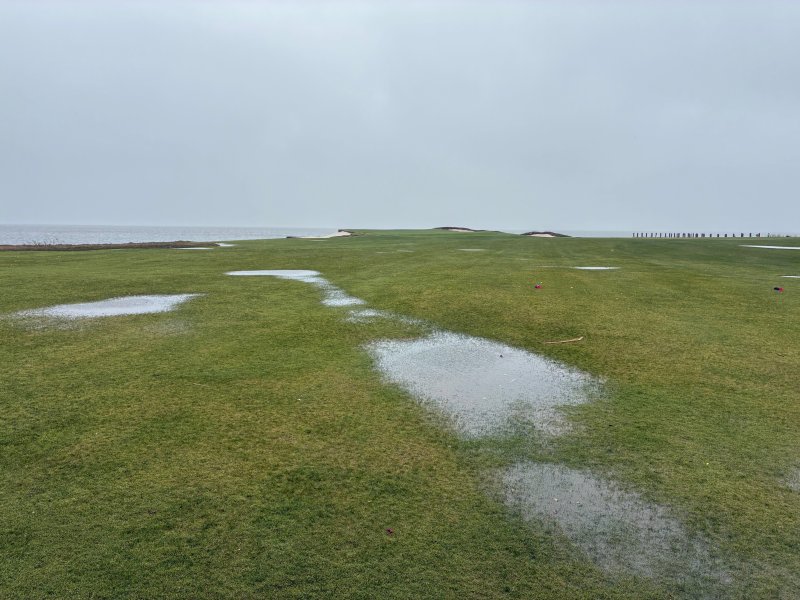
The Atlantic Ocean and Delaware’s brackish Inland Bays are among the best things to experience about life in the Cape Region.
When saltwater floods your golf course during a nor’easter or hurricane, however, you will think very differently.
Saltwater does not treat golf turf kindly. For local course superintendents, it is one of several water-related challenges they face.
Rehoboth Beach Country Club’s low elevation creates larger water-related risks than the more upland courses experience. Handling the occasional flood on that property requires special treatment, as recently noted by course superintendent Alan Fitzgerald.
“When we get the major salt intrusion, when the tide gates aren’t working and the water comes over the road, we dump gypsum,” he said. “Gypsum neutralizes the salt, releases it and breaks it up. Then the irrigation system moves it out to the drain lines.”
Attacking the saltwater problem also requires patience.
“We have to wait until it dries out to put out the gypsum, so the saltwater is gone completely. We also have to make sure the water table is low enough, so that when we irrigate, we can push the water out through the drains,” Fitzgerald said.
With the property so low, however, there’s not much positive drainage, he said.
“We use gypsum everywhere, especially after a big salt intrusion. We alternate with a liquid solution, not quite the same, when it’s not as bad, just to take a little off,” Fitzgerald said. “We found we needed to stick to a regular program [of gypsum treatment].”
On rare occasions, the saltwater comes from below and not from flooding. Fitzgerald said, “We had issues last summer with irrigation water with a little salt intrusion. [It was] reacting differently with the soil. We weren’t expecting it. The greens didn’t look so good, but they putted fantastic. After we did some soil testing, some water testing, we were able to figure out what we needed to do.”
Double whammies from tropical storms and nor’easters remain the primary causes of water issues.
“Erin hit in September and came over the road and flooded everything,” Fitzgerald said. “We seeded, did some gypsum, cut some bent grass, started growing it back. The Bermuda grass took a hit. It started coming back and got hit two weeks later with a nor’easter. Same thing. That’s the big downfall of being 2 to 3 feet above sea level,” he said.
Those October rains created issues for the Lady Blue Hen Invitational women’s golf tournament, held Oct. 17-19. Fortunately, most of the course dried out enough to keep the event on schedule. However, the wet conditions forced the tournament to use the lift, clean and place option for the 16th and 18th fairways.
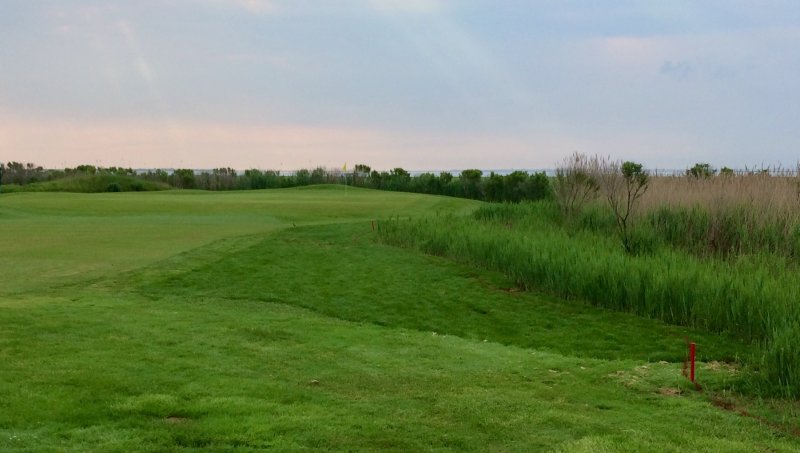
The Bay Course at Seaview Resort in Atlantic City, N.J., faces much the same problem on its easternmost holes, which are tucked into the salt marshes bordering Reeds Bay. Course Superintendent Bill Leedom discussed this management issue last June.
“Gypsum I put out fairly regularly. I can use spray gypsum to relieve some of the salts, but it doesn’t give me calcium. So I supplement when I can with a shot of gypsum when available,” he said.
Leedom said, “It’s a much harsher salt air environment. Gypsum neutralizes the salts and lets the salts leach out. [Hole] two out on the bay, I was told every year they sod [in the areas around the green]. When I got here, just my observation, high tide or full moon all that water floods in, so we put in drains to divert water. That spot is below sea level. I can’t drain it anywhere, so every month or so I apply gypsum, and it works.”
Tightly mown greens always need water, however, but only if it is not full of salt. Leedom also explained his irrigation improvements on the Bay Course.
“Almost every [water spray] head we had out here was full circle. There are areas where the heads are watering the rough for half the spread, and the other half is watering the native [grasses beyond the rough]. You don’t need that,” he said.
“What we did first was do all the greens,” he said. “Because the full circle [spray heads] would water the green and spin around. Now I’m watering what I don’t want to. We want to be stewards, use as little water as possible, and put it exactly where I want it.”
An irrigation head that only covers a half-circle can be run for half the time, cutting the water use in half and only covering what is needed. As Leedom put it, “Instead of running a four-minute cycle, the green gets two minutes of that.”
The same targeted approach works throughout the course. “So now we have all the greens part-circled. We’ve got about halfway through the tees. I did as much as I could with what I had,” he said.
Water requirements are only one part of the greens management puzzle. The next part of this series will cover aeration, green speeds for putting and other fun stuff.
Editor’s note: This is the third part of a continuing series on course maintenance.
-

Fritz Schranck has been writing about the Cape Region's golf community since 1999. Snippets, stories and anecdotes from his columns are included in his new book, "Hole By Hole: Golf Stories from Delaware's Cape Region and Beyond," which is available at the Cape Gazette offices, Browseabout Books in Rehoboth Beach, Biblion Books in Lewes, and local golf courses. His columns and book reviews are available at HoleByHole.com.
Contact Fritz by emailing fschranck@holebyhole.com.