













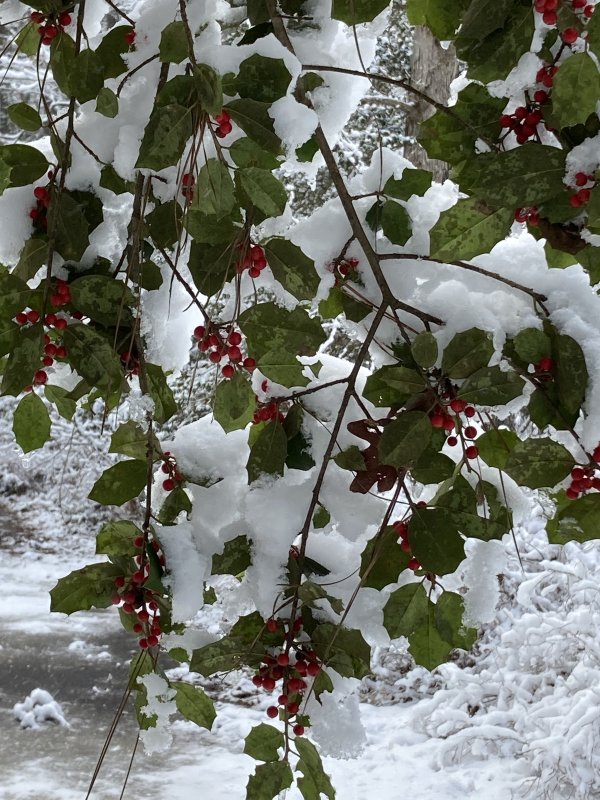
In the first few days of 2026, our temperatures hovered well below freezing. Enjoying a schedule-free holiday offers choices. I might burrow under an extra quilt and contemplate tropical adventures while drinking hot coffee. Or – embrace the chill. Put on a sweater or two, seriously think about winter survival skills, add more clothing and pack a snack!
For those walking the trails across our Cape Region, the brilliant crimson-red berries of the native American holly (Ilex opaca) highlight the winter landscape. It is like eye candy! The year-round green leaves provide the perfect backdrop for the stand-out fruit. If you are looking for winter wildlife activity, seek out the hollies. American robins, forsaking frozen ground, congregate with cedar waxwings, northern flickers, gray catbirds and eastern bluebirds to feast on berries when insects are scarce.
Listen for the shrill calls of one, two or three blue jays from the treetops. Sudden silence. A camouflaged Cooper’s hawk is perching in the tallest tulip poplar above the holly. The clusters of razor-sharp pointed holly leaves offer songbirds and small mammals a protective cover from predators. Wild turkeys may be found foraging for berries near the base of the pale-gray trunk, while hidden under the leaf litter, a caterpillar overwinters snug inside its chrysalis. It turns out that the American holly is a host plant for a woodland butterfly called Henry’s elfin (Callophrys henrici). In early spring, the next generation of these caterpillars will eat the holly flowers. And I thought caterpillars only ate leaves!
The American holly is native to the East Coast and thrives in the damp, sandy and acidic soils of Sussex County. In sunny locations, this slow-growing broadleaf evergreen may top 30 feet. With an iconic triangular shape, its bottom branches may extend 10 to 20 feet wide. The narrow leaves are scalloped with sharp spines. Leaves remain on the tree for three years before dropping. In many wooded areas, it grows as an understory shrub in partial shade.
Plants of the holly species are dioecious; each plant is male or female. Insect pollinators transfer the pollen produced in the male flower to the female flower. After pollination, the female plant will produce glossy scarlet berries. The round berries, also called drupes, are toxic to humans and pets. Holly flowers are an important early spring source of nectar and pollen protein for native bees.
Some 100 years ago, holly was big business in southern Delaware! Farm families collected boughs and created thousands of wreaths for seasonal income. According to Delaware Public Archives, the Pennsylvania Railroad ran a special train service in November and December called the Holly Express. Yuletide wreaths were collected in Selbyville, Millsboro, Georgetown, Milton and Bridgeville, and shipped to Philadelphia, New York City and Chicago. Records say that 2 million wreaths were made in 1934, bringing the state $188,000. By 1938, Delmarva holly value approached $1 million. In 1940, a family that made 10,000 wreaths a season could earn up to $500. By the mid-1950s, the market demand for fresh holly greens was replaced by artificial wreaths.
The American holly became the Delaware state tree in 1939. Today, we can travel the Sussex County Holly Trail from Milton, the Land of Holly, to coniferous forests, the Inland Bays and west to freshwater bogs. At the McCabe Preserve, American hollies are tucked among American beech (Fagus grandifolia) and tulip poplar (Liriodendron tulipifera) trees on a winding trail that gradually slopes toward the Broadkill River. Here, the holly has roots in the wetlands, perhaps sheltering a pair of wood ducks.
Under the loblolly pines (Pinus taeda), hollies share the understory with witch hazel (Hamamelis virginiana) and a hermit thrush, a secretive winter resident. At James Farm Ecological Preserve, a grove of hollies dominates the maritime forest along the Indian River Bay. Imagine a summer day, when the air is cooler in the grove, a relief from the wind and sun. The waxy cuticle on the holly leaves acts as a barrier against salt spray and dehydration. Hollies mix with mountain laurel (Kalmia latifolia) at Chapel Branch Nature Preserve to stabilize ancient sand dunes along a pristine Nanticoke River tributary.
Along with the American holly, many native plants support wildlife during the coldest months and add interest to the landscape – more eye candy! Many berries still clinging to the branch may be more palatable after a series of freeze-thaw cycles; they include red chokeberry (Aronia arbutifolia), cockspur hawthorn (Crataegus crus-galli) and winterberry (Ilex verticillata). Enjoy a walk on the wild side this quiet season.
-

Wild Cape is a monthly column by Alice Mohrman dedicated to the rich and diverse ecosystem of Delaware’s Cape Region. It is our hope to bring readers closer to the natural world by exploring fascinating creatures, plants and habitats that thrive in one of the most ecologically significant areas of the Mid-Atlantic.