












State agencies provide information on Cool Spring Crossing project
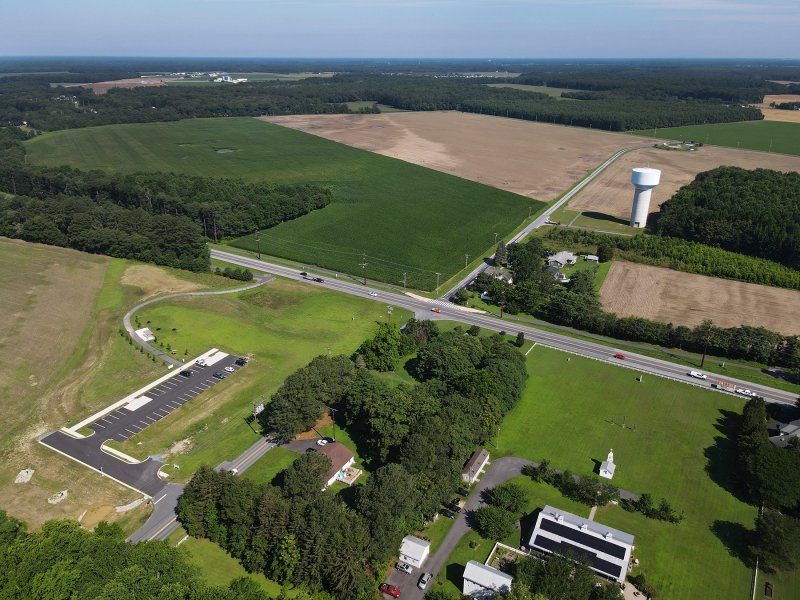
Two state agencies have responded to Sussex County Council’s request for additional information about traffic and environmental issues concerning the proposed Cool Spring Crossing residential and commercial development.
The county wants to know how road improvements required by the Delaware Department of Transportation will parallel the progress of the development of the 1,922 houses and 450,975 square feet of commercial space.
The project is one of the largest in the county’s history and would follow the Northstar development planned a short distance to the east on Route 9 that includes 852 homes and 96,118 square feet of commercial space. Northstar was approved by votes held in late 2024 and this year.
The county has asked the state about the effect of traffic generation for both projects and inquired about coordinating infrastructure improvements with the build-out of the project.
Jeffrey VanHorn, who recently became the director of the new DelDOT Division of Economic Development Coordination, responded to the county’s questions in a letter dated Dec. 3.
Key among the points, he noted the Northstar traffic generation estimates were not included in the Cool Spring Crossing traffic review because Northstar was not an approved project when that study was conducted.
VanHorn also told the county where to find answers to some of its questions in previously filed documents.
The timing of the 22 infrastructure improvements the developer will fund will be determined as the project progresses, in some cases, and for others it is spelled out. He referred the county to a general timeline included in the final TIS review letter.
Asked about the effect on the already congested intersection of Routes 9 and 5, updated projects anticipate significant bottleneck there by 2050 during any peak traffic at any time of the year, VanHorn noted.
“Throughout the monitoring, the intersection of US9 and SR5 has consistently been highlighted as the most critical, highest delay location, both today and in the 2050 forecast year,” he wrote.
At times, there will be more than 100 seconds of average vehicle delay by 2050, even if signals are optimized, he noted. During peak traffic, there will be significant queuing of vehicles, and it will take multiple traffic signal cycles to get through the intersection.
The state Coastal Corridors Study is looking at road-widening projects and possible construction of connector roads to divert traffic around trouble spots, VanHorn said. Widening the intersection itself would be a difficult project and one the state has not committed to undertake.
The county also asked the Delaware Department of Natural Resources and Environmental Control about its concerns, particularly the loss of 104 acres of woods.
In its letter requesting information from DNREC, the county noted the agency had raised issues during the state Preliminary Land Use Service report.
"Forests contained within the entire watershed are integral to the health of aquatic habitats due to their ability to capture, filter and retain water,” the county quoted DNREC as writing. “Forest removal results in increased nutrients and pollutants that reach streams from stormwater runoff when natural vegetation is replaced with lawns and paved areas."
In a response, Beth Krumrine, principal planner for the Climate & Sustainability Section of DNREC Division of Climate, Coastal and Energy, noted the agency has no authority to restrict tree removal from the project site. However, it previously recommended best practices to protect forested land.
The county also asked if the agency is satisfied with the developer’s contention that the project will not harm the nearby Broadkill River Natural Area because the site is separated from the area by Hudson Road.
“The Broadkill River Natural Area is a substantial reach of contiguous forest habitat that extends to the northwest … allowing wildlife to migrate and move from one location to another,” Krumrine wrote. “Habitat fragmentation from development continues to put pressure on animals searching for food and breeding habitat.”
Krumrine noted loss of large, contiguous forested areas reduces wildlife habitats, especially for migratory birds that need interior forests for food and breeding. Such large, contiguous tracts of land are needed across Delaware because of its position within the Atlantic Flyway.
“The proposed development would replace natural resources – trees and plants – which help absorb water and pollutants,” the county noted. “Replacing these natural resources with impermeable surfaces could increase the likelihood of flooding and contamination from runoff of fertilizers and nutrients used for lawns and gardens, as well as oil and gasoline leaks from cars.”
Asked what could be done to help alleviate those concerns, Krumrine noted the project must meet state stormwater regulations during and after construction.
While not required by law, she also suggested precautions. These include preserving as much forest land as possible, planting native trees and shrubs in yards and along streets, limiting impervious surfaces, minimizing areas of turf grasses and including pollinator gardens, and educating residents about benefits of native plantings, caring for native plants, applying home chemicals and fertilizers properly, and soil testing.
The agency responses will be announced at a future council meeting. The next meeting is set for Tuesday, Dec. 9. The public and applicant will have two weeks from that meeting to reply to the agencies’ comments, which will likely push the county’s consideration of the project applications into early 2026.

Kevin Conlon came to the Cape Gazette with nearly 40 years of newspaper experience since graduating from St. Bonaventure University in New York with a bachelor's degree in mass communication. He reports on Sussex County government and other assignments as needed.
His career spans working as a reporter and editor at daily newspapers in upstate New York, including The Daily Gazette in Schenectady. He comes to the Cape Gazette from the Cortland Standard, where he was an editor for more than 25 years, and in recent years also contributed as a columnist and opinion page writer. He and his staff won regional and state writing awards.
Conlon was relocating to Lewes when he came across an advertisement for a reporter job at the Cape Gazette, and the decision to pursue it paid off. His new position gives him an opportunity to stay in a career that he loves, covering local news for an independently owned newspaper.
Conlon is the father of seven children and grandfather to two young boys. In his spare time, he trains for and competes in triathlons and other races. Now settling into the Cape Region, he is searching out hilly trails and roads with wide shoulders. He is a fan of St. Bonaventure sports, especially rugby and basketball, as well as following the Mets, Steelers and Celtics.