












State weighs changes to coastal building line
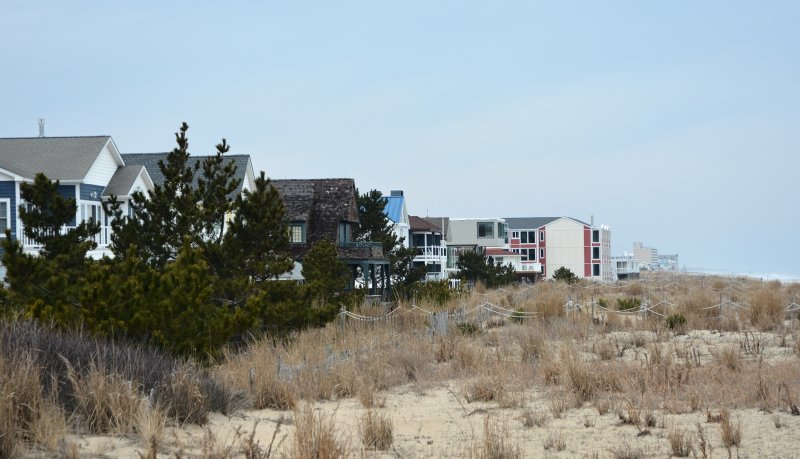
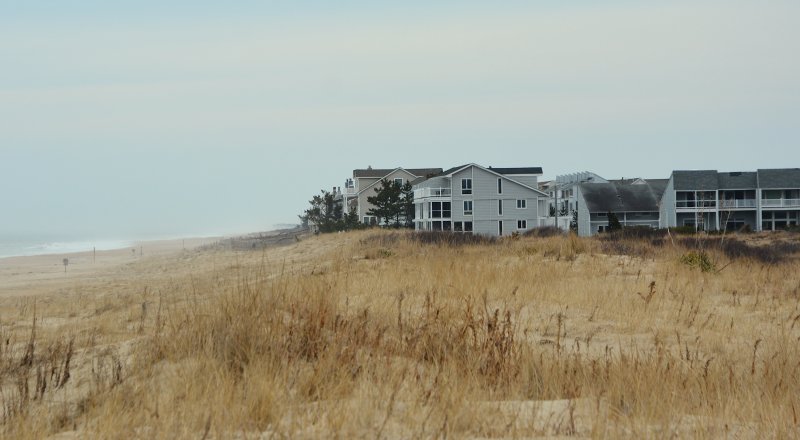

The state’s Beach Preservation Act has been in place since 1972, and while some of the act has been updated since, the line that regulates coastal building hasn’t been changed since a topographic survey was conducted in 1979. A new committee formed by the Delaware Department of Natural Resources and Environmental Control has been tasked with updating the building line.
The committee – a collection of local municipal officials, construction industry representatives, environmental experts and representatives from different state agencies – held its first meeting Feb. 17. It was virtual.
Josh Lippert, DNREC Shoreline and Waterway Management Section administrator, said the goal of the committee is to redefine and remap the coastal building line to reflect the current shape. This is being done to help strengthen the state’s beaches and dunes, to clarify code wording and to help with climate resilience, he said.
There wasn’t much discussion. Instead, Jennifer Pongratz, an environmental scientist with DNREC's Coastal Construction Regulatory Program, set the stage for future discussion by reviewing how the building line was established.
Pongratz said the creation of the Beach Preservation Act was spurred in response to the Storm of ‘62 that wreaked havoc along Delaware’s coast. That storm really showed that beaches are vulnerable, she said.
It took about a decade to establish the act, and in 1974, the building line was first defined as the landward toe of the dune or easterly edge of the road, said Pongratz. The act was updated again in 1981, which included a building line that used topography from a survey in 1979, she said.
The act defines the beach as the area from the Delaware/Maryland state line in Fenwick Island to the Old Marina Canal immediately north of Pickering Beach. The area extends from the mean high water line of the Atlantic Ocean and Delaware Bay landward 1,000 feet and seaward 2,500 feet. In general, the activities regulated are new construction, exterior renovations, excavation, hauling of sand, removal of sand, mechanical restoration of dunes, temporary structures, the installation of pipes or cables, septic systems and harmful dune doings.
The act does not regulate interior work to an existing structure, said Pongratz.
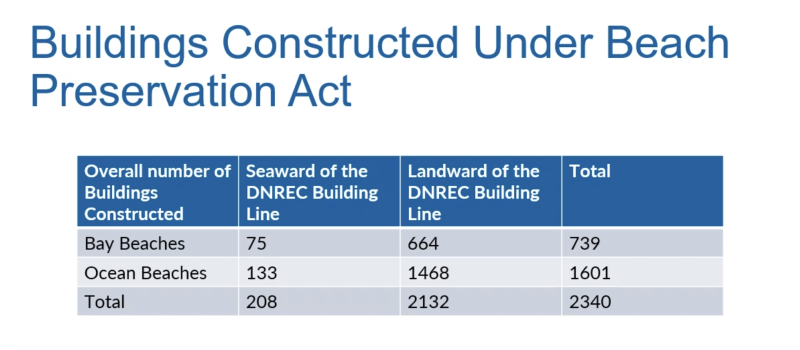
Since the regulations went into place, Pongratz said, there has been a total of 2,340 buildings constructed seaward and landward of the building line. A little less than 70% of the buildings – 1,601 – have been along the ocean beaches.
Pongratz said the state has been participating in periodic beach replenishment, which strengthens the resiliency of the dunes, but hides natural erosion. She then presented tables showing a range of annual erosion rates for bay and ocean coast communities.
For example, along the bay, Pickering Beach is experiencing roughly 5 feet of erosion per year, while Prime Hook Beach is experiencing less than 1 foot. Along the ocean, Henlopen Acres and North Shores are experiencing a little more than 4 feet of erosion per year, while Bethany Beach is seeing a little less than 2.5 feet.
There aren’t any beaches growing, said Pongratz, who then reviewed the process for approving projects that fall within the regulated area.
For construction projects landward of the building line, applicants need a letter of approval and to pay a $500 application fee. Some examples include cantilevered decks, dune crossovers and temporary structures. There is no public process for a letter of approval.
For construction projects seaward of the building line, there’s a $4,500 application fee, and a public process that includes a public notice and a 15-day comment period.
In commercial areas like Rehoboth Beach and Bethany Beach, where there are boardwalks and the dune is not natural, the building line is the westerly edge of the boardwalk, said Pongratz.
Looking forward, there's a proposed timeline that would have changes to the building line approved by October 2027, with an effective beginning date a couple of months later.
The committee’s next meeting has been tentatively set for Tuesday, April 21. Pongratz said she would like it to be in person, recommending the DNREC field office in Lewes off Pilottown Road.
Editor’s note: This story has been updated with the correct spelling of Jennifer Pongratz’s last name.

Chris Flood has been working for the Cape Gazette since early 2014. He currently covers Rehoboth Beach and Henlopen Acres, but has also covered Dewey Beach and the state government. He covers environmental stories, business stories and random stories on subjects he finds interesting, and he also writes a column called Choppin’ Wood that runs every other week. He’s a graduate of the University of Maine and the Landing School of Boat Building & Design.