













Story Location:
2301 KENTMERE PKWY
WILMINGTON, DE 19806
United States
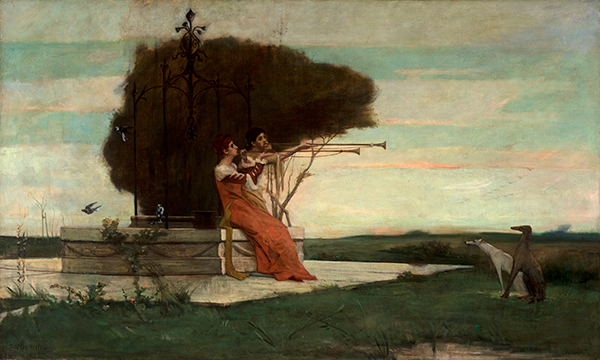
Did you ever wonder what this painting is about? Me too, so I went looking to see what viewers thought about it around the time it was made. This is often an effective strategy. Narrative elements and artistic choices that confuse us might have been perfectly comprehensible 146 years ago. Imagine my delight when I found a lengthy review of Morning published in the Boston Evening Transcript on February 14, 1880! Well, the author doesn’t clear up my questions about Dewing’s canvas, but the confusion and annoyance are so entertaining—and the screed so clearly penned in front of DelArt’s picture—that I thought I’d share. It’s akin to one of those rambling, one-star reviews we encounter online today. As academics like to say, this is worth quoting at length:
“Mr. Thomas Dewing’s latest picture, now on exhibition at Doll & Richards’s [a gallery in Boston], surpasses all his previous efforts in sentimental queerness and puzzling mysticism. It is quite a large canvas; in the centre of it, upon a square platform of finished stone surrounding what seems to be a well, with its ornamental iron framework to support the bucket and its chain, sit two maidens, with extremely long and thin brass horns glued to their lips. The like of these musical instruments was never seen on earth except in the opera of ‘Aida.’ Leaning back in nonchalant or dreaming attitude, the maidens are piping through these mystic trumpets with evidently piercing effect, for two slender Italian greyhounds seated some distance away from them in the field are plainly howling, the one with head thrown back and mouth open, the other with his ears desperately lowered, as if to get them between his legs. But this is not the only effect of the piping. Far in the distant sky, two long lines of birds converging to a V at the horizon have apparently been startled and distressed into taking their flight from the neighborhood of that well and its mystic maidens with elongated cornets. The spaciousness of radiant firmament, streaked with two long, thin (everything is dual, long and thin) parallel clouds, light and rosy, and the bright purity of the atmosphere breathing of morning light and freshness, are the redeeming points of the picture, which is entitled ‘Morning.’”
Heather Campbell Coyle
Curator of American Art