












Allen Chorman: Flying with confidence and common sense
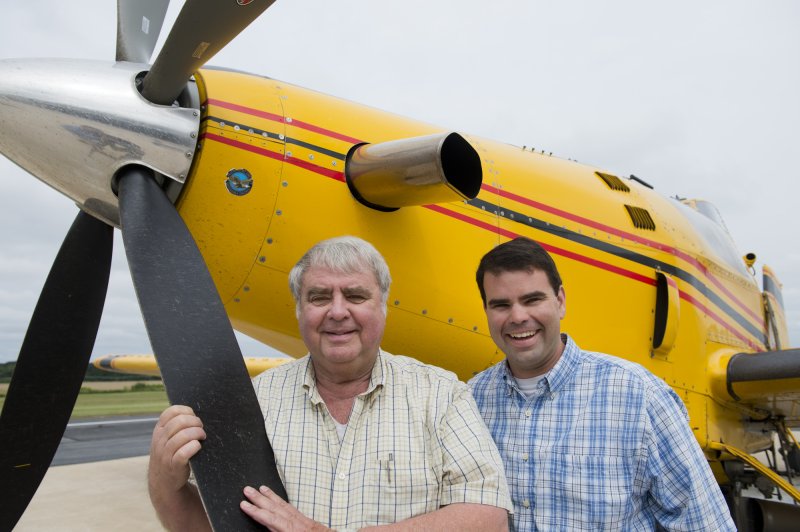
Allen Chorman relaxes in the easy chair of his Overbrook Shores home. He’s almost as comfortable there as he is when he sits in the pilot’s seat of one of his many mosquito- and crop-spraying airplanes.
But he has sat in those pilot seats far more than he has sat in his easy chair. Allen’s a worker. Doesn’t believe in vacations. Flying is his life, and he loves every minute of it.
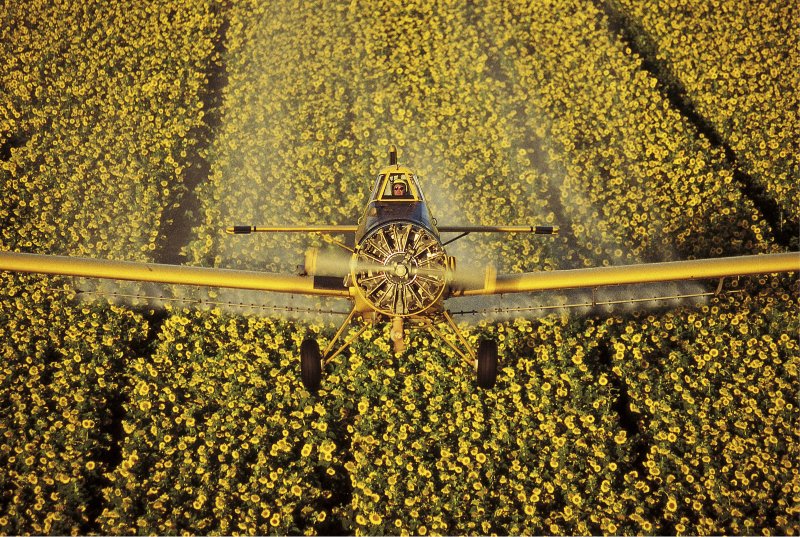
Chorman Aerial Spraying, now operated by his son, Jeff, is known all over the Delmarva Peninsula and across Delaware Bay into New Jersey.
Chorman grew up on Route 1 near Red Mill Pond, the eldest son of David and Eldora Chorman. He always said growing up they had an Ozzie and Harriett family, never having money, but with plenty of love for each other. Seven of them grew up elbow to shoulder in a five-room house.
Now Allen and his wife, Mary Ann, live at the other end of the pond.
When he was a kid, watching Joe Hudson and Buddy Lewis flying overhead in Hudson’s distinctive yellow Stearman biplanes, Allen and his brother would run around their yard mouthing the noise of airplane engines. “I was Joe, he was Buddy. We carried yellow squashes in our hands, the kind with curlicues on the end. They were our planes. The curlicue was the plane’s tail. We would spray the whole yard.”
They mimicked spraying planes flying low over the marshes and fields of Delaware, swooping quickly upward over tree lines and utility wires, banking sharply to make return runs.
No wonder that memory is embedded so deeply in Allen’s brain. Swapping the squashes for real planes in the years ahead, he repeated those maneuvers thousands of times while coincidentally entertaining hundreds of thousands of gaping motorists. They would pull off on shoulders of main and back-country roads to watch what appeared to be nothing less than aerial acrobatics.
“I know how to fly an airplane, really know how to fly.”
Chorman says that with the same self-assurance and spirit of conviction he has known his entire life. “There’s a big difference between really flying an airplane and just going from point A to point B.”
Seeing crop dusters flying at tree-top level and below in tight places is all the confirmation needed.
Allen credits legendary pilot, farmer and entrepreneur Joe Hudson for all of his flying ability and success. “He was a second father to me. I wouldn’t be where I am today without Joe.”
Allen started working for Hudson at 10 years old. He believed in working hard, never taking a real vacation in his life. The way he was brought up instilled that work ethic in him, and he lived it. “I drove tractors for Joe. Full time, day and night during the summer.”
“During World War II, my father was a tank mechanic,” said Allen. “When he came home, he went to work for Henlopen Motor Company in Lewes and worked on Joe’s planes at night. The tank engines were the same as the engines in Joe’s Stearmans.”
Allen would go to Rehoboth Airport with his father when he went to work on the planes. “I’d sit in the planes and pretend I was flying. My father would be yelling at me: ‘Don’t touch nothing, don’t move nothing!’
“By the time I was 15 or 16, I’d get up at 4:30 or 5 and ride my bicycle to the airport hoping Joe would take me with him. Sometimes if he didn’t have a real heavy load, he’d take me. When he couldn’t, I would just lay there on the grass at the airport after he took off and cry until he came back, it upset me so bad.”
When he wasn’t flying with Joe, Allen would clean and scrub the planes. “Joe appreciated the job I did and would say so. That made me feel good."
Allen remembers his first flight with Joe. “It was one afternoon and he said, ‘Allen, you want to go with me tonight?’ He said he and Buddy were going to fly from an airstrip in Dover and do a section of the state up to Cheswold. He put me in the passenger seat, and I looked at him like he was God. You learn a lot by sitting in that passenger seat.”
By the time he was 16, Allen had made his first solo flight. By 17, he had his first pilot’s license and at 18 had his commercial license. He graduated Lewes High School in 1965 and started flying for Joe immediately.
He served as Joe’s chief pilot for 20 years until 1987, when he bought Joe’s business.
In the ensuing years, under Allen’s ownership and then with his son, Jeff, whom he taught to fly, the business continued to grow. At last count, the business flies 25 airplanes, two helicopters and, most recently, drones.
In the early days at Rehoboth Airport, Allen flew charter trips all over the Mid-Atlantic states while spraying crops and mosquitoes in the summer. He sprayed for Delaware Mosquito Control from 1966 until 2010.
“He often says there is nothing like spraying a town with a Twin Beech,” said Jeff. “And he is right, there is nothing that can compare to it. I am sure many Delawareans have seen him fly in his yellow Thrush or twin-engine Twin Beech during his career. He has a love for agriculture and took great pride in providing aerial spraying services to the farmers in Delaware his whole life. Many farmers he sprayed for include three generations of family.”
Crop dusting was his life, and Allen took it very seriously. He had more than 31,000 accident-free hours. But that doesn’t mean he didn’t have close calls.
Allen experienced 12 complete shutdowns over his flying career. “The engines quit running, which means I had to land the planes without power, wherever I could. But I could land them; again, because I knew how to fly an airplane, and you have to know how to do that to save your life. I was never injured and never left a scratch on a plane.
“The first time was right near my house on Red Mill Pond on Ransford Bryan’s farm. The engine quit on me, over top the trees and just over the pond. I made it past the front yard, just over the wires. The soybeans were so high they kind of arrested me as I came in, so I made it out of that one.
“Then there was the time I had to land on Ernie Hopkins’ farm. He came out to me where I landed and said: ‘Boy, come on in here and get some breakfast. Bacon, eggs and toast.’ I called Joe and he asked me where I was. I said I was at Ernie Hopkins’ place and he wanted to know how I got there. ‘The engine quit and I landed here,’ I said. Then he came out and we got her going again.
“They were just old planes then, engines worn out. But I was pretty good at what I did. It’s my life.”
When his landing gear gave out one day on a run between Rehoboth and Bethany, Allen determined the problem was only on one side. So he finished his run and then headed to Georgetown to try to bring the plane down with only one side of the gear down.
“I finished the run to reduce my weight and then flew around the airport for a while to get rid of as much fuel as I could before landing. A National Guard guy was there with a helicopter and radioed me, asking me what hospital I wanted him to take me to after I crashed. He figured I’d be injured of course.
“But I was cocky back then, and I told him to shut her down, I’d be OK. So I finessed her, and managed to keep her pretty level until I slowed her as much as I could, and put her down in the grass between runways. She spun around when we finally touched down on the one side, but we came out better than could be expected.”
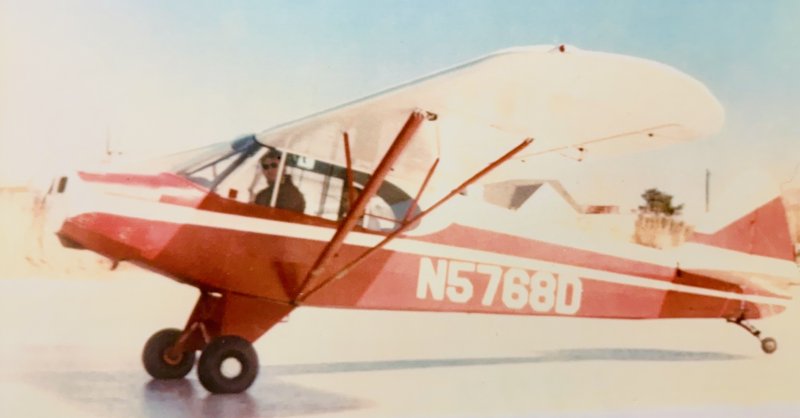
One of his most memorable landings came in January 1977, when several single-digit days froze Rehoboth Bay solid. “I was at a snack bar at Old Landing when some of the boys were talking about Billy Marshall driving his Cadillac on the bay. I thought about the Cub I had only weighing 1,200 pounds, so I figured if he could drive his Cadillac out there, I could land a plane on the ice. So I did. Worked out just fine.”
Allen married Mary Ann Wagamon from Georgetown in 1974. She enjoyed a long career as an intensive care nurse and supervisor at Milford Memorial Hospital, but never had to care for her husband for work-related injuries.
She said she has never worried about the hazardous work done by her husband, and now her son. “I’ve always had faith in their abilities.”
“He is direct and always would say what was on his mind,” said Jeff. “You always knew where you stood. He didn’t have any hobbies, but in later years he has enjoyed buying and restoring Case tractors. I will say he has an extreme amount of common sense and is truly a self-made man.”