












A deeper dive into speed camera data
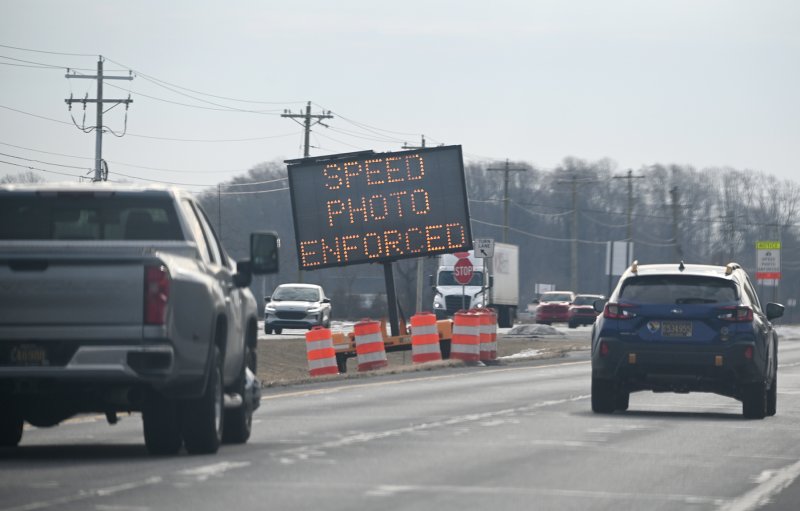
The speed camera along Route 1 at the north end of the Minos Conaway Road work zone near Lewes has been a hot topic of conversation since it went online in November.
Following a first-month report that claimed the Delaware Department of Transportation issued more than 25,000 tickets, the Cape Gazette submitted a Freedom of Information Act request for more detailed data.
Shanita Hall, a paralegal in DelDOT’s legal department, provided responses to the information request Feb. 9. She said much of the information sought is not data DelDOT is statutorily required to track. She said FOIA does not require an agency to create a document or program that does not already exist. She provided a copy of the Electronic Speed Safety Program’s annual report from December 2025, which includes data mandated by the legislature to evaluate program effectiveness.
Although DelDOT does not track much of the requested information, the agency did produce a document with the number of events recorded between Nov. 11 and Dec. 13. Hall said it was created to address the Cape Gazette’s inquiry, and the agency does not intend to continue updating it in the future.
Every event captured is reviewed by a trained, experienced technician, each of whom is a retired law enforcement officer. Those technicians determine if a violation should be issued. The number of actual issued violations is less than the total number of events.
Between Nov. 11 and Dec. 13, the camera captured 21,579 events. That number differs from what DelDOT reported in December, which was 24,749 recorded violations during the first month of operation.
Of more than 21,000 events, 88% of drivers were traveling between 61 and 67 mph. Although the speed limit in the work zone is 50 mph, citations are not issued unless a vehicle is photographed exceeding 60 mph. The camera captured 11 vehicles exceeding 90 mph, including one traveling 103 mph.
On average, 4% of the more than 15,000 vehicles that traveled past the camera on a daily basis were exceeding 60 mph, with the highest average number of events having occurred between 8 a.m. and 4 p.m. The highest number of events occurred in the hours of 12 p.m. and 3 p.m. The majority of drivers exceeding 60 mph (77%) were in the left lane. The average speed in the area of the camera was 52.1 mph during the monthlong window.
The date with the most events recorded was Thanksgiving, Nov. 27, when more than 1,200 vehicles purportedly exceeded 60 mph. The second most was Black Friday, Nov. 28, with more than 1,000.
It appears the majority of violations have been sent to vehicle owners outside Delaware. Between Nov. 11 and Dec. 31, 10,993 of the 17,385 violations mailed were to owners of vehicles registered outside Delaware.
As of Jan. 30, 7,538 of the more than 17,000 violations had been paid, resulting in $1.185 million in fines collected. If a violation is unpaid after the due date, it becomes delinquent after 120 days. If the owner of an in-state vehicle ignores the fine or fails to pay the citation within 120 days, the Division of Motor Vehicles puts a hold on vehicle registration renewals.
Since the ESSP began issuing tickets in July 2024 on I-95, nearly 29,000 vehicles have received more than one violation. Specifically for the Route 1 camera, the highest number of violations issued to a single registered vehicle is 18. Additionally, there are about 50 other vehicles that have received seven or more violations. Based on DelDOT’s fine matrix, the combined fine total for the driver with 18 violations would be at least $2,940 if they were traveling just 1 mph over the 60 mph threshold.
“For perspective, on I-95, there are registered owners whose vehicle has accrued 86, 79 and 52 violations, respectively, albeit during a longer enforcement period,” Hall said.
Two I-95 speed cameras were located near the Route 896 interchange, but one was removed in September 2025. The highest number of violations in a single month at those cameras was 27,331 in April 2025. Hall again noted violations are not the same as the number of events recorded.
“It is important to remember that DelDOT has been adding ESSP technicians throughout this program period, increasing from one to three technicians in early 2025,” she said. “Even with the increased staffing, DelDOT identified that additional technicians were necessary to handle the number of events being generated. As such, DelDOT began the process of hiring five additional technicians last summer, who are being onboarded and trained currently so that they may support additional camera deployments throughout the state. As additional deployments occur, DelDOT intends to make staffing adjustments as necessary to ensure the success of the ESSP program.”
The ESSP was created after the passage of House Substitute 1 for House Bill 94 by the 152nd General Assembly. It was signed into law by former Gov. John Carney in June 2023. According to the ESSP annual report from December 2025, the goal of the program is to improve roadway safety by enforcing posted speed limits on roadways within both work zones and residential areas, improve driver behavior, save worker and road users’ lives, reduce crashes and complement existing enforcement.
Per the annual report, 126,268 violations were issued for speeding in the I-95 work zone between the program’s start in July 2024 and March 31, 2025. Fine receipts totaled more than $9.8 million, with $2.6 million going to the Transportation Trust Fund, $868,000 going to the Fund to Combat Violent Crimes and $578,000 to the Volunteer Ambulance Company Fund.
DelDOT Director of Community Relations Charles “C.R.” McLeod said in the event that all expenditures related to the program are covered and excess revenue remains, that excess revenue is managed by the Delaware Office of Highway Safety and may be used only for transportation safety purposes for education, enforcement, engineering or administrative expenses.
Elovate, the camera vendor, received $278,460 for operating the two I-95 cameras at a monthly rate of $19,890 per camera. Elovate additionally received $175,528 for credit card processing fees.

Nick Roth is the news editor. He has been with the Cape Gazette since 2012, previously covering town beats in Milton and Lewes. In addition to serving on the editorial board and handling page layout, Nick is responsible for the weekly Delaware History in Photographs feature and enjoys writing stories about the Cape Region’s history. Prior to the Cape Gazette, Nick worked for the Delmarva Media Group, including the Delaware Wave, Delaware Coast Press and Salisbury Daily Times. He also contributed to The News Journal. Originally from Boyertown, Pa., Nick attended Shippensburg University in central Pennsylvania, graduating in 2007 with a bachelor’s degree in journalism. He’s won several MDDC awards during his career for both writing and photography. In his free time, he enjoys golfing, going to the beach with his family and cheering for Philadelphia sports teams.