












DelDOT struggles with human behavior
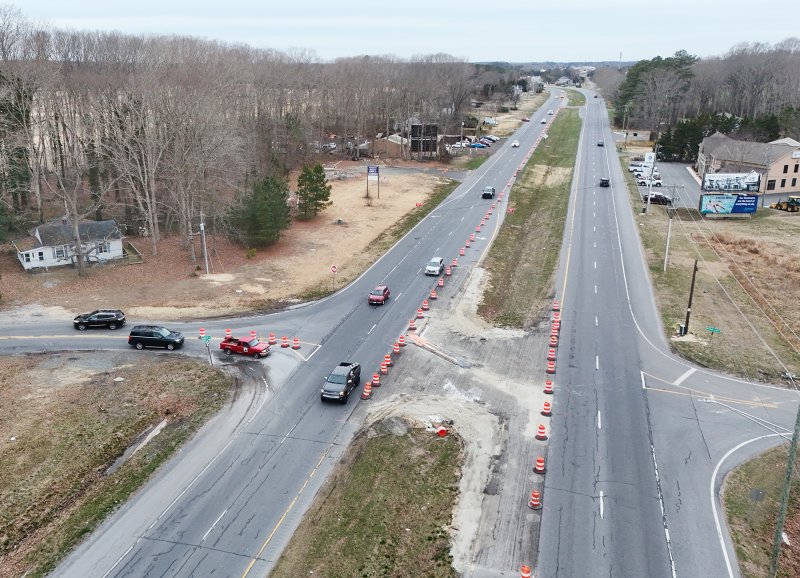
Before changing the traffic pattern at the Route 1 intersections with Hudson and Steamboat Landing roads near Milton, the Delaware Department of Transportation worked with a consultant to evaluate near misses.
The results showed motorists crossing two lanes to the Route 1 median had nearly 16 times more near misses than the national standard. The other conflict points at the intersection were within a few incidents of the national average.
After DelDOT reconfigured the median to restrict movements, the number of near misses was drastically reduced. But, it didn’t solve all problems. In fact, it actually created a new one – a significant number of drivers ignored the plastic delineators and pavement markings, and continued to drive across Route 1 to the median – an illegal movement. This meant the drivers chose not to merge with southbound traffic to use a designated U-turn nearly a half-mile south.
In response to the new problem, DelDOT is adding concrete barriers in the median crossover and constructing an acceleration lane for southbound traffic merging onto Route 1 from Hudson Road.
“Safety is a primary focus for DelDOT, and implementing cost-effective solutions in a stepwise approach ensures that resources are used efficiently,” said DelDOT Chief Traffic Engineer Peter Haag. “For the Route 1 crossover project, improvements are designed to reduce the risk of future fatalities and serious injuries while enhancing overall travel safety for all corridor users, which is consistent with the Safe System Approach. The goals were to minimize vehicle conflict points, establish clearly defined locations for authorized use only, and promote more controlled and predictable vehicle movements.”
The consultant, Quality Counts, also evaluated several other locations throughout the state, including the new roundabout at the intersection of Route 9, Beaver Dam Road and Plantation Road, and Route 9 in that same area near Five Points.
Quality Counts studied the Milton-area intersection twice in the last year – once before changes, then after the first round of changes. The company set up cameras in two places and recorded for 24 hours to track the movement of vehicles.
Steven Hollenkamp, vice president of business development at Quality Counts, said the Near Miss tool uses object detection to track vehicles. Artificial intelligence analyzes each frame of a video to ID a car, a person, a bike, and then tracks their speeds and trajectories across the frames, he said.
The program has the ability to determine when trajectories cross paths, and the time between the two vehicles passing each other. The Quality Counts system tags any near misses under three seconds, then divides them into smaller intervals – 1.5 seconds or less, 1.5 to 2 seconds and 2 to 3 seconds. It also separates the near misses by conflict type – vehicle to vehicle, vehicle to bicyclist, vehicle to pedestrian.
“We watch every clip during quality control, and anything that’s wild or unique goes into a highlight reel,” Hollenkamp said, adding the highlights are shared with the agency that hired Quality Counts to perform the study.
In the initial 24-hour study in July 2025, the program recorded 287 near-miss conflicts. Of those, 231 incidents occurred when drivers were attempting to cross Route 1 from Hudson Road to either go northbound on Route 1 or cross over to Steamboat Landing Road. Based on Quality Counts’ historic data, an intersection such as this one should only have about 14 incidents in a 24-hour period, making these near misses more than 16 times higher than the national average. Hollenkamp noted the average speed of through vehicles traveling on Route 1 was 64.2 mph in the 55 mph zone. The three other left-turn conflict points at the intersection were near the national average range. According to DelDOT, the average annual daily traffic for Route 1 in that area is 30,122 vehicles per day. There were 60 crashes at the intersection between 2012 and October 2025.
“You’ve got lots of instances every single day on just random days of the week where cars are shooting these small gaps and they’ve got fast cars coming in after them, and it’s happening at a high frequency,” Hollenkamp said.
Some could theorize that the removal of the traffic signal at Route 16 could increase speeds and decrease gaps, but Haag said that likely isn’t the only factor.
“Crash data is influenced by many factors, and isolating the impact of a single change, like the signal removal, is challenging,” he said. “Nevertheless, ongoing monitoring and coordination with enforcement efforts can help provide insight into how the removal is influencing vehicle movements over time.”
In October 2025, DelDOT changed the traffic pattern at several crossovers between the Broadkill River bridge and Cave Neck Road, including the Hudson Road/Steamboat Landing Road intersection. The new pattern attempted to force drivers on Hudson Road to travel south on Route 1 and make a U-turn at a crossover in order to head northbound. Plastic delineators and pavement markings were intended to send drivers in the correct direction.
When Quality Counts returned to do an after-study in November 2025, they studied the intersection for five days. They found the number of conflicts dropped from 287 in 24 hours to 73 over five days, or an average of 14.6 per day. Hollenkamp also noted there’s a big difference in traffic in July versus November.
“A major reduction in conflicts, but why are there any conflicts at all ... if the lefts are prohibited?” Hollenkamp said.
After watching the footage, they found drivers were ignoring the new traffic pattern to cross into the median an average of 131 times per day. Of those, 13, on average, were involved in a conflict.
“[These conflicts] are arguably more dangerous when they do happen, because this car that’s shooting across is now in the turn lane; they’re not in a shared median where everyone pays attention to each other,” Hollenkamp said.
DelDOT worked with Delaware State Police to enforce the traffic pattern, issuing more than 200 tickets over the span of a few days to drivers who illegally turned at the crossover.
Hollenkamp said Quality Counts built its AI model based on millions of images. Hollenkamp said the initial intersection analysis was a pilot study for DelDOT.
“The initial [study] was showing them what it could do and how it would work, and they really liked it and wanted to do an after-study,” Hollenkamp said. “Based on the results of the first study, they made a change to the roadway and then they wanted to see how that went.”
Hollenkamp lauded DelDOT for its willingness to revisit the intersection after further research found the changes created a new problem.
“All too often agencies, counties, cities, states, they spend money on deciding what to do, they spend money on designing that thing, they spend money on construction, and then that’s it,” he said. “There’s no, ‘Well, did this work?’ I think what DelDOT did should be done more often.”
“This was just one of the tools in their toolbox,” said Preston Hitchens, senior business development manager for Quality Counts, who grew up in Lewes and graduated from Cape Henlopen High School in 1979. “They carefully and, in my opinion, very thoughtfully invested in improving the safety in that corridor.”

Nick Roth is the news editor. He has been with the Cape Gazette since 2012, previously covering town beats in Milton and Lewes. In addition to serving on the editorial board and handling page layout, Nick is responsible for the weekly Delaware History in Photographs feature and enjoys writing stories about the Cape Region’s history. Prior to the Cape Gazette, Nick worked for the Delmarva Media Group, including the Delaware Wave, Delaware Coast Press and Salisbury Daily Times. He also contributed to The News Journal. Originally from Boyertown, Pa., Nick attended Shippensburg University in central Pennsylvania, graduating in 2007 with a bachelor’s degree in journalism. He’s won several MDDC awards during his career for both writing and photography. In his free time, he enjoys golfing, going to the beach with his family and cheering for Philadelphia sports teams.