













Dewey P&Z tables stormwater runoff ordinance
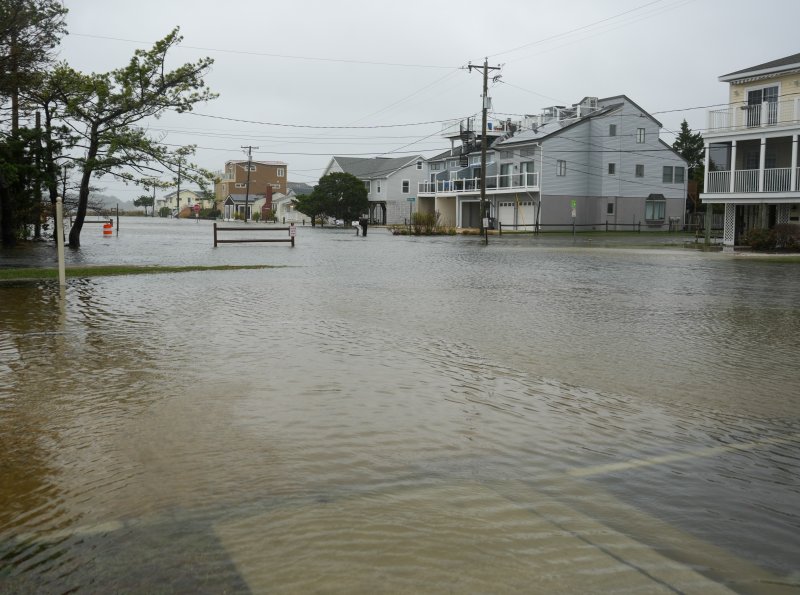
After a public hearing March 3, the Dewey Beach Planning and Zoning Commission voted to table a draft ordinance regarding stormwater runoff, guttering and downspouts.
The ordinance proposes an amendment to town code that would require all water – including stormwater and irrigation runoff – generated on new residential and mixed-use properties to be fully managed within the boundaries of the property.
“As a result of some of the new construction [in town], we find that it changes the permeable space, the grading is different and we have more sprinkler systems,” Chair Dave Lyons said. “So, what we have occurring is water is flowing off of someone’s property, either into their neighbors’ [properties] or onto the street.”
The ordinance would prohibit the discharge of water onto public streets, sidewalks or adjacent properties, and require construction plans to include appropriate grading, drainage or containment measures to prevent offsite flow, and to protect public infrastructure and neighboring properties.
It also states that any existing residential or mixed-use structure that does not satisfy the existing – and proposed – downspout discharge requirements shall be modified to satisfy the requirements within 90 days after notification by the town building official. As established in current code, failure to correct deficiencies within this period would be subject to a $250 fine, plus an additional $250 fine for every additional 30 days in which the deficiencies remain uncorrected.
Lyons drafted the amendment after the charter and code review committee asked the commission to help develop some property maintenance standards, including some relating to stormwater runoff, for homes and structures in town.
Current code says the discharge point for downspouts on all new, renovated and existing structures must be at least 4 feet from the nearest property boundary line, or a greater distance if necessary to contain discharge from downspouts within the boundaries of the property.
According to Assistant Town Manager Jim Dedes, the town has received numerous complaints from residents about water being discharged onto their properties from neighboring properties, even with the 4-foot minimum requirement.
“It is a problem for neighbors when new homes [are built],” Dedes said. “What is being proposed, [which] I think is a good thing, is for new construction to have to somehow come up with a way to adapt and to correct this.”
Implementation concerns
While Dedes thinks the ordinance is a good step toward a solution, he’s unsure how it could be executed.
Commissioner Mike Harmer, the head of Sussex County’s engineering department, agreed, saying the town should do more research and come up with some examples of how this could work before putting forth a regulation.
Through his job as county engineer, he said he’s seen that sump pump discharge and yard sprinklers can, at times, ruin the ability for lots to drain.
“It’s always all wet, and then in the winter it could be frozen,” Harmer said. “I definitely am a believer that anybody developing needs to start talking about sump pump discharge, I just don’t have the solution for that at hand.”
If the town wants to prevent offsite flow, he continued, maybe it should put in storm pipes and stormwater management measures. But until there are proven solutions and proper infrastructure available to residents to effectively contain discharge within their own properties, Harmer said, he will not support the ordinance.
“I think it’s an unreasonable request to ask to build a house, especially mixed use, and [have] no stormwater running anywhere,” Harmer said. “It would be irresponsible to develop a regulation that’s impossible for somebody to implement.”
Runoff and drainage patterns then vs. now
Commissioner Mark Nordquist said the issue is partly a result of changing runoff and drainage patterns over the years caused by changes in the footprints of houses.
Forty years ago, the footprints of houses in town were smaller. The roofs were smaller, Nordquist said, and the runoff would flow onto the yards, which were mostly sand, allowing for rapid absorption and drainage.
“Now, people put grass in, and [the water] doesn’t perk,” Nordquist said. “We’re building these homes with big footprints and big roofs, versus the little cottage that used to be next door, so you’re losing all this ground that the water used to perk through. We’ve kind of created the issue, and now we’re trying to solve it.”
Public input
Resident David Thomas said the ordinance has several red flags. He suggested it conflicts not only with basic stormwater engineering principles, but also with local, state and federal regulations.
“Modern stormwater design – including the standards used by FEMA, DNREC and the international codes – is built around a simple truth: Individual lots cannot handle the volume of water that streets and drainage systems are designed to carry,” Thomas said.
Indeed, modern regulations assume that individual properties, especially those with significant impervious surfaces like roofs, driveways and parking lots, cannot safely retain or infiltrate all rainfall.
However, it is also true that many coastal towns increasingly require property owners to manage, retain or treat stormwater runoff within their property boundaries.
Thomas argued that requiring homeowners to keep all runoff on their own property could create a number of issues, such as localized ponding, foundation saturation, increased mold and moisture problems, ineffective drainage during heavy rainfall and runoff directed toward neighbors, which he said is a high liability issue.
The commissioners said Thomas’ comments have been taken into consideration.
Another resident, David Moskowitz, took issue with the way the ordinance is written, saying it suggests it applies to all properties, not just new construction.
Lyons clarified that it would only apply to new construction.
Moskowitz also cited concerns about the penalty fees.
“What you’re trying to do is charge people $250 a month as it’s currently written, or they have to spend $30,000 or $40,000 [to correct the deficiencies],” Moskowitz said. “It’s going to be a very expensive thing for many people.”
Ultimately, the commissioners decided to table the ordinance until they had more information and specific examples of how the ordinance would be feasible in the town.

Ellen McIntyre is a reporter covering education and all things Dewey Beach. She graduated with a bachelor’s degree in journalism from Penn State - Schreyer Honors College in May 2024, then completed an internship writing for the Pittsburgh Post-Gazette. In 2023, she covered the Women’s World Cup in New Zealand as a freelancer for the Associated Press and saw her work published by outlets including The Washington Post and Fox Sports. Her variety of reporting experience covers crime and courts, investigations, politics and the arts. As a Hockessin, Delaware native, Ellen is happy to be back in her home state, though she enjoys traveling and learning about new cultures. She also loves live music, reading, hiking and spending time in nature.