













Sooner or later, the water will thaw out and folks will be chafing at the bit to go fishing. Unfortunately, the ocean and bay will still be too cold even for tog fishing.
According to my Water Temperature Ranges for Popular Game Fish chart, a tog’s lower avoidance is 45 degrees and their optimum range is 50 to 60 degrees. I have spoken with divers who tell me when the water becomes too cold, a tog will just lie down somewhere in a wreck and appear to go to sleep. As I write this, the water temperature at the Delaware Lightship Buoy is 35 degrees. I would guess that all those tog at the inshore wrecks and reefs are dreaming of fat crabs and warmer water.
Once the ice is off the ponds and tidal creeks and rivers, white and yellow perch will become likely targets. They feed and spawn in cold water, and I have even heard of them being caught under the ice.
Millington, Md., is a well-known hot spot for both white and yellow perch. I fished there many years ago and caught some yellow perch, but nothing to write home about. I was told, at the time, that the larger females had not arrived. That has been, pretty much, the story of my life. A day late or early and a dollar short.
I have had better luck at spillways. The one in Laurel at the head of Broad Creek, just below Records Pond, has been very kind to me since I was just a young lad.
Not only did I catch white and yellow perch there, but also hickory and American shad. We called the American shad, white shad. They were the real trophies back in the day.
The one lure that caught them all was the shad dart. I have no memory of using live bait at the spillway. I did use earthworms at times and caught some big sunfish in the summer, but in the spring, it was shad darts for shad and perch.
I rigged my shad darts two at a time on light monofilament line. I tied them about 10 to 12 inches apart with the heaviest one on the end and the lighter one farther up the line.
Now you may ask how a young boy from Claymont ended up fishing a spillway in Laurel. My parents divorced when I was very young, and my mother and I moved back in with her parents. When my mother remarried and moved to Pennsylvania, I chose to stay with my grandparents in Claymont. My grandparents were from Laurel, and we went there on a very regular basis.
I have found fishing a spillway is best done by working the area where the water begins to settle out. This will be somewhere below the dam and along the sides of the spillway. Look for disturbed water that melds into calm water and fish that edge. If there are any structures, such as old docks, piers or changes in bottom depth, these can also be excellent locations to work your shad darts. If you wish to target perch, try live minnows under a bobber. I never used live bait back in the day because it was not available to me at that time.
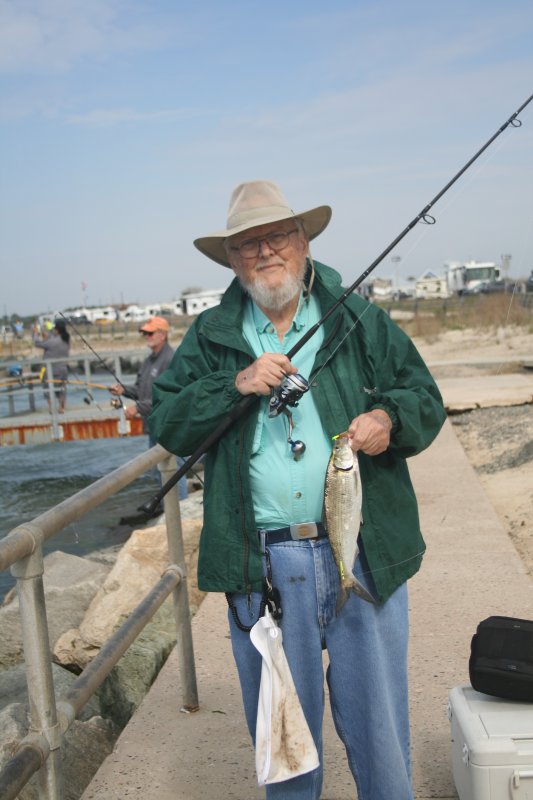
As for shad, they are lots of fun to catch, but not to my taste as far as table fare. Back in the 1950s into the late 1960s, I caught hickory shad two at a time from the Laurel spillway.
I also caught the occasional American shad. Those were a real exciting fish to catch. Not only were they bigger than the hickory shad, they would jump clear of the water. I thought it must be like catching a tarpon. This was until I actually caught a tarpon.
Back then, there were no regulations on shad. One man would come to the spillway with a contraption made from chicken wire and tree branches. He would put it overboard at the spillway, soak it for a few minutes, and when it was full of shad, it took two or three men to lift it out of the water.
Today, the recreational fishing regulations require anglers to keep only 10 hickory shad and only two American shad. I have not seen an American shad in many years. I only keep a few hickory shad for bait.
Now I do my shad fishing at Indian River Inlet. I still use a shad dart, but since the current is so strong there, I use a Stingsilver ahead of the shad dart to get it down to the fish.
I realize when the air temperature reaches 56 degrees, like it did on Wednesday, you think spring is here. Well, it ain’t.
-

Eric Burnley is a Delaware native who has fished and hunted the state from an early age. Since 1978 he has written countless articles about hunting and fishing in Delaware and elsewhere along the Atlantic Coast. He has been the regional editor for several publications and was the founding editor of the Mid-Atlantic Fisherman magazine. Eric is the author of three books: Surf Fishing the Atlantic Coast, The Ultimate Guide to Striped Bass Fishing and Fishing Saltwater Baits. He and his wife Barbara live near Milton, Delaware. Eric can be reached at Eburnle@aol.com.