












Groups lobby for more state funds for homeless programs
With homeless encampments popping up outside many towns in Sussex County and limited housing options for unsheltered individuals and families, local groups are lobbying for more state funding.
“Homelessness in Sussex County is not a Georgetown problem,” said Springboard Delaware Executive Director Judson at the April 21 Sussex County Council meeting. “It’s also not a Seaford problem. And it’s not a Rehoboth problem or a Millsboro problem. It’s a countywide problem.”
Homeless programs fall under the state’s jurisdiction, and Malone asked county council to support efforts to increase state aid for projects that create housing for unsheltered people.
“Sussex County has a role to play here too in terms of advocacy,” he said.
The state has left it to nonprofits and foundations to support the homeless, Malone said.
“That is too heavy a lift for nonprofits to both raise the money and perform the services,” he said.
Organizations that help the homeless are asking the state to increase by $5 million each the funding for two programs designed to prevent and end homelessness.
The Delaware State Housing Authority’s Home 4 Good Program now provides about $1.5 million annually to nonprofits to assist households facing homelessness or housing insecurity. The Delaware Health & Social Services Emergency Shelter and Transitional Housing Program allocates about $1.6 million for emergency shelter and transitional housing for individuals and families in crisis.
Carolyn Kelly, executive director of Family Promise of Southern Delaware, said her group supports additional state assistance. Kelly wrote a letter to the state on behalf of 14 shelter and homelessness service providers requesting more funds.
There are no state funds available to provide permanent housing for homeless families in Sussex County, she said. Families live in cars and people stay in abusive relationships or other dangerous situations for lack of other options, she said.
“Right now they have nowhere to go,” Kelly said.
She said if funds were available, she would work to create housing for families.
Her organization has helped 445 families since it formed nearly four years ago. Last year, Family Promise paid overdue rent and utility bills to assist 124 families to stay in their homes. It also helps people find housing and employment.
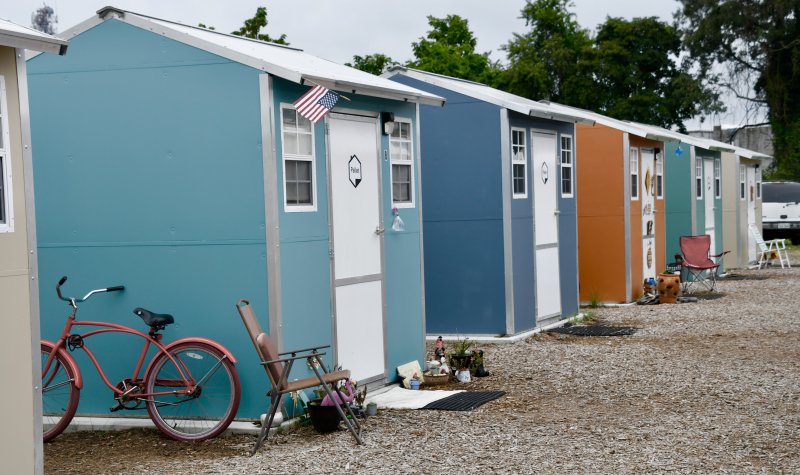
Springboard Delaware uses an Emergency Shelter & Transitional Housing grant to fund Pallet Village, a cluster of 40 shelters, each 64 square feet, off Kimmey Street in Georgetown that opened in January 2023, Malone said.
Springboard is in talks with officials in Dover and Wilmington about creating similar projects there, but more state funding would be needed, he said.
The number of homeless is often underestimated statewide, Malone said.
The annual Point in Time Count, an effort to find in one night people who are living unsheltered, tends to undercount the population, he said. While the statewide count was 167, it is believed that the actual figure is seven times higher, putting the total greater than 1,100.
“That defines a significantly different problem when you have that many people who have no place to go,” Malone said. “When I say homeless, I mean unsheltered homeless. Literally no place to go at night.”
Homeless people live throughout Sussex County, he said.
“There are encampments around every town, virtually, in the county,” Malone said.
Residents of those towns have legitimate concerns related to the widespread homelessness, such as public safety, neighborhood stability and quality of life, he said.
Municipalities and counties don’t have the resources or the authority to address the problem, Malone said.
“We don’t solve homelessness,” he said. “We circulate it. We manage it, instead of creating pathways out of homelessness. … That’s not a failure of us not trying hard enough; that’s a structural problem. We’re not working the right way. What’s missing is coordination. Coordination of services, of responsibility, of providers who provide services but don’t talk to each other. Silos of information and services.”
The county controls land use and zoning, which are important to finding solutions to homelessness, such as transitional housing and affordable permanent housing, Malone said. Creating housing takes years, and current efforts are still not addressing the lowest income levels, he said.
“We don’t have enough places for people to go,” Malone said. “That is the fundamental reason we are seeing more and more homeless. They have no place to go.”

Kevin Conlon came to the Cape Gazette with nearly 40 years of newspaper experience since graduating from St. Bonaventure University in New York with a bachelor's degree in mass communication. He reports on Sussex County government and other assignments as needed.
His career spans working as a reporter and editor at daily newspapers in upstate New York, including The Daily Gazette in Schenectady. He comes to the Cape Gazette from the Cortland Standard, where he was an editor for more than 25 years, and in recent years also contributed as a columnist and opinion page writer. He and his staff won regional and state writing awards.
Conlon was relocating to Lewes when he came across an advertisement for a reporter job at the Cape Gazette, and the decision to pursue it paid off. His new position gives him an opportunity to stay in a career that he loves, covering local news for an independently owned newspaper.
Conlon is the father of seven children and grandfather to two young boys. In his spare time, he trains for and competes in triathlons and other races. Now settling into the Cape Region, he is searching out hilly trails and roads with wide shoulders. He is a fan of St. Bonaventure sports, especially rugby and basketball, as well as following the Mets, Steelers and Celtics.