













The next life of Milton’s pecan tree
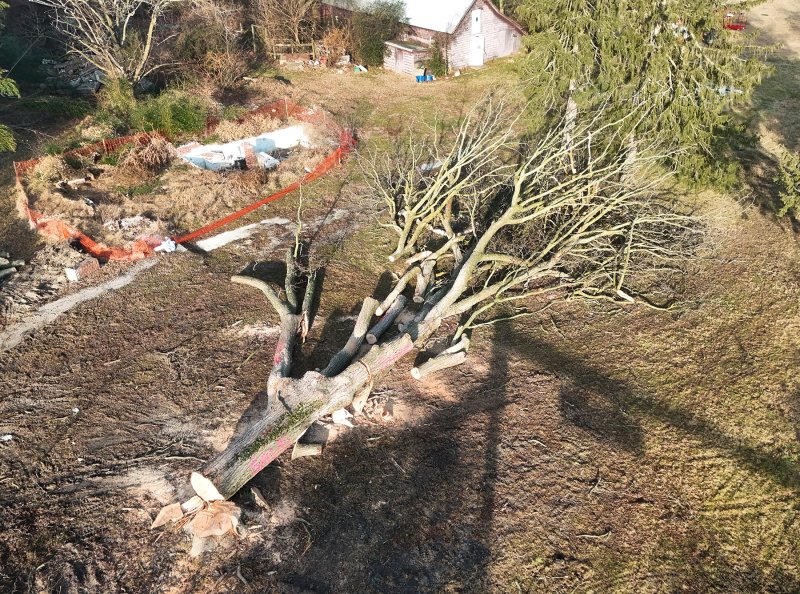
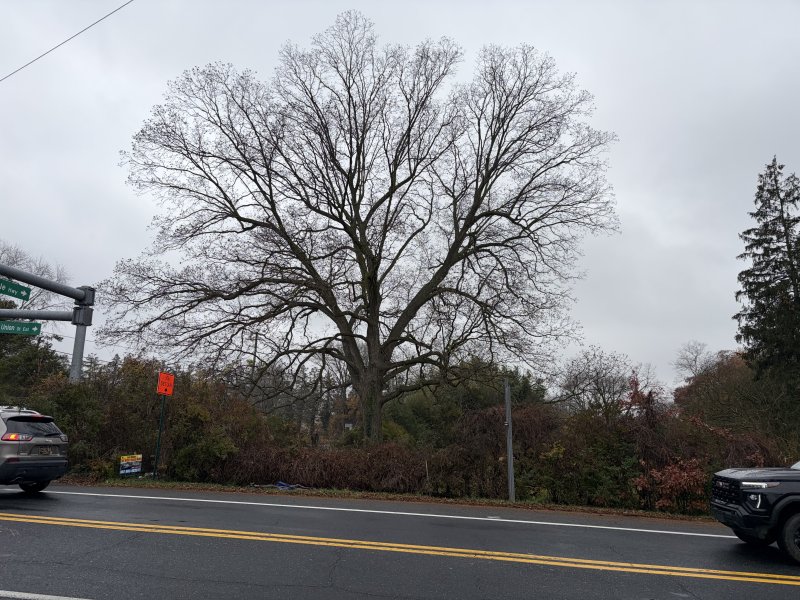
Despite being taken down in January, the pecan tree from the corner of Route 16 and Route 5 in Milton is set to live on in a variety of different ways.
The tree, which was believed to be more than 100 years old, was felled to make room for traffic improvements coinciding with the building of a Royal Farms. The tree was the first bit of site work to be done in preparation for the Royal Farms, with the rest of the site being cleared in early February.
Andy Gogates, a member of the Milton Planning and Zoning Commission, said when he found out the tree was slated to come down two years ago, he wanted to see if cross-sections of the tree could be preserved and studied. He had the idea of studying the tree’s rings to see how old it is and setting up an exhibit that would tie the history of the tree to the town’s history.
Gogates said the town and Royal Farms were generous enough to allow him to have two 10-foot cross-sections of the tree. He then came in contact with Doug Simpson, the owner of a mill in Bridgeville.
Simpson spent his life working around trees, either in logging or forest management, and when he retired, he decided to open his own mill.
“I love working with wood,” he said. “I decided that when I retired that this is what I wanted to do.”
Simpson was asked to cut out two “cookies,” cross-sections of a tree that can be used to determine its age. He was also asked to preserve some lumber for the building of a cabinet or furniture for display within the town’s administrative offices. In lieu of payment, Simpson was allowed to keep some of the lumber for his own use.
Simpson has done a lot of historical restoration work with lumber, mostly for contractors who want to craft pieces out of unusual custom logs. He didn’t really know about the pecan tree when he was first approached about preserving pieces, but upon his initial looking at the rings, he estimates that the tree is about 102 years old. Simpson said the tree had begun showing signs of internal decay; rot was found in the first cookie he tried to cut.
“It could have survived another 20 years, but it was on a downward trend,” he said.
Simpson said it will take about three months for the wood to be run through a kiln and dried in order to get the best view of the rings.
To help determine the exact age, Gogates reached out to the University of Delaware, where he was put in touch with Dr. Tara Trammell, an associate professor of urban forestry in the Department of Plant and Soil Sciences.
“I am interested in the removal of the pecan tree for a couple of reasons,” Trammell said. “Large, old trees are especially vital across our landscape since it takes decades for a tree to reach large stature, and large trees can provide greater benefits to residents, such as providing shade and improving stormwater management. While pecan trees are native to the U.S., we are not located in their typical range, so this large specimen is interesting.”
Trammell said the primary data to be determined from studying the tree rings is the tree’s actual age. To do that, a researcher typically needs multiple samples of the same species in a similar location. Each ring can be dated to a calendar year, and researchers can determine whether a tree had faster or slower growth.
For all involved, preserving the tree in some form is a passion project.
“I hope in whatever part I play that it means something to the people who care about the tree,” Simpson said.
Gogates added, “It will live on.”

Ryan Mavity covers Milton and the court system. He is married to Rachel Swick Mavity and has two kids, Alex and Jane. Ryan started with the Cape Gazette all the way back in February 2007, previously covering the City of Rehoboth Beach. A native of Easton, Md. and graduate of Towson University, Ryan enjoys watching the Baltimore Ravens, Washington Capitals and Baltimore Orioles in his spare time.