













Rehoboth officials eye annual fees, permits
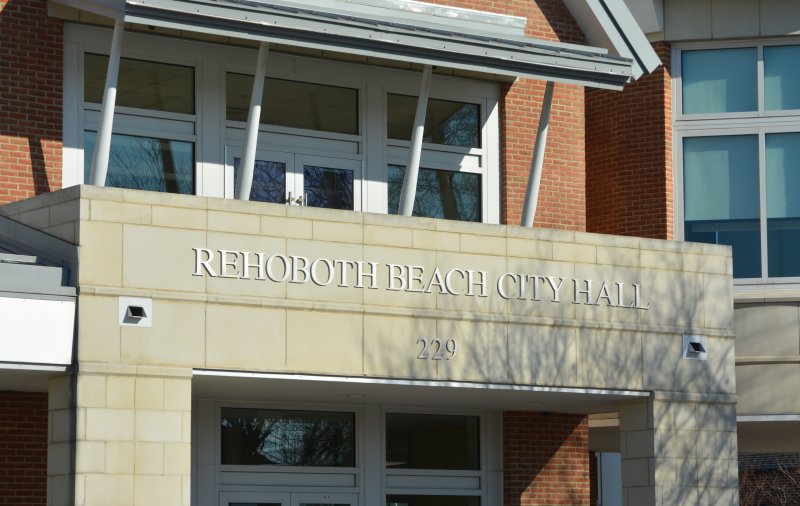
In an effort to ensure the city collects enough money from businesses to pay for the services those businesses need, Rehoboth Beach commissioners are taking a hard look at the schedule of fees and permits as part of the budgeting process for Fiscal Year 2027.
Rehoboth’s fiscal year runs April 1 to March 31. Commissioners and city staff held the first of five special budget meetings Jan. 16. Discussions resumed Feb. 9.
As proposed, there’s already a 20% increase across the board for all business licenses.
Pointing specifically to restaurants and bars, Commissioner Chris Galanty said the city must assure it’s generating appropriate revenue from the properties and activities that drive the highest demand for city services. The annual business license for a restaurant that serves alcohol is $750, plus the owners get two free transferable parking passes at $325 a pop, which means the city is charging them $100 for a business license, he said.
“Think about all the city services we provide to that business,” he said. “They’re getting off very cheaply, and it’s creating a disproportionate cost for residents. The businesses need to incur some of the costs for the services the city provides them.”
Commissioner Susan Stewart agreed the city needs to make sure businesses are paying an appropriate level, pointing to hotels and motels as an example. The city charges hotels and motels an annual fee of $50 per room, but these rooms are going for $500 to $800 per night, she said.
“The city does get license revenue, but it doesn’t get income tax or a gross receipts tax from restaurants or bars, and they’re consuming a lot of services,” said Stewart. “They do draw in parking revenue, but it’s important that they are paying their fair share and not place the burden on residents.”
Commissioner Suzanne Goode said she agreed, but given the economic environment, she suggested a gradual increase and phased-in approach with a known percentage rise over the next few years. The timing is a little delicate right now, she said.
No decisions were made on the issue, but Mayor Stan Mills tasked city staff with coming back at the next meeting with suggested changes to the fees.
Other budget discussions
Commissioners and staff went department by department, excluding the public works.
City Manager Taylour Tedder began by reviewing a few changes from the first meeting – a $4.5 million reduction in capital improvements for the wastewater project, a $300,000 increase for sidewalk repairs.
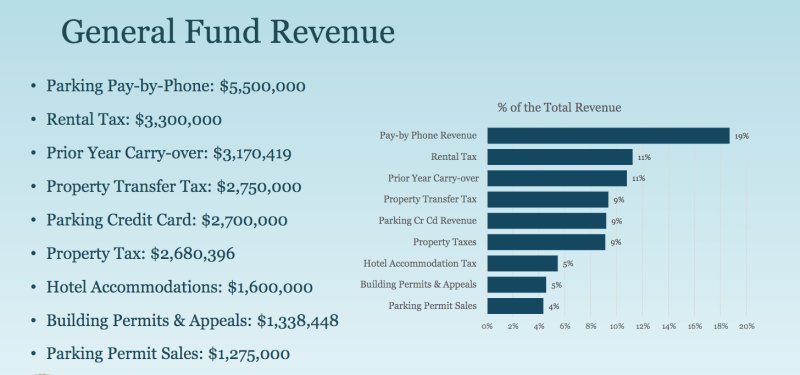
Tedder provided a breakdown of the city’s major revenue sources for the general fund – $5.5 million for pay-by-phone parking, $3.3 million in rental taxes, $3.17 million in carry-over from prior years, $2.75 million in property transfer taxes, $2.7 million in credit card parking, $2.68 million in property taxes, $1.6 million in hotel accommodations taxes, $1.34 million in building permits and appeals, and $1.275 million in parking permit sales.
The personnel issue that brought the most discussion is a change in category for the communications department. Currently, the head of the department is a manager-level position making $75,000 per year. As proposed, the position would be changed to a director-level position making $121,000 per year.
Goode questioned the need for a 61% salary increase for a position where the person has only been with the city since October.
Commissioner Patrick Gossett said poor communication from the city has been one of the complaints he’s heard over the years. Since the change was made this past fall, he said, he’s heard from constituents that the communication has been much better.
Stewart said the raise was warranted because the city hired a person who has exceeded expectations.
Last year, commissioners agreed to increase healthcare coverage to 100% for employees, up from 90%. Dependents are at 80%. Commissioner Mark Saunders said he would like a more in-depth review of healthcare benefits. It’s a lot of money and the commissioners probably have some questions, he said.
Tedder said insurance has gone up more than 4% for this year and next year, but he hadn’t planned on reviewing those benefits because there aren’t any proposed changes from the city’s end. The personnel director wasn’t available for the Feb. 9 meeting, but she will be at the next meeting, he said.
In general, as proposed, the total among the city’s three funds – general fund, water fund, wastewater fund – is about $51.2 million, which represents a year-over-year increase of about 17.2%. The approved budget for the current fiscal year is about $43.7 million.
As proposed, the general fund, which the city uses for day-to-day operations, would increase by about 4.3%, from about $28.3 million approved for the current year to about $29.5 million for next.
There are no tax increases and no new employee positions, but there is a 2% cost-of-living increase for employees.
Looking forward, the city is expected to resume budget discussions at 9 a.m., Friday, Feb. 20. It will be the third meeting and primarily focus on the public works, water and wastewater departments. The fourth budget meeting is scheduled for Monday, March 9, and will include a discussion about community partner contributions. The budget is expected to be approved during a commissioner meeting Friday, March 20.

Chris Flood has been working for the Cape Gazette since early 2014. He currently covers Rehoboth Beach and Henlopen Acres, but has also covered Dewey Beach and the state government. He covers environmental stories, business stories and random stories on subjects he finds interesting, and he also writes a column called Choppin’ Wood that runs every other week. He’s a graduate of the University of Maine and the Landing School of Boat Building & Design.