













Senate passes bill to change Electoral College process
A national effort to band together states with small numbers of Electoral College votes in order to form a larger voting bloc is gaining traction in Delaware as it moves through the state Legislature. Senate Bill 22 was voted out of committee March 6 and approved by the full Senate a day later by a vote of 14-7.
The bill supports the National Popular Vote effort that is asking states to join a compact that would give a state's Electoral College votes to the presidential candidate who wins the popular vote nationwide.
Currently, Delaware's three Electoral College votes go to the candidate who wins the popular vote in the state of Delaware.
Saul Anuzis, senior advisor with the National Popular Vote movement, said the bill would not change the state Constitution, only the way Delaware casts its Electoral College votes. “If and when Delaware passes the bill, it does not take effect until enough states sign on to reach 270 votes,” he said.
The Electoral College is made up of 538 votes from all 50 states, and a candidate for president must receive a majority of those votes to be elected president. A total of 270 electoral votes is the majority needed to elect a president, regardless of who won the popular vote.
So far, Anuzis said, there are 12 states that have passed bills for a total of 172 votes. New Mexico, Arizona and Oregon are among several states that are considering similar bills, he said.
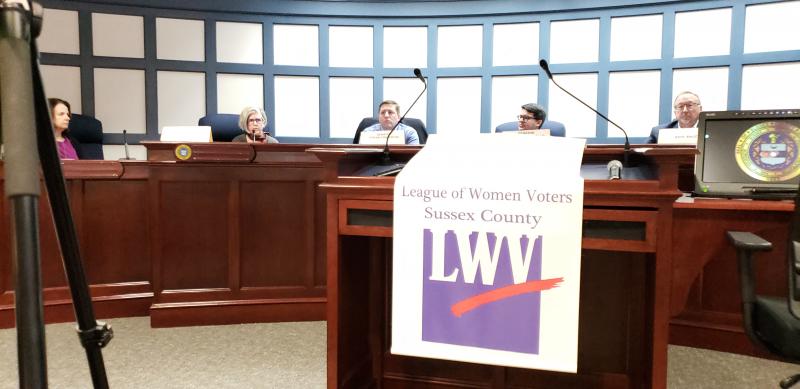
Anuzis spoke to more than 100 people in Sussex County March 3 before appearing in Senate committee March 6. He said today's Electoral College is a sham because it concentrates presidential campaigns on a few swing states. Under the proposed voting compact, he said, everyone's vote would count toward the greater popular vote, and candidates would be forced to pay more attention to states with smaller populations. States that agree to the compact could also benefit from campaign dollars, he said.
“The reason it works is because it's quintessentially right,” he said. “Right now we're letting four to six states decide the election, and that's not right.”
Anuzis said getting states to sign the compact – basically an Electoral College voting bloc – is a slow process, but he expects enough states will sign on to reach 270 votes by the 2024 presidential election. After convening, the Senate went into caucus and did not return before the Cape Gazette's deadline. “Nothing changes until you get to the 270 mark,” he said.
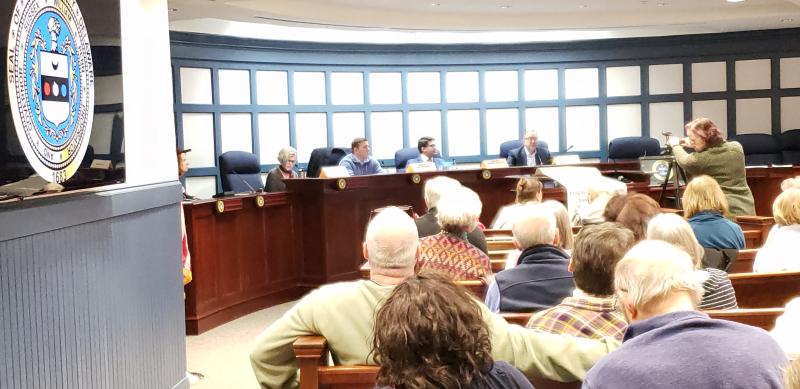
While the bill has support from the American Association of University of Woman and League of Women Voters, the committee hearing drew a crowd of more than 100 with differing views.
Lee Murphy, Republican candidate for Congress who lost to Scott Walker in the primary and who is now exploring a run for U.S. Senate in 2020, said the bill contradicts the purpose of the Electoral College. “I think the three electoral votes should go to what Delaware thinks,” he said.
Laird Stabler, national committeeman for Delaware's Republican Party, also supports keeping Delaware's electoral vote system and said Democrats have pushed for national vote changes after losing recent presidential elections despite winning the popular vote.
“Sour grapes is not a good way to conduct public policy,” he said.
With Sen. Brian Townsend, D-Newark, a prime sponsor, and Sen. Anthony Delcollo, R-Marshallton, one of several co-sponsors that include Speaker of the House Rep. Pete Schwartzkopf, D-Rehoboth Beach, the bill has bi-partisan support. The bill will now go to House committee for action.

Melissa Steele is a staff writer covering the state Legislature, government and police. Her newspaper career spans more than 30 years and includes working for the Delaware State News, Burlington County Times, The News Journal, Dover Post and Milford Beacon before coming to the Cape Gazette in 2012. Her work has received numerous awards, most notably a Pulitzer Prize-adjudicated investigative piece, and a runner-up for the MDDC James S. Keat Freedom of Information Award.