












The international council that regulates bluefin tuna has increased the amount American recreational anglers may take by 17%. That comes out to 231 metric tons of additional bluefin tuna.
If you have been paying attention, you are aware these fish have been in good supply close to the Delaware shoreline. The last time I was out to the Del-Jersey-Land Reef, and that was last December, we passed four schools of bluefins feeding under birds. One of the mates on the head boat Angler out of Ocean City, Md., tried to catch one on tackle that was woefully inadequate. Fortunately, he was unsuccessful.
My first experience with bluefin tuna was with small ones that we called footballs just off the Delaware Lightship Buoy back in the early 1970s. We caught all we wanted on cedar plugs. For those who do not know what a cedar plug is, it is a piece of wood with a lead head shaped like a torpedo with a hook out the back. We ran two on flat lines right outside the prop wash.
My next encounter with a bluefin was with a little larger fish.
We were fishing from Long Island, N.Y., with a captain who had mounted his fighting chair off the transom of his boat. When you were fighting the tuna, you were actually out over the water. Unfortunately, I can no longer remember the captain’s name or the name of his boat, but I still remember the experience. It was exciting!
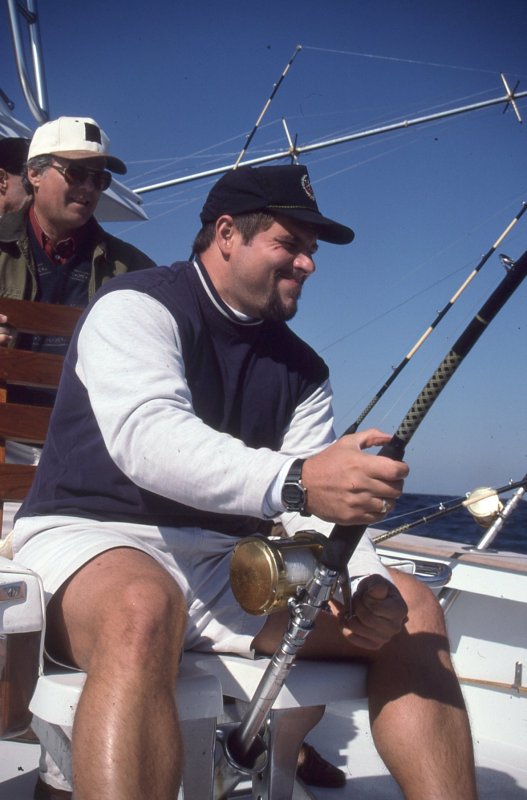
The captain would move the boat around until he marked some big bluefin, and then he would drop a bait down to the fish. Meanwhile, the angler, me, was seated in the fighting chair with a very heavy rod, a 130-reel filled with 300-pound mono and 400-pound shock leader.
When a big tuna picked up the bait, it was soon hooked as the line came tight against the heavy drag, and the ride began.
The idea was to keep the fish on the 400-pound shock leader, if possible. This required the captain to run the boat in reverse while the angler cranked in line almost as fast as the fish took it out.
I hate to say how long I was on this fish. My guess would be 30 to 45 minutes. Once we had the big tuna alongside the boat the mate put a gaff in it, and he and the captain loaded it onboard.
Back at the dock, there was barely time for pictures before the buyer tested the fish for fat content and made the captain an offer. After they settled on a price, the 350-pound bluefin tuna was on its way to Japan.
My next encounter with giant bluefins came in Cape Hatteras, N.C. Actually, I had a few encounters with these fish down there.
The first came when I heard a rumor that giant bluefins were being caught out of Cape Hatteras. I called Rom Whitaker on the Release. He confirmed the rumor and invited me and my son Ric to ride along the next day. We did, and Ric caught and released a 600-pound bluefin. The next few encounters were all connected with the TV show I was part of out of Norfolk, Va.
The first was back with Rom, and we once again got into some giant bluefins fishing over wrecks off Cape Hatteras. The difference was this time I had to catch one of the darn things.
The tackle was pretty much the same as in Long Island – a sturdy rod with a Penn 130-reel filled with 130-pound mono and a top-shot of 140-pound fluorocarbon. The difference here was the bait – live menhaden.
Before fishing began, the boats would head for an inshore location where menhaden were known to be. Gill nets were set and soaked. After the nets were pulled, the menhaden were put into live wells.
Once over a good wreck, the mate would toss out a few menhaden, prompting these giant bluefins to come up and grab them. The next batch had one fish with a hook. The angler was already in the chair. As soon as the line came tight, he was in for a battle.
Since I was the star of the show, I had to catch one of these giants. I asked the mate to toss the bait to a small one, but he didn’t listen. They estimated the bluefin I caught and released was between 600 and 700 pounds.
If you are planning to go after bluefin tuna off Delaware, you better have some sturdy tackle. At least 80-pound gear with 80 or 130 mono line. Do not use braid. A long top-shot of 100-pound fluorocarbon and a big circle hook will also work. If you don’t have a chair, standup gear will be necessary.
Good luck!
-

Eric Burnley is a Delaware native who has fished and hunted the state from an early age. Since 1978 he has written countless articles about hunting and fishing in Delaware and elsewhere along the Atlantic Coast. He has been the regional editor for several publications and was the founding editor of the Mid-Atlantic Fisherman magazine. Eric is the author of three books: Surf Fishing the Atlantic Coast, The Ultimate Guide to Striped Bass Fishing and Fishing Saltwater Baits. He and his wife Barbara live near Milton, Delaware. Eric can be reached at Eburnle@aol.com.