












State’s new dredge skews data for 2026 oyster bushel quota
The 2026 harvest quota for the state’s oyster beds in Delaware Bay has been set at about 13,900 bushels, which represents about a 7% increase over last year.
However, the increase to the quota isn’t as high as the established predictive model used by the state because, officials said, a new dredge used to set the quota was better at collecting oysters than the previous one, which skewed the results. The predictive model called for about 16,600 bushels to be harvested.
Ben Wasserman of the Delaware Department of Natural Resources and Environmental Control’s Division of Fish and Wildlife presented this year’s quota and the reasons for setting it lower than the accepted method at a March 3 meeting of the state’s Advisory Council on Shell Fisheries.
The state changed its predictive model for calculating the oyster harvest quota in 2018. The model includes a variable related to how efficient the dredge was at collecting material. The efficiency of the dredge was based on a study comparing how well it collected material versus a scuba diver harvesting everything in the same area.
The diver’s area is much smaller, but it can be extrapolated over all the state’s oyster beds for a total population, said Wasserman. The quota is typically 2% of the total, he said.
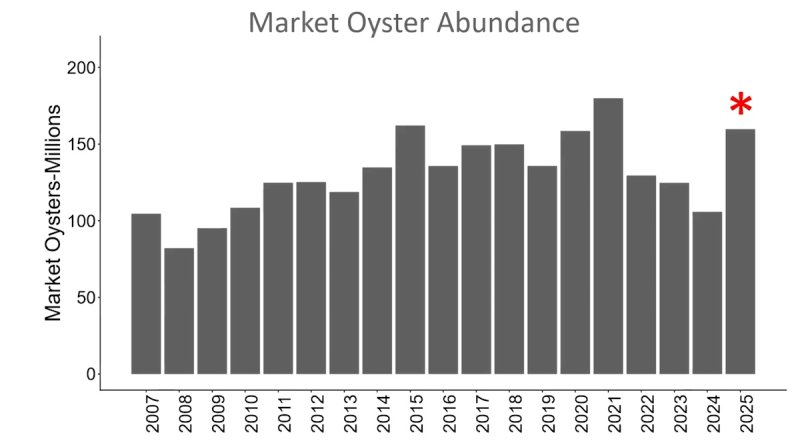
In 2024, the predictive model estimated there were about 100 million market-size oysters found in the bay’s beds. That same model estimated close to 150 million market-size oysters in 2025.
“I believe that some amount of this increase is not because the number of oysters down there has increased, but some amount of it is because the tool became more efficient,” said Wasserman.
To set the quota for 2026, Wasserman said the state went back to the predictive model it used from 2001 to 2017. The state used an index-based approach that was based on the number of oysters in a bushel during the fall survey and the actual harvest the following year, he said.
Following the meeting, Dr. Richard Wong, a biometrician for the state’s Fisheries Section, provided an explanation on why the state changed its dredge.
The equipment for the state’s research vessel, RV First State, was updated with a hydraulic dredge table, which improves the dredging process and has recently been adopted by the oyster industry, said Wong. The update required a longer tow chain and some minor modifications to the dredge, he said.
The thought is that the longer tow chain is likely responsible for the new dredge being better at catching oysters, said Wong.
Another reason the new apparatus was installed is because it reduces a huge amount of manual labor required to hoist the extremely heavy dredge onto and off the vessel deck, said Wong. It’s more than 300 pounds when full, and staff have suffered injuries over the years from doing the physically demanding work, he said.
“Our ability to conduct the survey has been more and more constrained because of reduced availability of staff strong enough to lift and throw a dredge for eight hours. It had become a necessity for the safety of our staff and the continued operation of the survey,” said Wong.
The retrofitting process took more than a year and did not allow enough time to conduct a new efficiency experiment, said Wong in an email March 9. The state does not have the equipment to conduct an efficiency experiment, so it will be contracting an agency or institution in 2026, he said.
“Given the uncertainty, we discussed staying status quo for the 2026 quota. In the end, we used the previous, long-standing method that was used for 16 years,” said Wong. “This was appropriate and well supported, and results in a higher quota in 2026.”
Slight increase predicted for Delaware Bay blue crabs
Every year, in the early spring, DNREC releases a projection of how many blue crabs are expected to be caught in Delaware Bay during the crabbing season. The project is based on the juvenile index taken the previous fall. Wong presented the prediction for 2026 during the recent meeting.
Based on the blue crab juvenile index taken last fall, the state is projecting a slight increase in blue crabs caught in 2026. However, if the increase is as minimal as projected, the actual number of crabs caught this year will be less than the actual number of crabs caught in 2025.
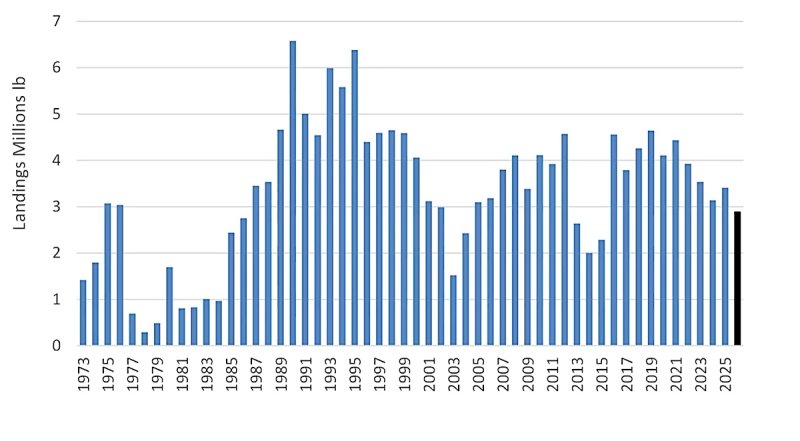
Last year, the juvenile index from 2024 projected 2.8 million pounds of blue crab would be caught in 2025, but in the end there were about 3.3 million pounds caught. For 2026, the juvenile index from 2025 is predicting about 2.9 million pounds of blue crab will be caught.
Last year’s increase in crabs caught was the first in four years, but it’s still well below the 4 million pound range the state saw from 2016 to 2021.

Chris Flood has been working for the Cape Gazette since early 2014. He currently covers Rehoboth Beach and Henlopen Acres, but has also covered Dewey Beach and the state government. He covers environmental stories, business stories and random stories on subjects he finds interesting, and he also writes a column called Choppin’ Wood that runs every other week. He’s a graduate of the University of Maine and the Landing School of Boat Building & Design.