













Tog fishing is still worth a trip this time of year
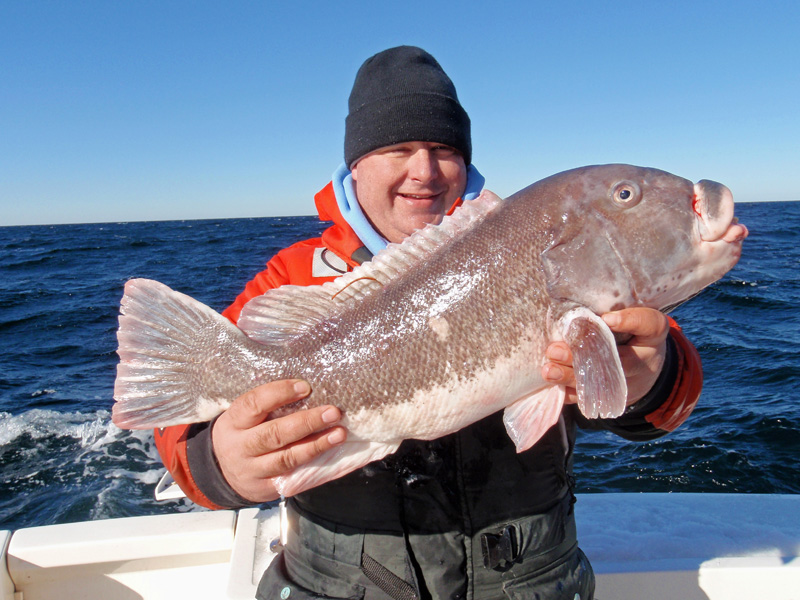
With black sea bass closed and the bluefin tuna way far to our south, tog are pretty much the only game in town for saltwater anglers. The current surface water temperature of 44.2 degrees is just below their low tolerance of 45 degrees, and I have a confirmed report of a three-man limit catch of tog to 13.5 pounds at the Del-Jersey-Land Reef. The big female was released.
I am sure most boat owners have put their pride and joy up for the winter. I know mine is tucked up on her trailer in my driveway. All three batteries are taking turns on the charger, and I hope they will be ready for some flounder trips this spring.
That leaves charter and head boats for us to chose from. Both fish pretty much the same. The only difference is on a charter boat you are going to be less crowded with just six anglers, while on a head boat you could be jockeying for a fishing spot with several other fisher-persons.
No matter where you are or who you fish with, the tog will treat you just the same. They will take the bait off your hook in less time than it took you to read that sentence.
When I lived in Virginia Beach, Va., they had a wonderful aquarium there, and I happened to be present during feeding time. When a tog took a piece of crab, he would take it in his mouth and spit out the shell in just a second or two. Actually, I don’t think it took him that long. This is why you must be ever vigilant when tog fishing.
I have found the best setup for tog is either a single-hook rig or a tog jig. I keep the leader short on both rigs so the tog can’t take off with the bait without me being aware.
My rod is a sturdy Tsunami Mangum 7.6 Extra Heavy. The reel is an Abu Garcia 10000 with plenty of 40-pound braid and a top shot of 50-pound fluorocarbon.
When placing the bait on the hook, make sure to have the barb exposed. These fish eat all sorts of sharp stuff – crabs, mussels and shrimp – so a little barb isn’t going to put them off. However, do not use circle hooks. A circle hook works by going inside the fish’s mouth, then hooking on the corner when the hook comes out. The manner in which a tog eats will not allow a circle hook to go far enough inside its mouth to be effective.
So, now you are all rigged up and ready to fish for tog.
One of the best trips I ever had was on a Super Bowl Sunday with the late, great Capt. John Nedelka. We left from Northside Marina and headed to one of many snags that John had written down in his book of numbers. The fishing was good from the start, and we had a mix of shorts and keepers until the six of us boxed our limit. Back at the dock, we had the fish cleaned and were home in plenty of time to watch the big game.
When you fish for tog, you should try to keep the line from your rod tip as close to 90 degrees to the water as possible. Tog live in some pretty rough neighborhoods. If your line is at an angle, chances are pretty good your rig will encounter a snag. I also hold my rod so the tip is pointing toward the water. When I feel a bite, I strike hard and raise the rod as fast as I can while reeling against a very tight drag. You have to snatch the tog away from the structure as quickly as possible, or the fish will pull your rig back down into his lair, and then you have a much bigger problem.
When you hook a big tog, which I seldom do, you have to keep him coming toward the boat or at least keep him from returning to the bottom. This is where the sturdy rod, strong line and good knots come into play. A big tog is going to test all of your tackle, and you must hold him or her off. As soon as you can, start to crank in some line and move the fish toward the boat. With luck, you will soon have your personal best.
My personal best came from a wreck down in Virginia Beach. All five anglers on the boat caught citations except me. Finally, it was getting dark, and the captain had to leave his secret wreck. Just as the sun began to set, I caught my citation. You can imagine the ribbing I took all the way back to the dock.
-

Eric Burnley is a Delaware native who has fished and hunted the state from an early age. Since 1978 he has written countless articles about hunting and fishing in Delaware and elsewhere along the Atlantic Coast. He has been the regional editor for several publications and was the founding editor of the Mid-Atlantic Fisherman magazine. Eric is the author of three books: Surf Fishing the Atlantic Coast, The Ultimate Guide to Striped Bass Fishing and Fishing Saltwater Baits. He and his wife Barbara live near Milton, Delaware. Eric can be reached at Eburnle@aol.com.