













Pecans perk up dishes from entrees to desserts
If you’ve been following the local news, you’re likely aware of the current controversy in Milton regarding an endangered southern pecan tree. Believed to be more than 100 years old, the tree is located on a property under development. Spokespeople for the Royal Farms company have confirmed the tree will be removed to make way for a gas station and convenience store.
For many residents of Milton, this will be a significant loss to the community and its history. There have been protest demonstrations, and a petition is circulating to appeal to both Delaware Department of Transportation and the developer to find a way to preserve the tree. So far, the only thing Royal Farms has agreed to is the donation of part of the tree’s trunk to the Milton Historical Society.
What is the significance of this pecan tree? According to the Delaware Department of Natural Resources and Environmental Control, this tree, at over 100 feet tall, is the tallest of its kind in the state. But, beyond that, the pecan is one of North America’s most important native nut trees, a relative of the hickory. Its name comes from the Algonquin Native Americans and translates as “all nuts requiring a stone to crack.”
Long before the holiday tradition of serving pecan pie, this nutritious nut was a food source for thousands of years. Indigenous people foraged for wild varieties of the pecan, collecting the nut meats to make flour. In Frederic Rosengarten’s volume, “The Book of Edible Nuts,” he describes how the Algonquins made “powcohicora,” or hickory milk, by soaking the chopped nuts in boiling water, then straining off the liquid.
Europeans first encountered pecans in the 16th century, when Spanish explorers reached the region that became Louisiana, Texas and Mexico. When these explorers returned, they brought pecans to Europe, Asia and Africa. Two of our nation’s founding fathers, George Washington and Thomas Jefferson, were known to have planted pecan trees on their property.
While native to this country in their wild forms, pecans were not commercially cultivated until the 1840s, when grafting techniques were perfected in Louisiana. This allowed growers to speed up the slow process of nut production and retain the most desirable characteristics found in productive, mature trees. Known for their rich, buttery and naturally sweet flavor, pecans are packed inside a tough, smooth shell.
If you don’t buy pecans already shelled, there’s a trick to making the job easier. Boil the pecans for about 10 minutes, then drain them in a colander to cool. Once you can handle them, remove the shells by using a nutcracker, or if you’re strong enough, crack them by holding two in your hand and squeezing them together.
Pecans, either shelled or whole, will last longer when stored in the refrigerator or freezer, because lower temperatures will prevent the fats from spoiling. They also retain more flavor in these environments due to lower moisture levels. Make sure to place them in a zip-top bag that is tightly sealed after excess air has been removed.
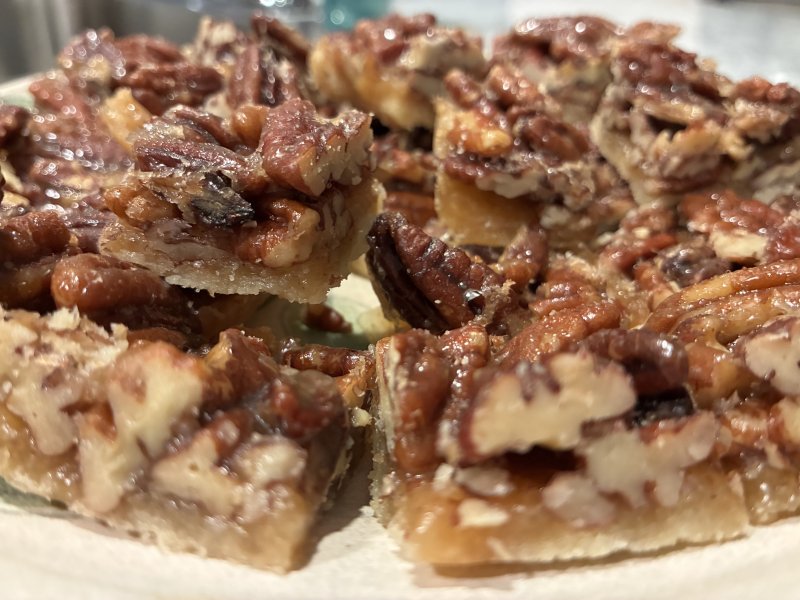
Pecans are best used in sweet dishes, like the pecan bars in the photo. My neighbor Ann offered to bake these for me when I mentioned I was writing about pecans. Similar in flavor to pecan pie, these are a perfect bite of crunchy and sweet. The recipe for pecan-crusted salmon gives you a quick and easy main course that goes well with rice and a green vegetable.
Ann’s Pecan Bars
Preheat oven to 350 F. Line a 9-by-13-inch pan with a foil sling sprayed with nonstick cooking spray; set aside. Combine flour, sugar, salt and melted butter. Press the mixture evenly across the prepared pan; set aside.
Combine sugar, corn syrup, vanilla, salt and butter in a mixing bowl. Add nuts and stir to coat. Spread mixture evenly onto the crust. Bake until bubbling, about 25 minutes. Allow to cool for 1 1/2 hours in the pan. Remove using the foil sling; transfer to a cutting board and slice into small bars. Yield: 4 dozen.
Pecan-crusted Salmon
Preheat oven to 375 F. Line a baking pan with parchment paper. Arrange the salmon pieces in a single layer, skin side down; set aside. In a small bowl, combine the remaining ingredients. Spread the mixture evenly on the salmon pieces. Bake until salmon is flaky and cooked through, about 15 to 20 minutes. Yield: 4 servings.
-

Send questions, comments and recipe ideas to Denise at deniseclemons1008@gmail.com.