












Winter weather is perfect time to inspect fishing gear
We seem to be in a bit of a cold spell. Temperatures have been below freezing for several days and snow is in the forecast for the weekend. This is not good news unless you are from one of our northern states or Canada where ice fishing is possible most of the year. I feel certain a few foolish souls will try to fish through the ice here in Delaware and they will end up having to be rescued by the local fire company.
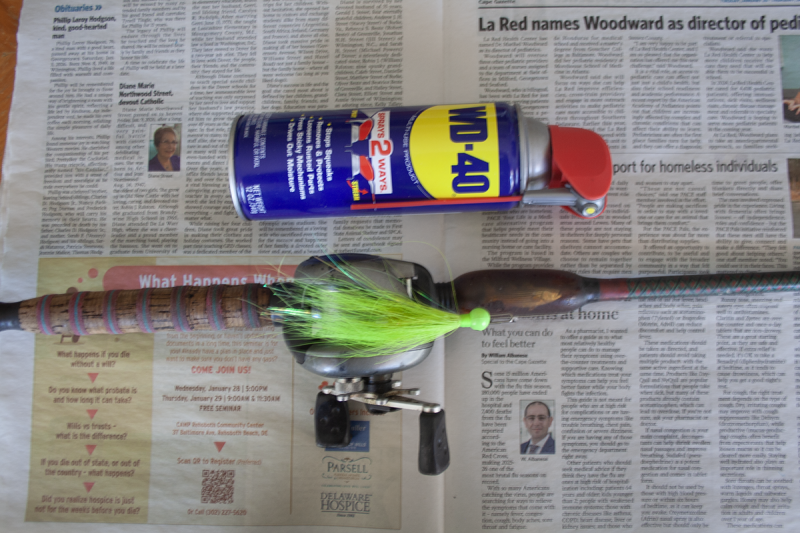
The first thing you should do when fishing is impossible is get out all your fishing tackle and make sure that all is in good shape. Go through everything in your tackle box or boxes. Take out all the lures, hooks, sinkers, snaps and swivels, and give them a good coating of WD-40. Then while your tackle box is empty, give it a good coating of WD-40 as well. The only things that should not be coated with WD-40 are the soft plastic lures.
Next up are your rods and reels. Check the condition of your line. Believe it or not, but monofilament line deteriorates in the sun and saltwater. It is a good idea to replace mono line every year if you do a lot of fishing. Retie all the knots connecting the shock leaders to your running lines. They have a tendency to weaken after running through the guides a few hundred times.
Speaking of the guides, check them for rough spots by running a cotton swab around the guides to see of any strands attach to the guide. If so, replace that guide.
There was a time when I would build rods over the winter. Then my brother-in-law Bobby Woods began a rod-building business in addition to working for General Motors. So, from then on, I let him build my rods.
It does take a good bit of talent to make a really nice-looking fishing rod. I have zero talent. I can build a functional rod, but pretty, not so much. If I want pretty, I go with Pat at PC Rods in Milton.
After taking care of the rods, you will want to work on the reels. Today’s reels are pretty bulletproof. They are well sealed so saltwater can’t get inside, and the outside is made from anti-corrosion material. Nevertheless, I like to spray all my reels really well with WD-40 after each use. Let the oil soak into the line and then wipe the reels down before putting them away. If the location where you plan to store your tackle for the winter is dusty, cover everything with an old sheet or blanket. As much as I love WD-40, it will attract dust.
While you have your plugs, metal lures, bucktails and rigs out, be sure to check the hooks for damage. A broken point can escape notice until you miss a few hard strikes.
With the very low limit for striped bass, it doesn’t hurt to have a few bucktails with the barbs crushed.
Back when I ran charter out of Virginia Beach and we had a two-fish limit on stripers, I would use barbed bucktails until the party had their limit. Then we would play catch-and-release with barbless bucktails until they decided they wanted to do something else. I had one gentleman from Georgia who only wanted to catch-and-release stripers. On one trip, he did so with over 50 behind the Third Island of the Chesapeake Bay Bridge-Tunnel.
Something you may not consider – fishing rags. Collect them from wherever you tossed them and make a pile for the washing machine. Use the strongest detergent you can find and the hottest water. Do not tell the wife what you are doing. Run the rags through the dryer, fold them up nice and neat, and no one will ever be the wiser.
I set all this up on a card table in my garage. If you don’t have a garage, you may have to use a table in the house. This could cause a conflict of interest. Some household members may consider the dining room or kitchen table strictly for eating and not suitable for working on fishing equipment. This is where a secondary use for the Cape Gazette comes into play.
Demonstrate how careful you will be to cover the table with the newspaper and additional wax paper as well as rags and even an old blanket under your feet. After you are done, no one will be able to tell you were there.
While reels, tackle and some rods may fit in the kitchen or dinning room, most surf rods will not. Save those for warmer weather to work on outside.
-

Eric Burnley is a Delaware native who has fished and hunted the state from an early age. Since 1978 he has written countless articles about hunting and fishing in Delaware and elsewhere along the Atlantic Coast. He has been the regional editor for several publications and was the founding editor of the Mid-Atlantic Fisherman magazine. Eric is the author of three books: Surf Fishing the Atlantic Coast, The Ultimate Guide to Striped Bass Fishing and Fishing Saltwater Baits. He and his wife Barbara live near Milton, Delaware. Eric can be reached at Eburnle@aol.com.