













WindSync quintet lights up Coastal Concerts stage
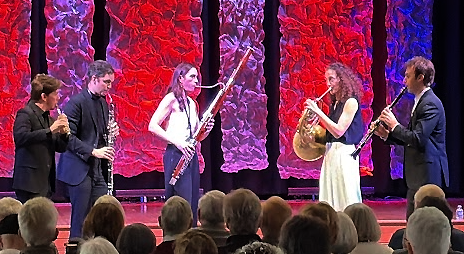
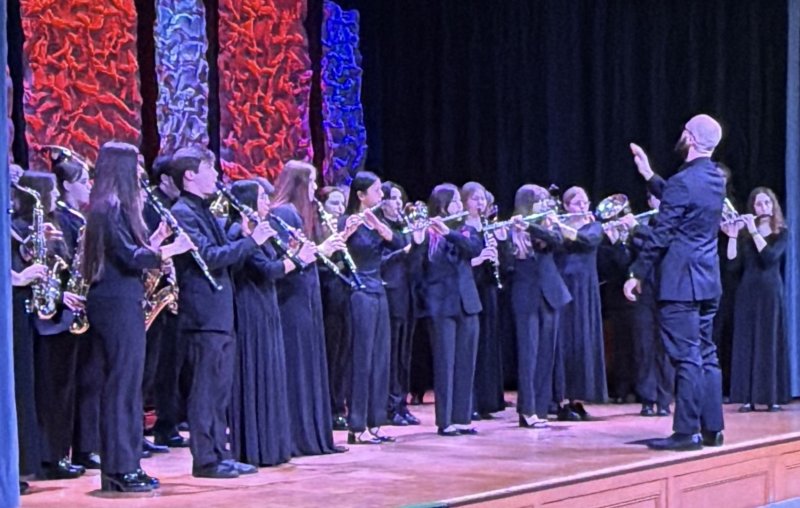
Coastal Concerts hosted WindSync quintet for a Feb. 14 performance at Bethel United Methodist Church in Lewes.
Comprising flute, oboe, clarinet, bassoon and horn, the ensemble combines virtuosic musicianship with theatrical presentation, memorized performances, and imaginative programming often incorporating narrative elements.
Opening the program with an enthusiastic rendition of John Philip Sousa’s “Washington Post March” was the Cape Henlopen High School Wind Ensemble, an audition-based group under the direction of Chris Burkhart.
WindSync dedicated the evening to Nadia Boulanger (1887–1979), the French composer, conductor and legendary teacher who shaped generations of composers including Aaron Copland, Leonard Bernstein, Philip Glass and Quincy Jones. Known as one of the first women to conduct major orchestras in Europe and the U.S., Boulanger’s influence rests less on her own compositions than on the clarity, discipline, and expressive integrity she instilled in her students.
In his pre-concert talk, oboist and audio engineer Lani Spahr highlighted Boulanger’s words, “The only thing lacking in many people is attention.” Spahr also offered insights into the program and Kara LaMoure’s adaptations for wind quintet.
WindSync began with Boulanger’s “Trois Pièces” (1914), originally for organ and later transcribed for cello and piano. LaMoure’s quintet arrangement preserves the work’s lyrical expressiveness: the first movement introspective, the second fleet and delicate, and the third broad and impassioned.
Next came Elliott Carter’s “Wind Quintet” (1948), a study in rhythmic independence and sharply characterized instrumental voices. Contrasting with Boulanger’s opening piece, Carter’s work showcases each instrument’s personality in lively, witty interplay.
The program continued with Jean Françaix’s “Wind Quartet “(1933), exemplifying his elegant, French neoclassical style.
The next piece was Philip Glass’s “Etude No. 17” (2012), one of 20 studies for solo piano, explores harmony, structure and Romantic expressiveness. Flowing arpeggios and gradually shifting harmonies reflect both Boulanger’s influence on clarity and form and Glass’s later immersion in Indian rhythmic concepts.
The evening concluded with W. A. Mozart’s “Serenade in C minor,” originally an octet and arranged for quintet by Mordechai Rechtman. Unlike a typical light-hearted serenade, the work broods darkly, with complex harmonies and demanding textures.
For a final flourish, the quintet performed their arrangement of George Gershwin’s “Summertime” from Porgy and Bess.
The Coastal Concerts season will continue with a performance by the Seraph Brass quintet at 7 p.m., Saturday, March 28.