













Story Location:
2301 KENTMERE PKWY
WILMINGTON, DE 19806
United States
Many works that Samuel Bancroft loved most are better described as products of the British Aesthetic movement than of the Pre-Raphaelite movement. The relationship between Aestheticism and Pre-Raphaelitism is difficult to parse. Pre-Raphaelitism has a definitive beginning, with the 1848 founding of the Pre-Raphaelite Brotherhood. But it has no clear endpoint; artists worked under its banner well into the twentieth century. By contrast, there is no secure start date for Aestheticism. In the 1850s some Pre-Raphaelite artists began to move away from their movement’s early mandates, particularly their policy of painting directly from nature. Artists who followed them, such as Edward Burne-Jones and Albert Moore, produced art whose chief aim was beauty rather than narrative or moral lesson. They were pioneers of the Aesthetic movement.
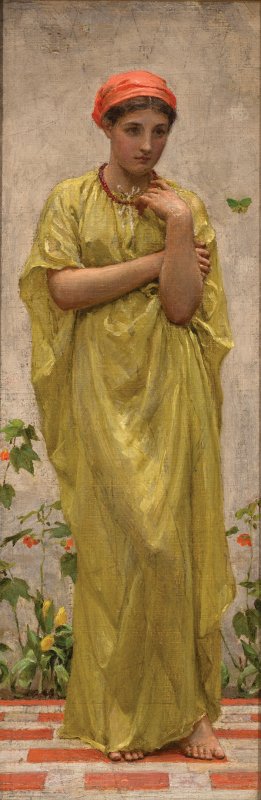
Moore was a quintessential aestheticist. He created paintings that lacked narrative context and exemplified the motto of the Aesthetic Movement: “art for art’s sake.” During his thirty-year career he rarely strayed from the formula for which he became known: narrow vertical canvases depicting slender women in classical drapery, set within shallow decorative spaces. Moore often named his paintings after a secondary focus of the composition; titles such as Azaleas, Birds, and Acacias underscore the paintings’ still-life qualities.
Bancroft purchased only one work by Moore, The Green Butterfly, which takes its name from the small green butterfly in the upper left. A classically draped figure stands against a gray wall on a terracotta tile floor with folded arms and a soft lowered gaze. Above her shoulder, the small green butterfly hovers against the wall, a minor detail that anchors the painting’s title and echoes the plants below. In its restraint and focus on color, pattern, and pose, The Green Butterfly reflects Moore’s commitment to the Aesthetic ideal of beauty pursued for its own sake.
Sophie Lynford
Annette Woolard-Provine Curator of the Bancroft Collection
Plan your Del Art visit today to see The Green Butterfly, currently on view. www.delart.org.