












Dogfish Head expansion approved
Dogfish Head brewery in Milton, which began as a 100,000-square-foot facility in 2002, has grown in sales by an average of 40 percent per year since it was founded, say its owners.
Today, the Cape Region business produces 75,000 barrels of beer a year. In 2009, it added 26 more jobs.
To continue to grow, more brewing tanks are needed, along with larger office space for its 70 employees and still-growing staffing needs, owners say.
But residents of the adjacent Chestnut Crossing residential development say that while they don’t oppose the nearby brewery, trucks roar by their homes daily, and compressors hiss in their back yards.
A sparse stand of trees needs to be beefed up, they say, to help cut down noise. They say contention has been brewing for years.
Complaints led code enforcement officers to check noise levels, but the brewery has not violated town code or been found to be operating outside the law. Supporters point out the brewery is located in a light-industrial district where such business is permitted. They say the business was established before the gabled, craftsman-styled homes were built in the development next door.
After a three-hour discussion, Milton Planning & Zoning Commission unanimously approved preliminary site plans – with some conditions, including the planting of 7-foot tall leyland cypress trees – before expansion plans for an office building and an outdoor tank farm move ahead. Dogfish executives have said all along they’ve been proactive on responding to residents’ complaints as a good neighbor in good faith.
Many sides of proposed expansion
A public hearing Wednesday, April 1, drew 50 demonstrators packing the upstairs conference room of the Milton Public Library.
On one side of the argument, Chestnut Crossing residents say the brewery property should have been zoned for heavy industrial use. They complained of daytime activity, malodorous breezes and rumbling trucks. On the other side, devoted Dogfish Head employees – many of whom moved here from out of state – testified the company is like a second family. The company’s growth benefits the surrounding area – about 40 percent of the brewery’s employees live in Milton, they say.
In the middle of the conflict is a brewery that draws 600 to 1,000 tourists a week over the summer, a company that owner Sam Calagione insists has always attempted to be a good neighbor.
Rising tanks, a Milton landmark?
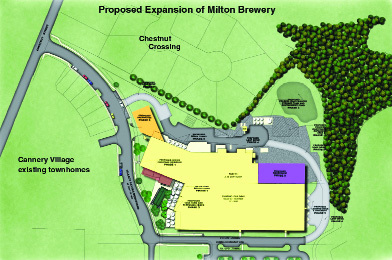
Dogfish Head brewery Chief Operating Officer Nick Benz unveiled plans for Phase 1 that include a two-story wood, glass and metal office space. The first floor includes a visitor entrance and beer-tasting bar, similar to current floor plans. Unlike the current building, however, the second floor would overlook an outdoor pedestrian plaza. Inside, it would contain cubicles for the administrative, marketing and executive offices.
“Everything we’re attempting to do is make this a first-class destination,” said Benz.
Plans for Phase 2 call for building 18 fermentation tanks, each 46 feet high, that would line the front of the new façade. Only six of them would be built in Phase 2. All of the tanks would be partially covered by a decorative scrim. A 1-foot concrete retaining wall would also surround the double-encased tanks to prevent accidental leakage.
Benz said Dogfish executives spent more than $20 million since 2003 to make the brewery less of an eyesore. Still, officials want visitors to see the rising tanks as a landmark for the brewery and the Town of Milton. Executives also plan to sink another $10 million into the brewery’s design and expansion, if its final site plan is approved.
“There’s nothing to increase noise or odors related to expansion,” said Benz.
But some residents disagree.
Chestnut Crossing resident David Downing said executives are deceiving residents when they say no extra noise or odors will come with expansion.
“It’s a question of volume,” Downing said.
Sue Fox, who also lives in Chestnut Crossing, said she enjoys the yeasty smell wafting from the brewery. “When I moved in, I was excited to live next to Dogfish,” she said. But the combination of more trucks hauling beer and waste combined with compressors working continuously to provide an increased beer supply might make the brewery unbearable.
She suggested changing the use to a heavy industrial zone.
When Ellen Calhoun bought her home at the end of the Chestnut Crossing cul-de-sac, she said the brewery wasn’t an intrusion. But the pleasant noise of crickets and frogs soon gave way to compressors and trucks, she said.
Dogfish head attorney Mark Dunkle of Dover-based Parkowski, Guerke & Swayze said residents knew they were buying property next to a light-industrial zone.
Milton town attorney Mary Schrider-Fox said deeds for lots 17 through 22 of the Chestnut Crossing development say the light-industrial zone exists. Dunkle also said the project was endorsed by Director of the Office of State Planning Connie Holland and Director of the Delaware Economic Development Office Alan Levine.
Calagione said his brewery, which was recently featured in the New Yorker, brings added business to the area. He also said he’s bent over backward to allay residents’ complaints. His plans also included planting more trees. “We feel we’ve earned the right for that good neighbor policy to go in both directions,” he said.
The grounds of the old canning factory used to be marked by knife fights in the parking lot, he added.
“We never said we weren’t going to continue to grow. We’ve earned the right by staying within the code, staying within the law. We know we have to stay within the code and the law. But I want to remind you we are not under trial for breaking the code or laws in the past,” said Calagione.
Planning & Zoning Commission Chairwoman Ginny Weeks said the council very much liked the proposed design. Member Louise Frey likened the office plans to the architectural style of Frank Lloyd Wright. Future plans for upcoming phases will be scheduled for the commission’s review.