













Delaware Judiciary expresses condolences on passing of retired Justice Henry Ridgely Horsey
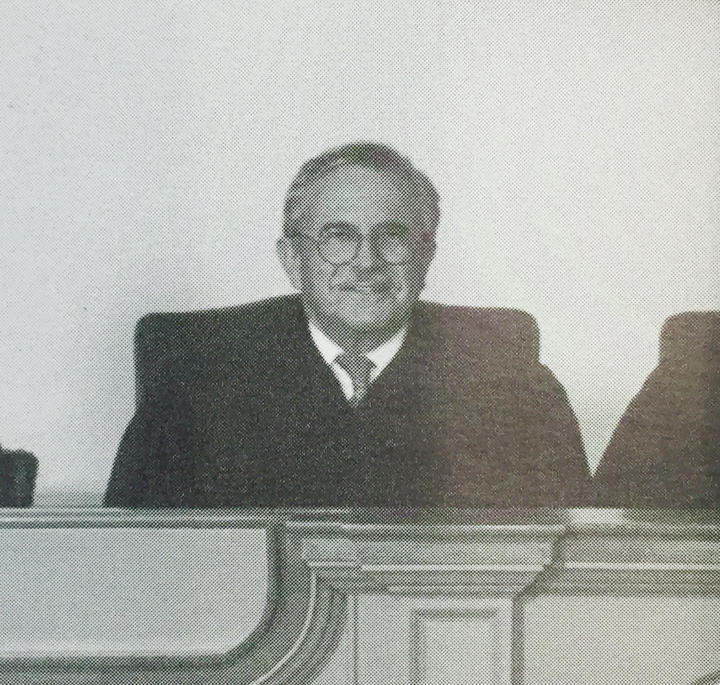
The Delaware Judiciary was saddened to learn of the passing of retired Justice Henry Ridgely Horsey Thursday night, March 3, and offered their condolences to his family and friends.
Justice Horsey, 91, served on the Delaware Supreme Court from 1978 until 1994.
“It was an honor for me to serve with Justice Horsey, who warmly welcomed me to the Delaware Supreme Court,” said Justice Randy J. Holland speaking on behalf of the Delaware Supreme Court. “Justice Horsey continued a family tradition of judicial and public service that spans 250 years. Many of his opinions are landmark decisions on a wide variety of legal principles.”
Horsey hailed from a family with a long tradition of reverence for the law and service to the citizens of Delaware. One of his forefathers, Nicholas Ridgely of Eden Hill Farm, served as a judge of provincial Supreme Court of the three lower counties of the Pennsylvania colony, an area that later became the State of Delaware.
Justice Horsey served in the U.S. Army for three years, from 1943-46 during World War II, first in the infantry and later in the combat engineers, with two years in the European Theater. Upon his discharge in 1946 as a sergeant, he resumed his education at Harvard College and Harvard Law School, graduating in 1952. He was admitted to the Delaware Bar in 1953 and practiced law in Wilmington as an associate and then a partner at Berl, Potter & Anderson (now Potter, Anderson & Corroon) from 1953-62. From 1962 until 1965, Horsey served as a trust officer and assistant vice president of the Wilmington Trust Company. He then returned to the practice of law in Dover, joining the Delaware Attorney General’s Office for several years and operating a solo law practice until 1969 when he joined the Dover office of Morris, James, Hitchens & Williams, until 1978 when he was appointed to the Delaware Supreme Court.
During his tenure on the state’s highest court, Horsey authored more than 200 published opinions. Many of Horsey’s opinions became landmark decisions, most notably his opinion in Riley v. State, which became the format for the seminal holding by the U.S. Supreme Court in the landmark 1986 case Batson v. United States, which prohibits attorneys from removing prospective jurors during jury selection in criminal proceedings based on race. Many other opinions by Horsey are landmark rulings in regard to principles of corporate governance.
At the 1984 Superior Court investiture of Henry DuPont Ridgley, who would later go on to become a Delaware Supreme Court Justice as well, Horsey passed on to his young relative the “Ten Commandments for a New Judge”
“First and foremost, be kind. Second, be patient. Third, be industrious. Four, be prompt. Five, there is no unimportant case. Six, give the office the prestige and dignity expected of it. Seven, but don’t take yourself too seriously. Eight, be tolerant of appellant courts if and when you are reversed. Nine, don’t leave home or the courthouse without your most precious tool, common sense. Ten, pray for divine guidance.”