













I was listening to the radio the other day, and a song I’d never heard began to play. The lyrics were quite simple, describing how it just wasn’t possible to do the things we did when we were younger, with the refrain, “He’s too old to cut the mustard.” According to food historians, we should look to the area of East Anglia in Great Britain for the source of the saying, where there were widespread mustard crops in the fields.
These plants could grow to six feet tall and were cut by hand with scythes. It was difficult work and required very sharp tools. When the scythe blades became blunt, they couldn’t cut the mustard. Another observation is the challenge of making the spicy condiment we refer to as “prepared mustard.” The authentic recipe entails grinding the seeds with a mortar and pestle, although there are others that use mustard powder.
The idiom "cut the mustard" is used to indicate success or having met expectations, especially when performing a task well. The leaves, seeds, flowers and stems of this plant are all edible and have a pungent, spicy flavor. The leaves can be cooked or eaten raw in salads. The stems can be prepared and eaten like broccoli. The seeds can be ground into a powder for flavoring other sauces or to make hot mustard.
There are three main types of mustard cultivars, all members of the Brassica family botanically. White or yellow mustard is the mildest-tasting of the three, and its seeds are used to make prepared mustard. Black mustard seeds are used to make moderately spicy mustard and found in Southeast Asian cooking. Brown mustard is the hottest variety. Its seeds are used for Dijon-type mustards, Chinese hot mustards and curries. It is also grown for its greens.
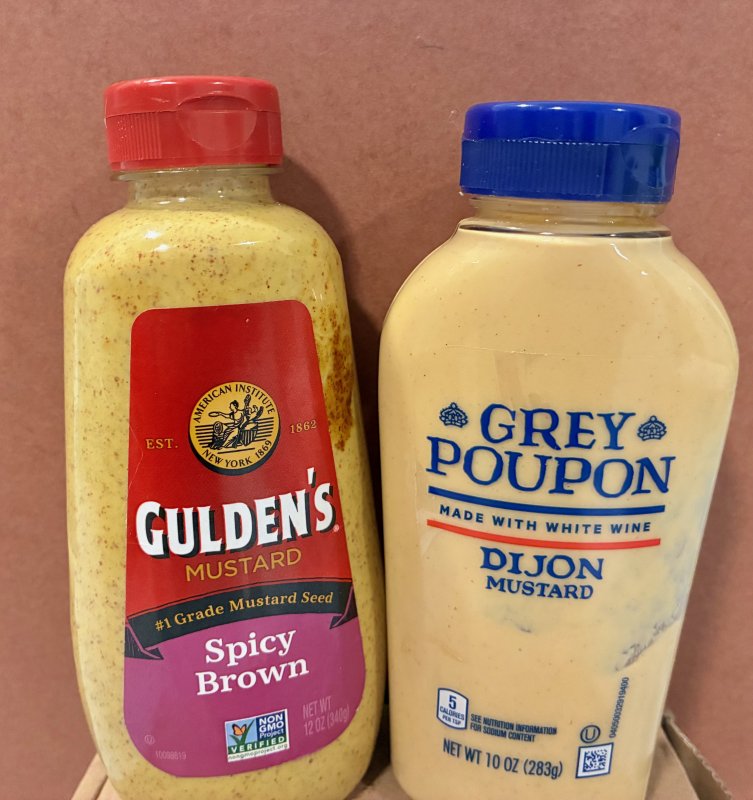
You will find a wide variety of mustard styles for sale in your grocery store or speciality market. They range from standard yellow (what I call hot dog mustard), to darker and spicier brown style, to the very sharp and smooth Dijon. You can see from the photo what’s in my refrigerator. There are also preparations that leave some of the seeds intact, providing a crunchy mouthfeel as you bite into your ham and cheese sandwich.
While "passing the mustard" is about handing over the Grey Poupon, "cutting the mustard" is the phrase that means to meet expectations, similar to "passing muster.” Sometimes the expressions are used interchangeably. The latter comes from the military and means "to pass inspection." Since the 15th century, muster has referred to calling together people for inspection, taking attendance or marching exercises.
If you join the military, you muster in, and when you end your military service, you muster out. Also, formations are still referred to as “musters,” the goal of which is to pass muster. In the civilian world, if you pass muster, you have met a required standard. Now, whether we’re cutting the mustard or passing muster, we’re demonstrating that we have what it takes to succeed at a task.
Finally, to help you all accomplish something useful by making a tasty dish, I’ve included instructions on making grainy mustard from seeds, as well as recipes for two dishes from the Norwich Mustard Museum, which features the familiar yellow cans and jars of Colman’s English mustard.
Whole-Grain Mustard
In a wide-mouth Mason jar, combine the vinegar, mustard seeds and white wine. Cover loosely and leave to soak at room temperature for at least four hours or up to two days. Stir the kosher salt into the soaked mustard seeds. Use an immersion blender to process the mixture, about one minute for a coarse-ground mustard.
Taste the mustard and store it covered in the refrigerator if you are satisfied with the flavor. If you prefer a mellower mustard, let it age at room temperature for a day or two, then store in the refrigerator for up to one year. Yield: 1 C.
Beef Salad with Mustard Dressing*
Arrange the salad leaves in a serving bowl. Cut the steak into thin strips.
Heat the oil in a large frying pan until hot. Add the steak, in small batches, and sauté until cooked but still slightly pink in the center. Season to taste with salt and pepper.
Using a slotted spoon, scatter the steak over the salad leaves. Heat the pan and add the vinegar, stirring to loosen any browned bits. Stir in the mustard until combined. Pour the hot dressing over the beef and serve immediately with crusty bread. Yield: 4 servings. *Adapted from Colman’s Mustard Shop.
Mushrooms with Mustard Cream*
Heat the oil in a large skillet. Cook shallots, garlic and mushrooms over medium heat until beginning to brown. Stir in the crème fraiche and mustard. Season to taste with salt and pepper. Serve as a main meal with pasta or as a starter with a crisp-fried bread slice and salad. Yield: 2 to 3 servings. *Adapted from Colman’s Mustard Shop.
-

Send questions, comments and recipe ideas to Denise at deniseclemons1008@gmail.com.