












European Union ambassadors discuss climate change
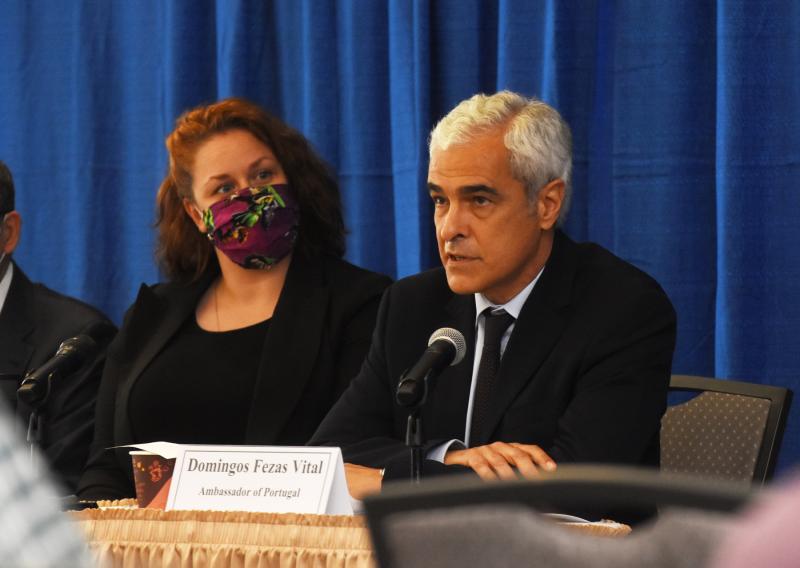
Ambassadors from Denmark, Portugal, Croatia and Cyprus visited the Virden Center in Lewes Oct. 18 to discuss how each of their countries is dealing with and adapting to climate change.
The visit was part of a larger effort to highlight and strengthen the cultural, educational, scientific and business ties between the state of Delaware and European Union member states.
Sen. Tom Carper welcomed the ambassadors to Lewes. He described climate change as the “greatest challenge we face on this planet” before highlighting some of the work Congress is doing to combat the crisis and how Delaware can be a part of the solution.
Offshore wind provides immense benefits, he said. In addition to creating jobs, he said, the energy can be used to create clean hydrogen without creating more carbon dioxide.
“We can use that clean hydrogen for a number of things including propulsion to vehicles, including big trucks,” he said.
Shawn Garvin, secretary of the Delaware Department of Natural Resources and Environmental Control, said Delaware has a responsibility to lead the efforts to reduce emissions while also preparing for the impacts of climate change. He said Delaware’s greenhouse gas emissions exceed those of many small countries.
Transportation is currently the leading contributor to greenhouse gas emissions in Delaware, Garvin said. Transitioning to cleaner transportation sources, expanding charging stations, reducing vehicle miles traveled and improving efficiency of freight delivery are some of the ways to reduce emissions, he said.
Carper said he recently spoke with General Motors President and CEO Mary Barra, whom he first met at the Detroit Auto Show 10 years ago.
“She said she’s all in on electric,” Carper said. “That’s where the future is. We’ve done all we can with the internal combustion engine.”
While Carper doesn’t disagree, he said the future of the automobile industry will also include hydrogen fuel cells.
Economic impacts
In Delaware, Garvin said, climate change threatens many of the state’s biggest industries. Rising temperatures will have a major impact on the agricultural industry, which contributes $8 billion annually to the economy. Tourism, which contributes $3.5 billion annually to the state’s GDP, is another threatened industry.
“Nearly $1.5 billion in tax-assessed properties is located within areas that are projected to be inundated by 1.5 meters of sea-level rise,” he said.
Delaware is located within a “sea-level rise hotspot” due to a combination of rising seas, sinking land and ocean currents, he said. It’s estimated that Lewes could see between 50 and 135 high-tide flooding events by 2050, he noted, referencing a National Oceanic and Atmospheric Administration study. Lewes had nine such events in 2019, he added.
Climate change is also expected to bring both higher frequency and intensity of heavy rain events over the next century, he said.
Garvin said the state is in the process of developing a comprehensive climate action plan that will provide a roadmap for reducing emissions and increasing efficiency. It’s also focused on resiliency and adaptation. The plan is expected to be released soon, he said.
He said Delaware is watching the action being taken by European Union nations, specifically in wind and solar, and will use that information as it develops its own programs to address climate change.
Renewables around the world
Denmark is one of the countries leading the world in offshore wind power.
“Our transition to green economy started back in the ’70s,” said Ambassador Lone Dencker Wisborg. “It was not because we wanted to protect the climate ... it was actually an energy security issue stemming from the oil crisis that made us look for alternative energy sources. We have a lot of wind in Denmark, so it was a natural place to look.”
The transition has been a boost to the workforce. She said for every gigawatt installed, almost 15,000 jobs have been created.
“We believe the potential in Delaware for offshore wind is between 15 and 20 gigawatts,” she said. “You can multiply that by 15,000 jobs, so there is a huge potential here.”
Denmark is embracing green energy in both public and private ventures, she said. Danish-based company Ørsted, which has been developing plans for several years to build a wind farm off the coast of Delaware and Maryland, was known as Danish Oil and Natural Gas Company just 10 years ago.
The Port of Esbjerg was once an oil and gas city, but it is now the leading port in Europe for offshore wind. Companies are also thinking of putting carbon dioxide emissions into reservoirs where they have excavated oil and gas, in a process called carbon capture.
“It sounds like a fantasy, but it’s real,” she said. “It’s something I think is very relevant for Delaware.”
The Portuguese are heavily invested in renewable energy, said Ambassador Domingos Fezas Vital, noting that about 60 percent of Portugal’s energy consumption comes from renewables. In 2016, Portugal ran solely on renewable energy for three straight days.
“We’ve been proving that betting on renewables is, economically speaking, a sound investment,” Vital said.
Like Denmark, Vital said Portugal did not have much of a choice other than to embrace renewable energy.
“It was not out of our concern for climate action,” he said. “It’s because we don’t have fuel, other sources of energy, so we had to go for it.”
Solar, in particular, is becoming highly competitive with other sources of energy, he said.
“Renewables in Portugal were highly subsidized in the beginning, and it’s paid off,” he said. “What we are witnessing now is a lowering of the prices that is quite significant.”
In addition to solar, Portugal is also developing wave energy, using the force of waves in the ocean to produce power.
Climate change effects
Croatian Ambassador Pjer Šimunović said his country is seeing a disturbing pattern of sea-level rise. Recently, he saw a model of how his native city of Split would fare if sea-level rise continued unimpeded.
“It would basically be flooded,” he said. “And that’s not to talk about some of the more fragile cities in the Adriatic, such as Venice. The sense of necessity to protect the environment has been heightened.”
He said the European Union is at the forefront in developing and applying policies to address climate change, extreme weather and erosion of the oceans and seas. He said the Biden administration is working toward those goals as well.
“We see a convergence of interests when it comes to address this issue,” he said. “Europe and America have very ambitious plans to limit, stop and ultimately reverse carbon emissions.”
The goal is to reach net zero emissions, he said.
“We are implementing a full range of measures aiming to do just that, making a transition toward green energy and getting rid of fossil fuels such as coal and burning oil,” he said.
He knows not everyone is on board, though.
“Some countries, some companies see it profitable to boost production of fossil fuels to a further detriment to our environment, including marine pollution,” he said.
Marios Lysiotis, the ambassador from Cyprus, said the Mediterranean is warming at a rate 20 percent higher than the rest of the world.
“All these things have consequences,” he said, pointing to devastating fires that ravaged the region this past summer. Other issues include land erosion and water shortages, he said.
In mid-October, Cyprus was the host of the International Conference on Climate Change in the Mediterranean and the Middle East: Challenges and Solutions. The two-day event brought together international scientists, policymakers and experts to discuss recommendations for a climate action plan. The goal is to implement at the local level, Lysiotis said.
“It’s local government-driven, but is also includes a lot of international activity, even for the United States, and we believe that we can create bridges of cooperation with institutions and researchers which could help meet these challenges,” he said.
Portuguese Ambassador Vital highlighted that his country and Kenya will co-host the 2022 UN Ocean Conference next summer. The goal is to develop a strategy that is globally approved.
Now is the time for countries to work together to develop policies to address climate change issues, he said.
“It’s not possible to address such an issue without a policy that goes beyond our borders,” he said.


Nick Roth is the news editor. He has been with the Cape Gazette since 2012, previously covering town beats in Milton and Lewes. In addition to serving on the editorial board and handling page layout, Nick is responsible for the weekly Delaware History in Photographs feature and enjoys writing stories about the Cape Region’s history. Prior to the Cape Gazette, Nick worked for the Delmarva Media Group, including the Delaware Wave, Delaware Coast Press and Salisbury Daily Times. He also contributed to The News Journal. Originally from Boyertown, Pa., Nick attended Shippensburg University in central Pennsylvania, graduating in 2007 with a bachelor’s degree in journalism. He’s won several MDDC awards during his career for both writing and photography. In his free time, he enjoys golfing, going to the beach with his family and cheering for Philadelphia sports teams.