













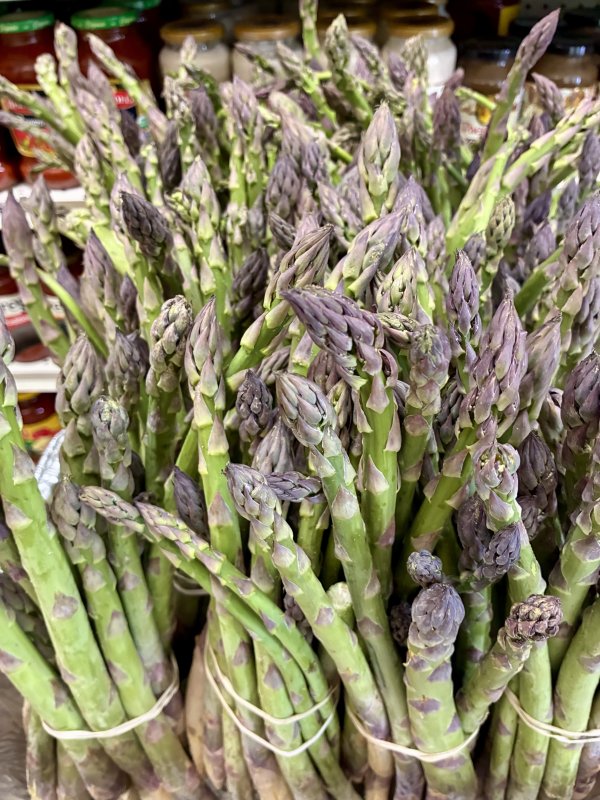
Asparagus is one of my favorite vegetables, not only for its distinctive flavor and quirky growing habit, but also because when I see those lovely green stalks at the grocery, it is a sign that spring is here. Lloyd’s Market in Lewes has an abundant supply of local asparagus available, as seen in the photo.
Asparagus has been a prized food since the time of ancient Greece and Rome. More than 2,000 years ago, Egyptians cultivated asparagus for medicinal purposes, and spears were offered to their gods in religious rituals. The plant was originally discovered in the wild, with pencil-thin spears, but the ancient Romans cultivated asparagus in the first century AD, producing spears that weighed as much as one-third of a pound.
The name comes from the Persian word “asparag,” which translates as “shoot,” a description of how it grows. It became known as the food of kings, with France’s Louis XIV insisting it be grown in greenhouses to enjoy year-round. We can thank the European settlers who brought the vegetable to North America in the 17th century, where it was called “sparagus” or “sparrow grass.”
To grow asparagus (which can be done in a backyard garden or raised bed), start with 1-year-old roots called crowns. These will grow both vertically, producing spears, and horizontally, providing a base for more spears. Growers are advised to not try to harvest for the first three years, so the plant can develop dependable roots. Once you reach year three, the plant is hardy enough to harvest the spears. A well-established crown will last for up to 15 years.
Most shoppers will easily find green asparagus, the most common kind, but there is also a purple variety that has a slightly sweeter flavor. This type should only be cooked briefly or used in salads to avoid losing its unique color. Another variety, white asparagus, is simply green asparagus that hasn’t seen the sun. Spears have remained underground, often cultivated in mounds of dirt to protect them from light. These are more tender than the green, with a similar flavor profile.
Now that you’ve secured your fresh, spring asparagus, what will you do with it? The possibilities are boundless. But first, you have to address the controversial removal of the woody stems. Some people advocate holding the spear horizontally with two hands and bending it slightly until it snaps. This should mark where the moist, tender upper spear can best be separated from the more desiccated part of the stem.
Some people will snap each spear separately, hoping to find the exact spot at which it should break. Others will use the first spear as an example and cut the ends from the remaining spears at about the same point. Even after removing the thickened end, some cooks advise using a vegetable peeler to remove the top layers at the base of the stem to ensure tenderness.
How can you cook asparagus? Roast, braise, steam, grill, sauté, stir-fry or shave raw into salads. Dress the cooked spears with lemon juice, wrap them in prosciutto, add them to a frittata or quiche, purée them into soup, stir them into risotto or use them to replace basil in your favorite pesto recipe.
Public Service Announcement – There is one drawback to enjoying asparagus; it contains sulfur compounds that will give your urine a distinctive odor. It’s completely harmless and not a reason to avoid this healthful, delicious spring vegetable.
Lemon Parmesan Asparagus
Asparagus & Spinach Quiche*
Preheat oven to 375 F. Coat the inside of a 9-inch pie pan with nonstick cooking spray; set aside. Rinse, drain and trim asparagus; cut into 1-inch pieces. Heat oil in a large skillet over medium. Add onion and cook, stirring often until translucent, 2 to 3 minutes. Increase heat to medium-high and add asparagus, cook, stirring often, until the asparagus is tender-crisp, 3 to 4 minutes. Add spinach, thyme, garlic and cook, stirring constantly, until the spinach is wilted and the garlic is fragrant, 1 to 2 minutes. Remove from heat and let cool for 10 minutes. In a large bowl, whisk together eggs, half-and-half, mustard, salt and pepper. Gently stir in the asparagus mixture and cheese; pour into the prepared pie pan. Place the quiche on a rimmed baking sheet and bake until set and golden brown around the edges, 30 to 35 minutes. Let stand for 10 minutes before slicing. *Adapted from Eating Well.
-

Send questions, comments and recipe ideas to Denise at deniseclemons1008@gmail.com.