












Recreational fishermen harvest majority of striped bass
It seems I struck a nerve down in Washington, D.C., at the office of Stove Boat LLC, a public affairs and communications consultancy specializing in ocean-related industries, including fisheries, the environment and shipping, among others.
Robert Vanasse, the principal there, disagreed with my statement that recreational fishermen were not solely responsible for overfishing of striped bass. He had his staff search the documents of the Atlantic States Marine Fisheries Commission until they found data to support his statement.
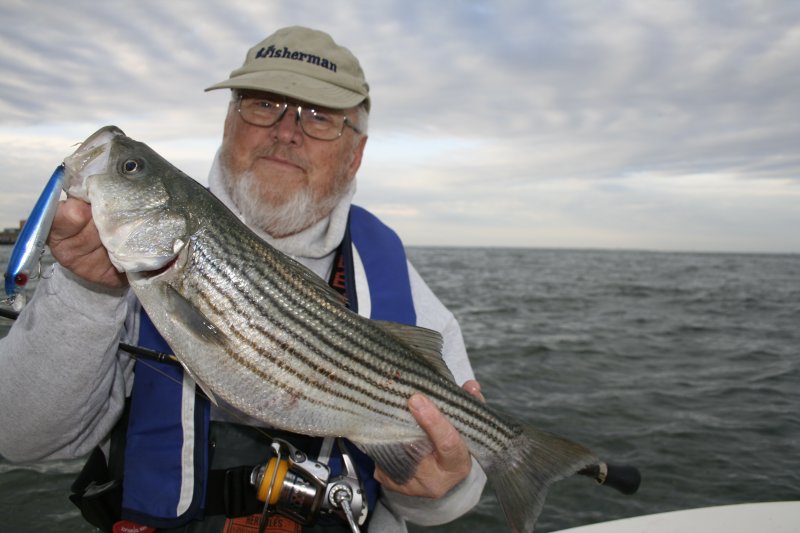
Sure enough, they found information in ASMFC documents that reported that recreational fishing accounted for 87% of striped bass removals in both 2019 and 2020 and recreational release mortality was 54% of total mortality in 2020. Commercial fishing accounted for the remainder of the mortality. The other four footnotes had similar statistics.
In 2022-23, with a one-fish slot limit of 28 to 31 inches along the Atlantic Coast and pretty restrictive limits in the Chesapeake and Delaware bays, according to the fifth footnote, recreational fishermen still accounted for 49% harvest and 40% discard mortality. Commercial fishermen had 10% of the harvest and 0.5% of the discards.
While this highly questionable data does show that recreational fishermen did harvest or cause discard mortality for a majority of the striped bass removed from the stock, nowhere does it show or mention that recreational fishermen overharvested the stock. These figures only show the total striped bass removed by recreational and commercial fishermen. I suppose if the stock was indeed overfished, then since we removed most of the stripers, the conclusion is we are responsible for the overfishing.
Now, you may ask, exactly where does this data come from? If you guessed the Marine Recreational Informational Program, you would be correct. I believe the data from that source is about as accurate as trying to hit a running deer at 100 yards with a bowling ball.
Currently, there is a regulation in Maryland to prohibit striped bass fishing during the month of August. There is also a bill in a legislative committee that would cancel that regulation. Charter boat captains, tackle shop owners and all businesses connected with striped bass fishing support that bill. Conservation groups who know that releasing stripers in the very warm August water is not good for their survival oppose said bill. It is possible that by the time you read this, the bill will have passed out of committee or been killed.
Underwater plants
A recent article in Outdoor Delaware, a publication from DNREC, told the story of underwater vegetation and how important it is to so many other things.
One of the first things I learned from Kayla Clauson, an environmental scientist with DNREC, was that many underwater plants drop seeds. I always assumed they propagated by spreading roots. But no, they drop seeds just like land-based plants.
I did know how important underwater plants are to small fish and crabs. Their presence gives these tiny creatures a place to hide from hungry predators and yet find food for themselves.
A large section of underwater plants can diminish the force of waves against the shoreline and cut down on erosion. Just like plants above the water, plants below the water take in carbon dioxide and produce oxygen. With great concern about ocean acidification caused by too much carbon dioxide going into the water, any help with removing that chemical can do nothing but improve the condition of the water.
Apparently, Delaware Bay is not as welcoming to underwater plants as waterways to our north and south. There is a continuous band of marine seagrass stretching from North Carolina to Maine except for a break around Delaware Bay. Exactly why Delaware Bay is different from the Chesapeake Bay is unclear. It could be that Delaware Bay water is warmer and more opaque than the Chesapeake’s.
Whatever the reason or reasons, DNREC has established a facility in Lewes for research and restoration. The site enables scientists to harvest and process seeds, and conduct experiments to see how plants fare under different conditions and which is best suited for restoration.
DNREC has also started a volunteer monitoring program where Delawareans can collect water-quality data on behalf of the workgroup.
Clauson would like to make folks in Delaware more attuned to the underwater plants found in our saltwater and brackish water areas. These plants are very important, and it seems that Delaware has been behind in our research. With the establishment of this new facility in Lewes, I believe we can close the gap.
-

Eric Burnley is a Delaware native who has fished and hunted the state from an early age. Since 1978 he has written countless articles about hunting and fishing in Delaware and elsewhere along the Atlantic Coast. He has been the regional editor for several publications and was the founding editor of the Mid-Atlantic Fisherman magazine. Eric is the author of three books: Surf Fishing the Atlantic Coast, The Ultimate Guide to Striped Bass Fishing and Fishing Saltwater Baits. He and his wife Barbara live near Milton, Delaware. Eric can be reached at Eburnle@aol.com.