













Rehoboth considering changes to commercial GFA calculation
Story Location:
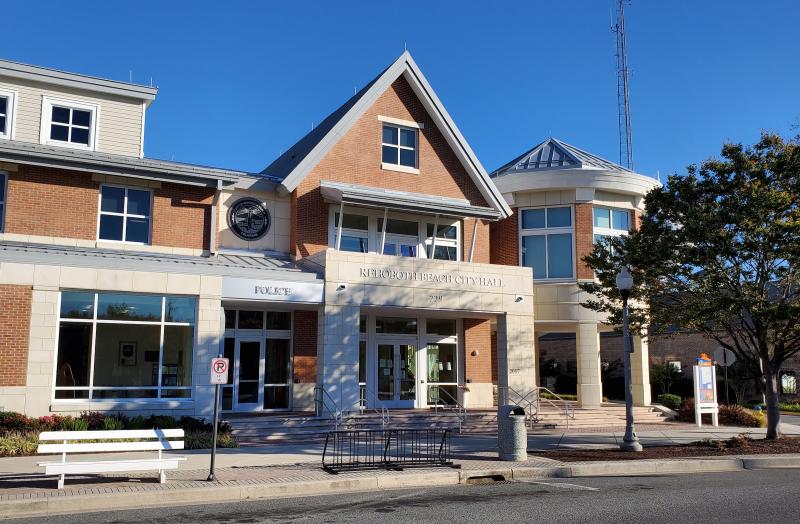
Rehoboth Beach City Hall
229 Rehoboth Avenue
Rehoboth Beach, DE 19971
United States

Earlier this year, Rehoboth Beach commissioners changed city code to define what architectural features do and don't count toward the gross floor area calculation of one- and two-family home construction.
Now, commissioners are taking on the same task with commercial construction, and they’ve set a public hearing for 2 p.m., Friday, Oct. 15, to get citizen comment on proposed changes.
It was commercial construction, primarily the proposed Atlantic Crown hotel on Baltimore Avenue, that spurred the city’s move toward defining, with lists, what does and doesn’t count toward gross floor area calculation. Since the hotel was first introduced in July 2018, the primary sticking point between the city and the developer has been whether the balconies of the hotel rooms facing Baltimore Avenue should count toward gross floor area, which is part of the floor-to-area ratio and ultimately helps determine the number of parking spaces a project is required to have.
The question was recently settled by Delaware Superior Court Judge Mark H. Conner, who affirmed that the Rehoboth Beach Board of Adjustment ruled properly when it voted in favor of the building inspector’s definition of architectural features that are a part of gross floor area – porches, balconies, decks and staircases.
However, the problem with including those features – as pointed out by the Atlantic Crown attorney during the September 2019 board of adjustment hearing – is that the city hadn’t differentiated between commercial and residential construction, and had not been enforcing the list for residential construction, while enforcing it for commercial construction. At the time, former Building Inspector Damalier Molina said the discrepancy was a result of him examining commercial construction plans and his assistant Matthew Janis examining residential.
The morning after that hearing, Molina issued a notice saying gross floor area for residential and commercial construction would be calculated the same. The problem with his decision was that it immediately put some of the new homes built over the past decade in Rehoboth Beach out of code because they had some of those features. That’s why commissioners, under former Mayor Paul Kuhns, took on residential construction first – to correct the new problem.
Proposed changes to commercial construction
With residential construction issues resolved, and bolstered by the results of the recent court case, commercial construction was brought back for discussion a few meetings ago.
Commissioners Susan Gay and Patrick Gossett have conducted the interviews with Janis, who took over as building inspector about a year ago, and crafted language that they say reflects how he interprets code related to the gross floor calculation in the commercial district. Both have pitched the changes as a clarification of the code.
This is how it’s being enforced now, Gay said a number of times over recent meetings.
As proposed, gross floor area in a commercial use would include floor space of all habitable spaces above a finished height, at or above 7-feet-6-inches; portions of basements above a finished height at or above 6-feet-6-inches; porches, balconies, decks, patios, pergolas, gazebos, canopies, whether covered or uncovered; courts closed on three or more sides and covered; atria, or greenhouses, closed on all sides and covered; walkways and corridors that are covered; storage and equipment spaces, at a finished height at or above 6-feet-6-inches; heating, ventilating and cooling devices, compressors or pumps in enclosed and roofed habitable areas; roofed outdoor showers; covered parking, carport, garage, porte-cochere at or above grade; parking area located below finished grade or finished floor of habitable space; all interior and exterior stairwells and stairhalls, on all levels, above grade; elevators, elevator equipment rooms, and elevator shafts; swimming pools, swimming pool pumps, filters and equipment and surrounding deck.
There are fewer proposed exclusions – open areas such as, but not limited to, parking lots, loading zones and driveways if uncovered; and underground parking area, as defined in code.
These proposed changes have been discussed a few times over the last couple of months at city meetings, and there has been some wordsmithing, but generally speaking, not much has changed.
With a majority of the commissioners supporting the proposed changes, opposition to the new lists has been limited, but present.
Commissioners set the public hearing date during a Sept. 17 commissioner meeting. Commissioner Edward Chrzanowski voted against setting a date because he said he doesn’t think the ordinance is ready for public comment, and he could think of at least one difference between the lists and how things have been interpreted recently – Clear Space Theatre Company’s Rehoboth Avenue project.
Under these lists, the patio between the theater’s two proposed buildings would be counted, but that wasn’t part of the discussion before, said Chrzanowski.
At another meeting, a Sept. 8 commissioner workshop, former Commissioner Richard Byrne, in his last meeting as commissioner, said he thought the changes would put the city’s commercial developers at a competitive disadvantage.
Byrne clarified his comment in a Sept. 10 email. He said he’s supportive of the need to clarify aspects of the zoning code, but the draft proposal is too rigid. This policy can result in commercial buildings that have straight up-and-down exterior walls – buildings that look like boxes, said Byrne.
“It leaves no incentives for creative design,” said Byrne. “Typically, a balcony, terrace, or patio isn’t included in the square footage calculations. This is because balconies and patios are not enclosed, not heated, and not livable. Open-air balconies and decks are not an integral part of the internal area of a building.”
Byrne said neighboring resort towns are not approving similarly rigid policies because they become disincentives for commercial development. Such policies drive out those who want to invest, and with them go the tourist dollars.
Bottom line, the purpose of zoning is to control bulk, which doesn’t mean giving up beauty and charm, said Byrne. Like most, he said he wants to limit the overall dimensions of buildings, but not give up aesthetics or those characteristics which sustain a viable resort business district.

Chris Flood has been working for the Cape Gazette since early 2014. He currently covers Rehoboth Beach and Henlopen Acres, but has also covered Dewey Beach and the state government. He covers environmental stories, business stories and random stories on subjects he finds interesting, and he also writes a column called Choppin’ Wood that runs every other week. He’s a graduate of the University of Maine and the Landing School of Boat Building & Design.