













Restaurant, credit card companies clash over bill to end surcharges on tips
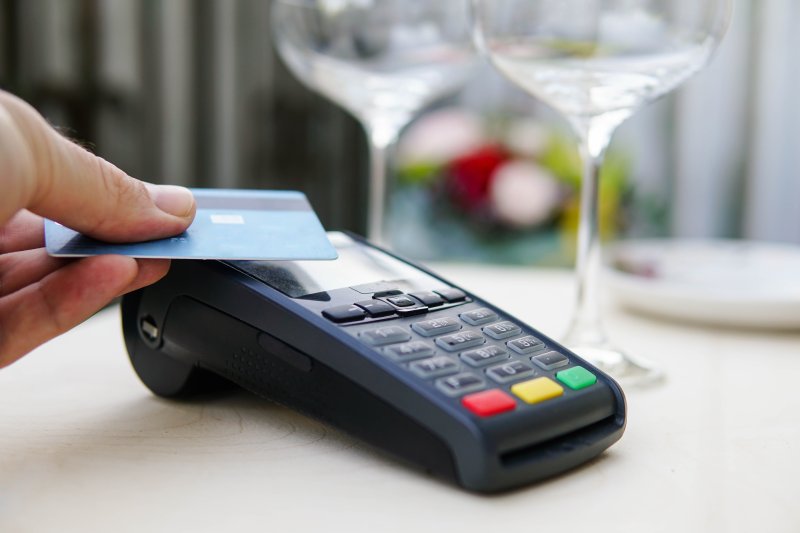
A bill that would end surcharges on credit card tips may have support from restaurants, but the credit card industry is pushing back.
“This is a big deal for small businesses, and all businesses that have transactions with tips,” said Carrie Leishman, president and CEO of the Delaware Restaurant Association.
House Bill 315, sponsored by Senate Minority Leader Gerald Hocker, R-Ocean View; Sen. Darius Brown, D-Wilmington; and Rep. Kim Williams, D-Marshallton; with support by Rep. Claire Snyder-Hall, R-Rehoboth Beach; and Sen. Russ Huxtable, D-Lewes; would stop credit cards and other payment card networks from charging fees for tips left on credit card transactions.
The bill, which has bipartisan support, also would prevent a credit card company from increasing its fee on the sales portion of the charge to make up for taking away the charge on tips.
Leishman said credit card surcharges are the third or fourth largest expense in a restaurant.
“Currently, workers get 100% of the tip, but restaurants pay the surcharge on money they never receive,” she said.
Since the pandemic, Leishman said 90% of transactions in a restaurant are paid by credit card, and fees charged by credit cards continue to rise. Fees are higher for reward cards, which offer cash back or points toward other purchases.
“When the banks say they are paying for the points, it’s actually the business paying more fees so the consumer gets the points,” she said.
Jimmy O’Conor, owner of Woody’s Dewey Beach, said the fees associated with credit cards are getting out of hand, costing him more than $100,000 to process.
“And I’m a little guy. It’s the cost of doing business, but I think it’s getting out of control with the amount of money,” he said. “The margins that we work on, it just slices into it a little more.”
O’Conor said his restaurant already encourages cash tips, but he has not yet gone to a cash discount.
“Is it really worth it for a big bank to go after 3% of a tip for a server or a service industry person?” he asked.
The current minimum wage for tipped employees in Delaware is $2.23 per hour, but as of Jan. 1, 2025, the required minimum earnings is $15 per hour. Employers can count tips toward the $15 per hour minimum. If tips fall short of the $15 minimum, the employer must make up the difference.
O’Conor said he has heard through the grapevine that support is dwindling for the bill.
“The banks have all these lobbyists getting to the representatives,” he said. “The banks are spending millions and millions and millions of dollars in ads.”
The Electronic Payments Coalition is behind the ad campaign against HB 315, but would not say how much it has spent on it.
Nick Simpson of the Electronic Payments Coalition said the main issue with the bill is that it would require restructuring of the entire credit card payment system.
“It’s not like when your iPhone updates overnight,” he said. “The payment network nowhere in the world functions by separating out pieces of a transaction … it’s not an easy fix. It would be like telling your fax machine to send an email.”
Simpson said an order is typed in and receipt printed through a point-of-sale machine, which is connected to a processor – the box that you tap or swipe to pay. The processor then connects to a payment network.
“It’s not just a simple update at one point. All of these things talk to one another,” Simpson said.
The multi-step process would have to be updated, and it would have to be done worldwide since payments and commerce aren’t confined to the Delaware border, he said.
Traveling from one state to another with conflicting credit card rules would also add to complication, he said.
“We live in a connected global payment system, and these one-off state bills fundamentally undermine that,” Simpson said.
Carrying the risk
The credit card companies carry all the risk of nonpayment, said John Bratsakis, president of the Delaware Credit Union Association. For example, he said, if someone fraudulently steals a card and spends $100 at a restaurant – $20 for a tip – the restaurant and server are both paid even if the credit card wipes out a fraudulent transaction.
“We’re required as a financial institution to cover 100% of that transaction. Merchants and restaurants rely on that protection,” Bratsakis said.
The cost for that service is called the interchange fee.
“The bank is guaranteeing that restaurants will get paid, and the interchange is the price that fuels all of this,” Simpson said.
While credit card processing fees have increased over a decade, he said so have total credit card sales.
“When they talk about how their interchange and credit processing costs have doubled, what they’re leaving out is their sales have also doubled,” Simpson said.
Additionally, he said, processor companies such as Square, Cabbage and Toast charge their own fees. Those fees can range from 3% to 6%, depending on what other services the processor is charging them.
“People pushing this legislation have massively oversimplified it. They are either willingly not telling the whole truth or they don’t understand how the system works,” Simpson said.
O’Conor said his restaurant uses Toast as a processor, which can separate out the tip from the sales.
“It’s already being done,” he said, acknowledging that processing fees are rising.
National effort
Large, multimillion-dollar restaurant groups would benefit most from the bill, Simpson said, not Delaware restaurants and tipped workers.
“This is a national effort that we’ve seen from corporate mega-stores who have pushed this legislation all across the country,” he said.
Because of the difficulty of isolating a portion of a bill, Simpson said it is likely credit card companies would tell merchants that tipping is no longer available.
“If restaurants are forced into a situation where they are only able to accept cash tips, restaurant servers could lose thousands of dollars a year,” he said.
The main reason is because the system isn’t built to separate a bill, Simpson said.
And if cash is the only option for tips, servers would lose because people don’t carry cash these days.
“When I go to the beach, I pack my beach bag, take my wallet and my credit card, and that’s it. I’m not carrying around change and dollar bills that are going to get wet and soggy,” he said.
Leishman referred to credit card industry pushback against the bill as Wall Street vs. Main Street, and their ads that proclaim waitstaff and other tipped workers will lose their tips if the bill passes as wrong.
She estimated the bill will bring $6 million into Delaware’s economy, adding, “And quite frankly, I’d rather see $6 million come back to Delaware than go to Wall Street.”
Restaurants are the largest employer in Sussex County, she said, but the bill would benefit all businesses that accept credit cards and tips.
“We’re very fortunate that people trust small businesses, and that people care for the health and viability of businesses. And if you can put $6 million back in the Delaware local economy, it’s not only good for restaurants, it’s also good for Delaware,” she said.
A similar bill that passed in Illinois is now held up in federal court. HB 315 moved through committee March 10, but has yet to be placed on the House agenda.

Melissa Steele is a staff writer covering the state Legislature, government and police. Her newspaper career spans more than 30 years and includes working for the Delaware State News, Burlington County Times, The News Journal, Dover Post and Milford Beacon before coming to the Cape Gazette in 2012. Her work has received numerous awards, most notably a Pulitzer Prize-adjudicated investigative piece, and a runner-up for the MDDC James S. Keat Freedom of Information Award.