



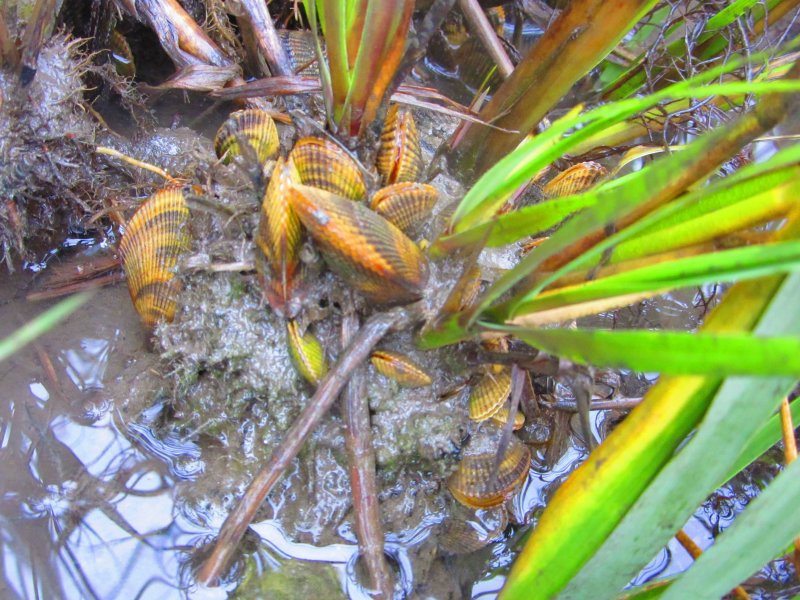
 These Atlantic ribbed mussels are attached at the base of a clump of smooth cordgrass. ALICE MOHRMAN PHOTO
These Atlantic ribbed mussels are attached at the base of a clump of smooth cordgrass. ALICE MOHRMAN PHOTO
These Atlantic ribbed mussels are attached at the base of a clump of smooth cordgrass. ALICE MOHRMAN PHOTO
I arrived early for my first shorebird survey. Parking along the salt marsh, time seems suspended, so waiting here is relaxing. Behind the dunes of a dynamic shoreline, the extensive field of cordgrass has transformed from winter gold to vibrant emerald green. The growing season has arrived!
Vibrating with energy, avian species posture and claim nesting territory. Red-winged blackbirds call “konk-la-re” from shrubby edges, while a “whee, wee, wee” identifies a willet in flight, and a clapper rail chuckles low in the grasses. With all this visible exertion at the surface of prime salt marsh habitat, imagine the active energy, physical and organic, below all those green stems.
Toes in the mud, I am a creature at ease, excited to explore. Closest to the water, a substrate of muddy silt is knitted together by the roots of smooth cordgrass (Sporobolus alterniflorus). Cordgrass is a keystone species, or the glue that holds the habitat together. This grass mat of intertwining roots or rhizomes sits over layers of sponge-like peat and is flooded twice a day with salt water. Like a sponge, the marsh absorbs and releases excess water. Jumping up and down feels like jumping on a giant water bed, but be aware that you may wind up waist-deep in the mud!
From Maine to Florida, salt marshes are considered the “nursery for the ocean.” These amazing wetlands provide nutrients, space and water for young marine organisms, such as oyster larvae and fish fry, to grow. In southern Delaware, the creeks meander through the marsh offering a water network for grass shrimp, mummichogs, blue crabs and terrapins. At the height of summer, a waft of sulfur or rotten-egg smell from the salt marsh is natural and signals high nutrient productivity. Under the mud, anaerobic (without oxygen) bacteria are decomposing the plant and animal material. The by-product of this process is an oily sheen on the water surface and a memorable fragrance (an acquired preference).
Smooth cordgrass, once classified as spartina, thrives in salt water! This plant pushes excess salt to the outside. In the sun, the salt crystals sparkle on the flat leaf blades. A strong root system is key to supporting both the plant species and the unique salt marsh ecosystem. Recent studies by the University of Georgia Sea Grant program identify the Atlantic ribbed mussel as an ecosystem engineer. This nonedible ribbed mussel (Geukensia demissa) is an abundant bivalve with two hinged oblong shells sporting a corduroy texture. This mollusk species thrives in groups submerged in the mud at the base of smooth cordgrass. Ribbed mussels improve the survival of cordgrass by stabilizing the sediment, strengthening plant roots with nitrogenous waste and increasing marsh height. Massing in groups, each mussel secretes 50 to 100 byssal threads. Each thread has an adhesive or “glue” at the tip. The adhesive hardens in water and allows the threads to attach to cordgrass roots and other hard surfaces, reinforcing a strong, tangled foundation that supports the shoreline.
Mathew Harrington, an associate professor at McGill University, has been researching mussels for more than 20 years. His findings indicate that byssal threads, also known as “mussel’s beard,” have strong, stretchy, collagen-like fibers, comparable to an Achilles tendon, that are coated in a rough, sandpaper-like protein. The threads, produced by a gland in the foot of the mussel, are non-living tissues as tough as Kevlar and able to stretch two times their measured length. A single thread from an adult mussel can hold up to 4.3 kg, or the weight of a gallon of milk, before snapping. On a personal note, medical researchers in the biomimicry field are interested in these protein threads and their adhesive properties for surgical repairs, wound healing and bone regeneration.
Thank the Atlantic ribbed mussel for improving our water quality! This long-lived powerhouse, up to 15 years old (count the ribs), is a filter-feeding dynamo. While each mussel submerged under water is feeding on plankton, it is also removing bacteria, particulate matter and contaminants entering the salt marsh. One ribbed mussel is able to filter 6.8 liters or 229.935 ounces of tidal water every hour! According to Delaware Sea Grant, a sizable cluster of ribbed mussels can filter and clean all the water entering a marsh during each high tide cycle! Great boardwalk views of our local salt marsh wetlands may be found at Holts Landing State Park, Bethany Beach Nature Center, Burton Island Nature Preserve and Prime Hook National Wildlife Refuge.
These Atlantic ribbed mussels are attached at the base of a clump of smooth cordgrass. ALICE MOHRMAN PHOTO
Wild Cape is a monthly column by Alice Mohrman dedicated to the rich and diverse ecosystem of Delaware’s Cape Region. It is our hope to bring readers closer to the natural world by exploring fascinating creatures, plants and habitats that thrive in one of the most ecologically significant areas of the Mid-Atlantic.
Event Details :


Premier Listing
Sponsored Content














Premier Listing
Sponsored Content
Real Estate Marketplace
Sponsored Content


In the Market
Sponsored Content